Geribaldi-Doldán Noelia, Fernández-Ponce Cecilia, Quiroz Roberto Navarro, Sánchez-Gomar Ismael, Escorcia Lorena Gómez, Velásquez Erika Puentes, Quiroz Elkin Navarro
Departamento de Anatomía y Embriología Humanas, Facultad de Medicina, Universidad de Cádiz, Cádiz, Spain.
Instituto de Investigación e Innovación Biomédica de Cádiz (INiBICA), Cádiz, Spain.
Front Oncol. 2021 Jan 29;10:603495. doi: 10.3389/fonc.2020.603495. eCollection 2020.
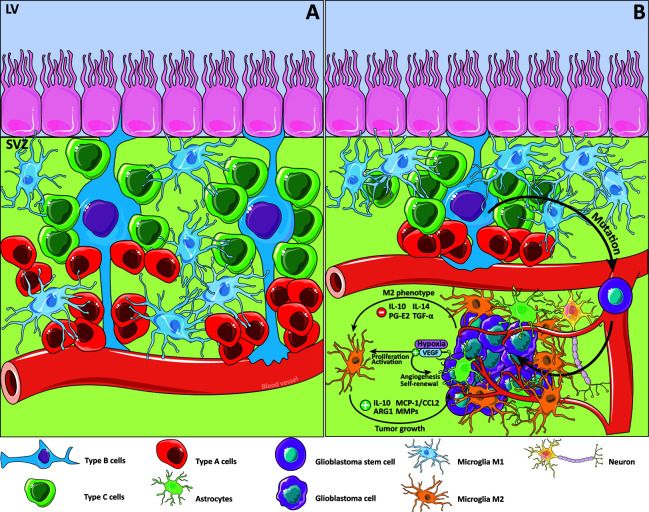
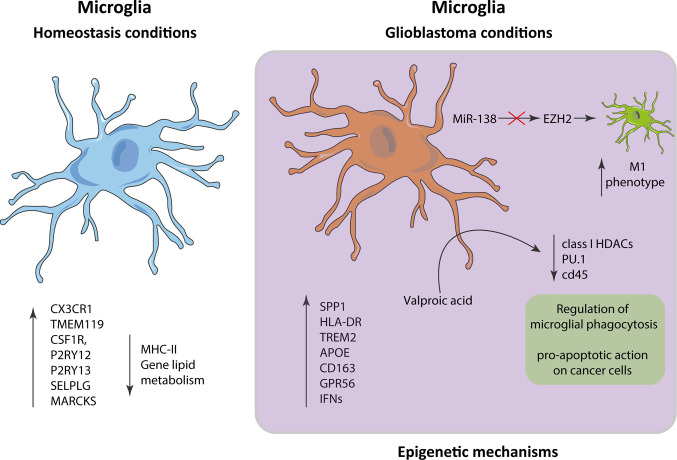
Glioblastoma (GB), the most aggressive malignant glioma, is made up of a large percentage of glioma-associated microglia/macrophages (GAM), suggesting that immune cells play an important role in the pathophysiology of GB. Under physiological conditions, microglia, the phagocytes of the central nervous system (CNS), are involved in various processes such as neurogenesis or axonal growth, and the progression of different conditions such as Alzheimer's disease. Through immunohistochemical studies, markers that enhance GB invasiveness have been shown to be expressed in the peritumoral area of the brain, such as Transforming Growth Factor α (TGF-α), Stromal Sell-Derived Factor 1 (SDF1/CXCL12), Sphingosine-1-Phosphate (S1P) and Neurotrophic Factor Derived from the Glial cell line (GDNF), contributing to the increase in tumor mass. Similarly, it has also been described 17 biomarkers that are present in hypoxic periarteriolar HSC niches in bone marrow and in hypoxic periarteriolar GSC niches in glioblastoma. Interestingly, microglia plays an important role in the microenvironment that supports GB progression, being one of the most important focal points in the study of therapeutic targets for the development of new drugs. In this review, we describe the altered signaling pathways in microglia in the context of GB. We also show how microglia interact with glioblastoma cells and the epigenetic mechanisms involved. Regarding the interactions between microglia and neurogenic niches, some authors indicate that glioblastoma stem cells (GSC) are similar to neural stem cells (NSC), common stem cells in the subventricular zone (SVZ), suggesting that this could be the origin of GB. Understanding the similarities between SVZ and the tumor microenvironment could be important to clarify some mechanisms involved in GB malignancy and to support the discovering of new therapeutic targets for the development of more effective glioblastoma treatments.
胶质母细胞瘤(GB)是最具侵袭性的恶性胶质瘤,其中很大一部分由胶质瘤相关小胶质细胞/巨噬细胞(GAM)组成,这表明免疫细胞在GB的病理生理学中起着重要作用。在生理条件下,小胶质细胞作为中枢神经系统(CNS)的吞噬细胞,参与诸如神经发生或轴突生长等各种过程,以及诸如阿尔茨海默病等不同病症的进展。通过免疫组织化学研究发现,增强GB侵袭性的标志物在脑肿瘤周围区域表达,如转化生长因子α(TGF-α)、基质细胞衍生因子1(SDF1/CXCL12)、鞘氨醇-1-磷酸(S1P)和胶质细胞系衍生的神经营养因子(GDNF),这些都促使肿瘤体积增大。同样,也有研究描述了17种生物标志物,它们存在于骨髓中缺氧的小动脉周围造血干细胞龛以及胶质母细胞瘤中缺氧的小动脉周围胶质瘤干细胞龛中。有趣的是,小胶质细胞在支持GB进展的微环境中起着重要作用,是新药开发治疗靶点研究中最重要的焦点之一。在这篇综述中,我们描述了GB背景下小胶质细胞中改变的信号通路。我们还展示了小胶质细胞如何与胶质母细胞瘤细胞相互作用以及其中涉及的表观遗传机制。关于小胶质细胞与神经发生龛之间的相互作用,一些作者指出胶质母细胞瘤干细胞(GSC)与神经干细胞(NSC)相似,后者是脑室下区(SVZ)的常见干细胞,这表明这可能是GB的起源。了解SVZ与肿瘤微环境之间的相似性对于阐明GB恶性肿瘤涉及的一些机制以及支持发现更有效的胶质母细胞瘤治疗新靶点可能很重要。