Animals, health, Territories, Risks and Ecosystem (ASTRE), University of Montpellier, Agricultural research for Development (CIRAD), National Research Institute for Agriculture, Food and the Environment (INRAE), Montpellier, France.
Agricultural research for Development (CIRAD), UMR ASTRE, Bangkok, Thailand.
Front Public Health. 2021 Jan 28;8:616328. doi: 10.3389/fpubh.2020.616328. eCollection 2020.
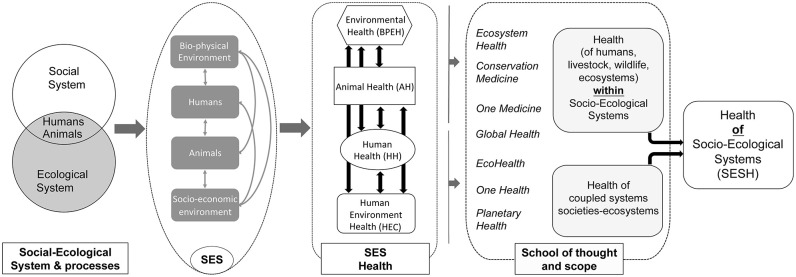
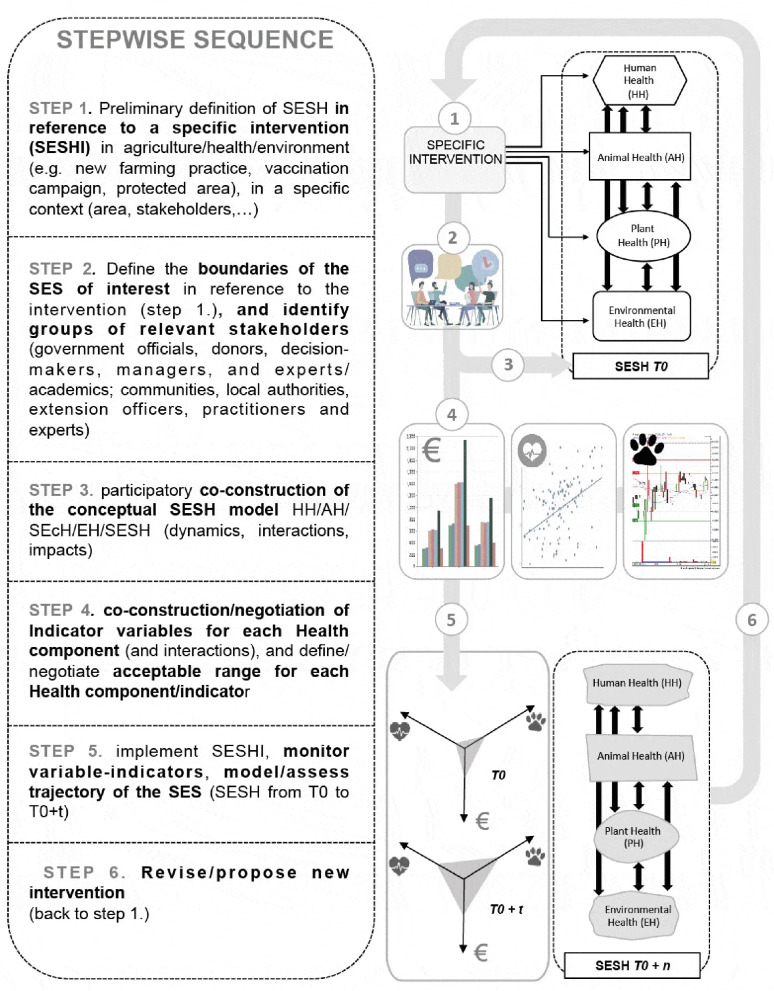
The past two decades have seen an accumulation of theoretical and empirical evidence for the interlinkages between human health and well-being, biodiversity and ecosystem services, and agriculture. The COVID-19 pandemic has highlighted the devastating impacts that an emerging pathogen, of animal origin, can have on human societies and economies. A number of scholars have called for the wider adoption of " integrated approaches" to better prevent, and respond to, the threats of emerging zoonotic diseases. However, there are theoretical and practical challenges that have precluded the full development and practical implementation of this approach. Whilst integrated approaches to health are increasingly adopting a social-ecological system framework (SES), the lack of clarity in framing the key concept of resilience in health contexts remains a major barrier to its implementation by scientists and practitioners. We propose an operational framework, based on a transdisciplinary definition of Socio-Ecological System Health (SESH) that explicitly links health and ecosystem management with the resilience of SES, and the adaptive capacity of the actors and agents within SES, to prevent and cope with emerging health and environmental risks. We focus on agricultural transitions that play a critical role in disease emergence and biodiversity conservation, to illustrate the proposed participatory framework to frame and co-design SESH interventions. Finally, we highlight critical changes that are needed from researchers, policy makers and donors, in order to engage communities and other stakeholders involved in the management of their own health and that of the underpinning ecosystems.
过去二十年,人类健康和福祉、生物多样性和生态系统服务以及农业之间的相互联系已经积累了大量理论和经验证据。COVID-19 大流行突显了一种新出现的动物源病原体对人类社会和经济可能造成的破坏性影响。一些学者呼吁更广泛地采用“综合方法”,以更好地预防和应对新出现的人畜共患疾病的威胁。然而,理论和实践上的挑战使得这种方法无法充分发展和实际实施。尽管健康领域的综合方法越来越多地采用社会-生态系统框架(SES),但在健康背景下明确框架中弹性的关键概念仍然是科学家和实践者实施的主要障碍。我们提出了一个基于社会-生态系统健康(SESH)的跨学科定义的操作性框架,该框架明确将健康和生态系统管理与 SES 的弹性以及 SES 内部的行为者和代理人的适应能力联系起来,以预防和应对新出现的健康和环境风险。我们重点关注在疾病出现和生物多样性保护中发挥关键作用的农业转型,以说明拟议的参与性框架,以框架和共同设计 SESH 干预措施。最后,我们强调了研究人员、政策制定者和捐助者需要做出的关键改变,以便让参与自身健康和支撑生态系统管理的社区和其他利益攸关方参与进来。