Division of Population Behavioral Health, UCLA-Semel Institute for Neuroscience and Human Behavior, Los Angeles, California, USA
Division of Population Behavioral Health, UCLA-Semel Institute for Neuroscience and Human Behavior, Los Angeles, California, USA.
BMJ Open Qual. 2021 Feb;10(1). doi: 10.1136/bmjoq-2020-001028.
Given the high rates at which patients present with behavioural health (BH) concerns in primary care (PC), this setting has become the de facto mental health system. As a result, screening for depression and other BH conditions in PC has become a critical target for improving patient outcomes. However, integration of screening into busy PC workflows can be challenging due to barriers such as limited time and resources.
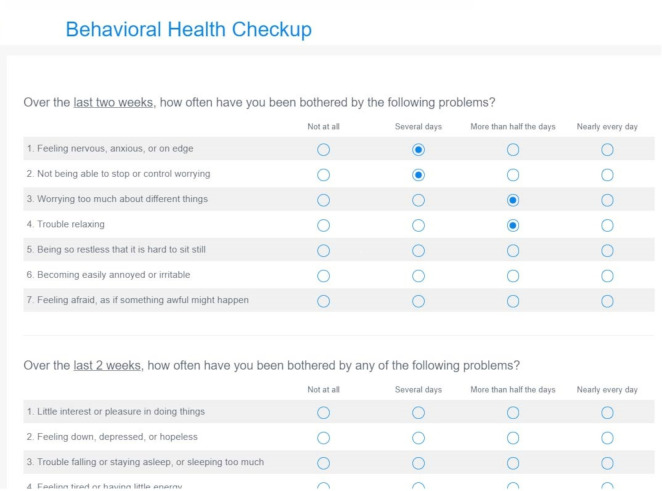
A digital, cloud-based BH assessment tool, which included electronic health record enhancements, was developed and implemented in two urban PC practices as a prelude to a planned larger-scale implementation. The implementation strategies included a reorganisation of workflows within the PC setting, comprehensive training for staff and PC physicians, and institution of an incentive programme for PC clinic managers. To examine whether the introduction of the cloud-based BH assessment tool and associated implementation strategies was associated with increased screening rates, we compared rates of screening from January through June 2017 to rates of screening from January through June 2018 (subsequent to implementation). We also examined BH symptomatology reported by patients in PC.
Following the implementation process, rate of BH screening with Patient Health Questionnaire-2 (PHQ-2) increased from 50.5% to 57% (p<0.00000000000000022) and rates of subsequent screening with PHQ-9, for those scoring at risk, defined as a score of ≥1, on PHQ-2, increased from 34.5% to 91.4% (p<0.00000000000000022). Additionally, high rates of 'moderate' and 'severe' symptoms of depression (40.3%), anxiety (42.6%) and substance use (26.7% alcohol; 31.2% other substance use) were observed among PC patients.
Results suggest that a comprehensive implementation plan, including digitisation of BH assessment, reduced the burden of systematic screening. High rates of BH symptomatology underscore the need for comprehensive BH assessment and systems planning to address the high need for BH services among PC patients.
鉴于患者在初级保健 (PC) 中出现行为健康 (BH) 问题的比率较高,该环境已成为事实上的心理健康系统。因此,在 PC 中筛查抑郁和其他 BH 病症已成为改善患者预后的关键目标。然而,由于时间和资源有限等障碍,将筛查纳入繁忙的 PC 工作流程可能具有挑战性。
开发并在两家城市 PC 诊所实施了一种数字化、基于云的 BH 评估工具,该工具包括电子健康记录增强功能,作为计划中的更大规模实施的前奏。实施策略包括在 PC 环境中重新组织工作流程,对员工和 PC 医生进行全面培训,以及为 PC 诊所管理人员实施激励计划。为了研究引入基于云的 BH 评估工具和相关实施策略是否与筛查率的提高有关,我们比较了 2017 年 1 月至 6 月(实施前)和 2018 年 1 月至 6 月(实施后)的筛查率。我们还检查了 PC 患者报告的 BH 症状。
实施流程后,使用患者健康问卷-2 (PHQ-2) 进行 BH 筛查的比例从 50.5%增加到 57%(p<0.00000000000000022),对于 PHQ-2 得分≥1 的风险患者,使用 PHQ-9 进行后续筛查的比例从 34.5%增加到 91.4%(p<0.00000000000000022)。此外,PC 患者中观察到较高比例的“中度”和“重度”抑郁(40.3%)、焦虑(42.6%)和物质使用(酒精 26.7%;其他物质使用 31.2%)症状。
结果表明,综合实施计划,包括 BH 评估的数字化,减轻了系统筛查的负担。高比例的 BH 症状强调了全面的 BH 评估和系统规划的必要性,以满足 PC 患者对 BH 服务的高需求。