Laboratory of Molecular Biology of Exercise (LaBMEx), School of Applied Sciences, University of Campinas (UNICAMP), Limeira, SP, 13484-350, Brazil.
Laboratory of Nutritional Genomics (LabGeN), School of Applied Sciences, University of Campinas, Limeira, SP, 13484-350, Brazil.
Sci Rep. 2021 Feb 15;11(1):3813. doi: 10.1038/s41598-021-82352-8.
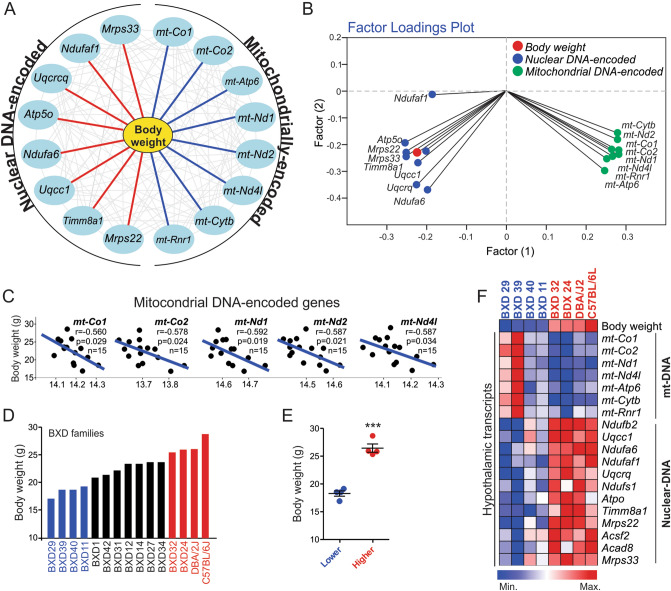
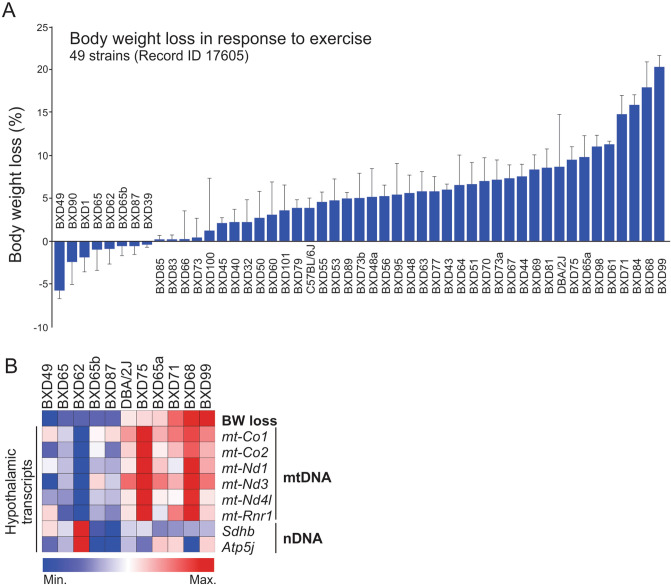
The maintenance of mitochondrial activity in hypothalamic neurons is determinant to the control of energy homeostasis in mammals. Disturbs in the mitochondrial proteostasis can trigger the mitonuclear imbalance and mitochondrial unfolded protein response (UPR) to guarantee the mitochondrial integrity and function. However, the role of mitonuclear imbalance and UPR in hypothalamic cells are unclear. Combining the transcriptomic analyses from BXD mice database and in vivo experiments, we demonstrated that physical training alters the mitochondrial proteostasis in the hypothalamus of C57BL/6J mice. This physical training elicited the mitonuclear protein imbalance, increasing the mtCO-1/Atp5a ratio, which was accompanied by high levels of UPR markers in the hypothalamus. Also, physical training increased the maximum mitochondrial respiratory capacity in the brain. Interestingly, the transcriptomic analysis across several strains of the isogenic BXD mice revealed that hypothalamic mitochondrial DNA-encoded genes were negatively correlated with body weight and several genes related to the orexigenic response. As expected, physical training reduced body weight and food intake. Interestingly, we found an abundance of mt-CO1, a mitochondrial DNA-encoded protein, in NPY-producing neurons in the lateral hypothalamus nucleus of exercised mice. Collectively, our data demonstrated that physical training altered the mitochondrial proteostasis and induced the mitonuclear protein imbalance and UPR in hypothalamic cells.
维持下丘脑神经元中线粒体的活性对哺乳动物的能量稳态控制至关重要。线粒体蛋白质稳态的紊乱会引发线粒体-核失衡和线粒体未折叠蛋白反应(UPR),以保证线粒体的完整性和功能。然而,线粒体-核失衡和 UPR 在下丘脑细胞中的作用尚不清楚。我们结合 BXD 小鼠数据库的转录组分析和体内实验,证明了体育锻炼改变了 C57BL/6J 小鼠下丘脑的线粒体蛋白质稳态。这种体育锻炼引起了线粒体-核蛋白失衡,增加了 mtCO-1/Atp5a 的比例,伴随着下丘脑 UPR 标志物的高水平。此外,体育锻炼还增加了大脑的最大线粒体呼吸能力。有趣的是,对几种同基因 BXD 小鼠的转录组分析表明,下丘脑线粒体 DNA 编码基因与体重和几种与食欲反应相关的基因呈负相关。正如预期的那样,体育锻炼降低了体重和食物摄入量。有趣的是,我们发现在锻炼后的小鼠外侧下丘脑核的 NPY 产生神经元中有大量的 mt-CO1,一种线粒体 DNA 编码的蛋白质。总之,我们的数据表明,体育锻炼改变了下丘脑细胞的线粒体蛋白质稳态,并诱导了线粒体-核蛋白失衡和 UPR。