
新型冠状病毒肺炎相关急性呼吸窘迫综合征的体外生命支持:一项欧洲体外生命支持组织国际调查。
Extracorporeal life support in COVID-19-related acute respiratory distress syndrome: A EuroELSO international survey.
作者信息
Mang Sebastian, Kalenka Armin, Broman Lars Mikael, Supady Alexander, Swol Justyna, Danziger Guy, Becker André, Hörsch Sabrina I, Mertke Thilo, Kaiser Ralf, Bracht Hendrik, Zotzmann Viviane, Seiler Frederik, Bals Robert, Taccone Fabio Silvio, Moerer Onnen, Lorusso Roberto, Bělohlávek Jan, Muellenbach Ralf M, Lepper Philipp M
机构信息
Interdisciplinary COVID-19-Center, University Medical Centre, Saarland University, Homburg, Germany.
Department of Internal Medicine V-Pneumology, Allergology and Critical Care Medicine, University Medical Centre, Saarland University, Homburg, Germany.
出版信息
Artif Organs. 2021 May;45(5):495-505. doi: 10.1111/aor.13940. Epub 2021 Mar 28.
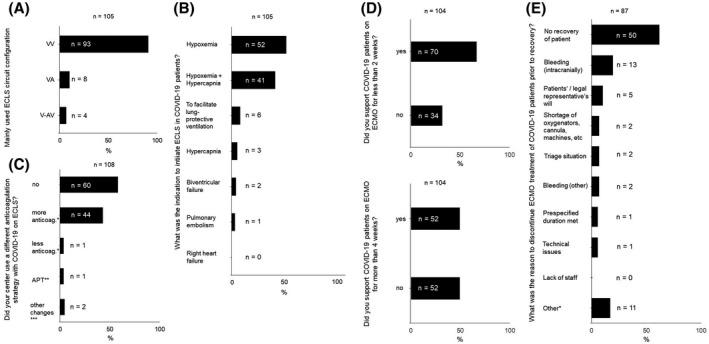
Extracorporeal life support (ECLS) is a means to support patients with acute respiratory failure. Initially, recommendations to treat severe cases of pandemic coronavirus disease 2019 (COVID-19) with ECLS have been restrained. In the meantime, ECLS has been shown to produce similar outcomes in patients with severe COVID-19 compared to existing data on ARDS mortality. We performed an international email survey to assess how ECLS providers worldwide have previously used ECLS during the treatment of critically ill patients with COVID-19. A questionnaire with 45 questions (covering, e.g., indication, technical aspects, benefit, and reasons for treatment discontinuation), mostly multiple choice, was distributed by email to ECLS centers. The survey was approved by the European branch of the Extracorporeal Life Support Organization (ELSO); 276 ECMO professionals from 98 centers in 30 different countries on four continents reported that they employed ECMO for very severe COVID-19 cases, mostly in veno-venous configuration (87%). The most common reason to establish ECLS was isolated hypoxemic respiratory failure (50%), followed by a combination of hypoxemia and hypercapnia (39%). Only a small fraction of patients required veno-arterial cannulation due to heart failure (3%). Time on ECLS varied between less than 2 and more than 4 weeks. The main reason to discontinue ECLS treatment prior to patient's recovery was lack of clinical improvement (53%), followed by major bleeding, mostly intracranially (13%). Only 4% of respondents reported that triage situations, lack of staff or lack of oxygenators, were responsible for discontinuation of ECLS support. Most ECLS physicians (51%, IQR 30%) agreed that patients with COVID-19-induced ARDS (CARDS) benefitted from ECLS. Overall mortality of COVID-19 patients on ECLS was estimated to be about 55%. ECLS has been utilized successfully during the COVID-19 pandemic to stabilize CARDS patients in hypoxemic or hypercapnic lung failure. Age and multimorbidity limited the use of ECLS. Triage situations were rarely a concern. ECLS providers stated that patients with severe COVID-19 benefitted from ECLS.
体外生命支持(ECLS)是支持急性呼吸衰竭患者的一种手段。最初,关于使用ECLS治疗2019年大流行性冠状病毒病(COVID-19)重症病例的建议受到限制。与此同时,与急性呼吸窘迫综合征(ARDS)死亡率的现有数据相比,ECLS已被证明在重症COVID-19患者中能产生相似的结果。我们进行了一项国际电子邮件调查,以评估全球范围内的ECLS提供者此前在治疗重症COVID-19患者时是如何使用ECLS的。一份包含45个问题(涵盖适应症、技术方面、益处以及治疗中断原因等)的问卷,大多为多项选择题,通过电子邮件分发给了ECLS中心。该调查获得了体外生命支持组织(ELSO)欧洲分会的批准;来自四大洲30个不同国家98个中心的276名体外膜肺氧合(ECMO)专业人员报告称,他们将ECMO用于治疗非常严重的COVID-19病例,大多数采用静脉-静脉配置(87%)。建立ECLS最常见的原因是单纯低氧性呼吸衰竭(50%),其次是低氧血症和高碳酸血症并存(39%)。仅有一小部分患者因心力衰竭需要进行静脉-动脉插管(3%)。接受ECLS的时间在不到2周至超过4周之间不等。在患者康复前停止ECLS治疗的主要原因是临床无改善(53%),其次是大出血,主要是颅内出血(13%)。只有4%的受访者报告称,分流情况、缺乏工作人员或缺乏氧合器是停止ECLS支持的原因。大多数ECLS医生(51%,四分位距30%)认为COVID-19诱导的ARDS(CARDS)患者从ECLS中获益。接受ECLS的COVID-19患者的总体死亡率估计约为55%。在COVID-19大流行期间,ECLS已成功用于稳定CARDS患者的低氧或高碳酸血症性肺衰竭。年龄和多种合并症限制了ECLS的使用。分流情况很少成为问题。ECLS提供者表示,重症COVID-19患者从ECLS中获益。

 Zotero 插件