Department of Anesthesiology and Critical Care, Institut D'investigació August Pi I Sunyer, Hospital Clínic, Villarroel 170, 08025, Barcelona, Spain.
CIBER de Enfermedades Respiratorias, Instituto de Salud Carlos III, Madrid, Spain.
Intensive Care Med. 2020 Dec;46(12):2200-2211. doi: 10.1007/s00134-020-06192-2. Epub 2020 Jul 29.
The main characteristics of mechanically ventilated ARDS patients affected with COVID-19, and the adherence to lung-protective ventilation strategies are not well known. We describe characteristics and outcomes of confirmed ARDS in COVID-19 patients managed with invasive mechanical ventilation (MV).
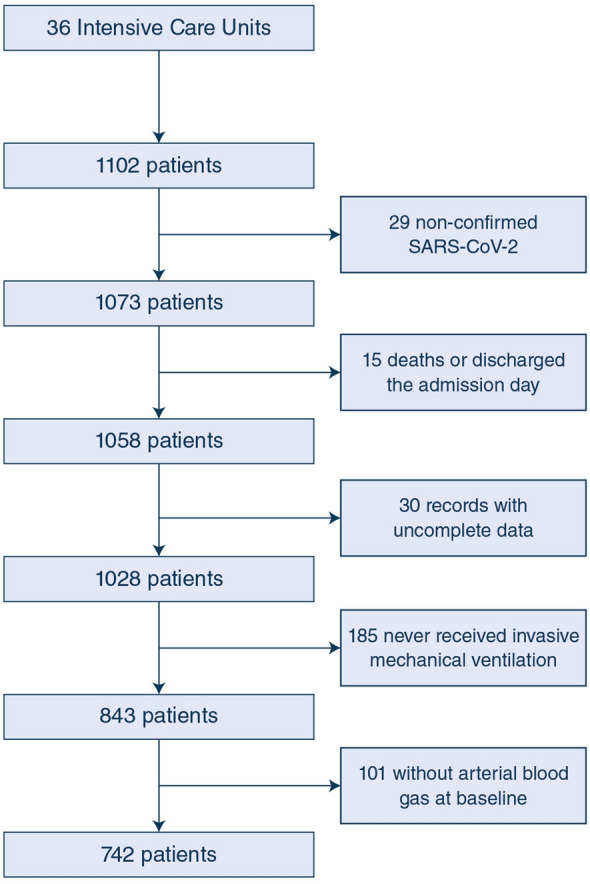
This is a multicenter, prospective, observational study in consecutive, mechanically ventilated patients with ARDS (as defined by the Berlin criteria) affected with with COVID-19 (confirmed SARS-CoV-2 infection in nasal or pharyngeal swab specimens), admitted to a network of 36 Spanish and Andorran intensive care units (ICUs) between March 12 and June 1, 2020. We examined the clinical features, ventilatory management, and clinical outcomes of COVID-19 ARDS patients, and compared some results with other relevant studies in non-COVID-19 ARDS patients.
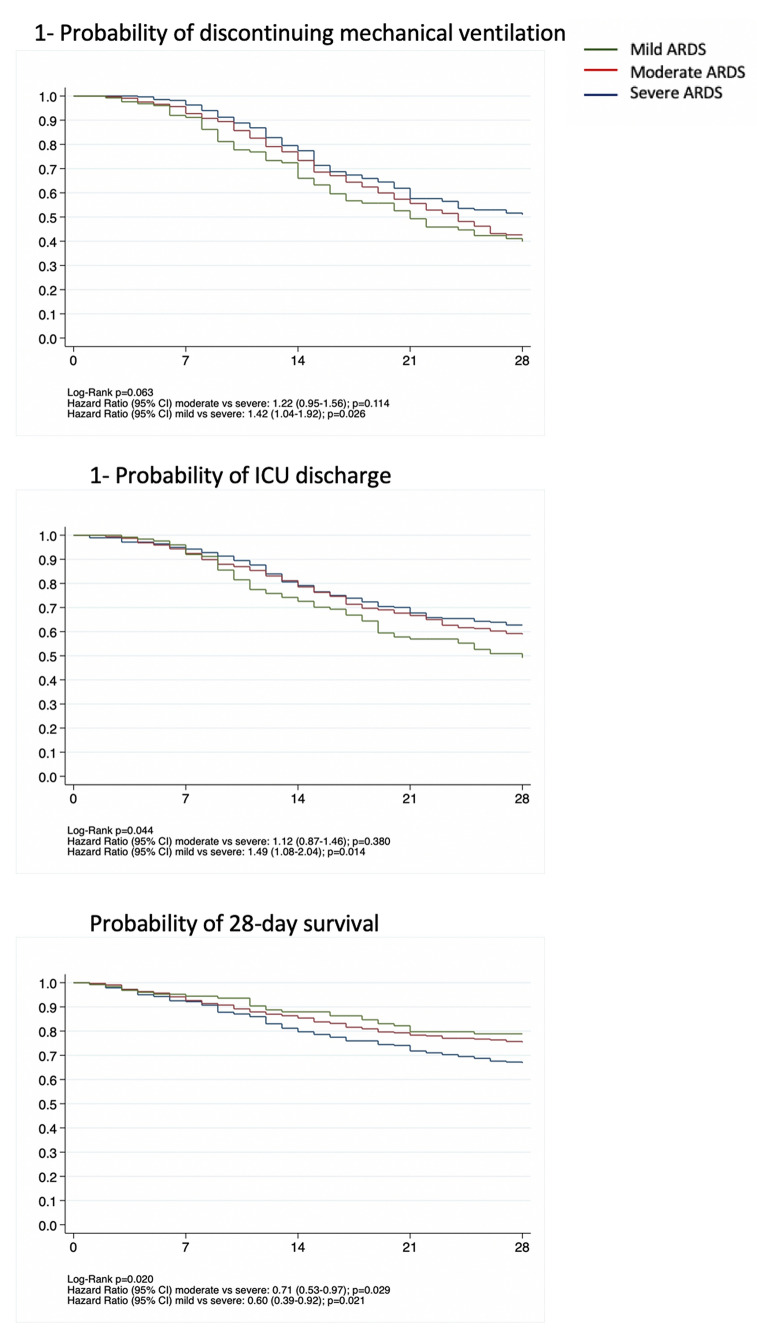
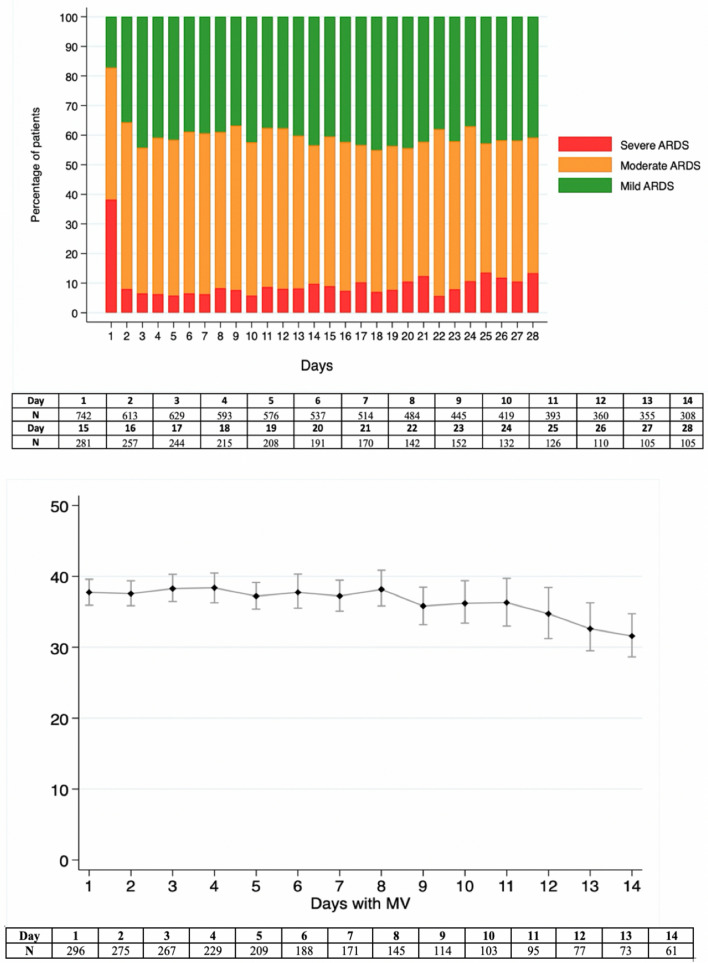
A total of 742 patients were analysed with complete 28-day outcome data: 128 (17.1%) with mild, 331 (44.6%) with moderate, and 283 (38.1%) with severe ARDS. At baseline, defined as the first day on invasive MV, median (IQR) values were: tidal volume 6.9 (6.3-7.8) ml/kg predicted body weight, positive end-expiratory pressure 12 (11-14) cmHO. Values of respiratory system compliance 35 (27-45) ml/cmHO, plateau pressure 25 (22-29) cmHO, and driving pressure 12 (10-16) cmHO were similar to values from non-COVID-19 ARDS patients observed in other studies. Recruitment maneuvers, prone position and neuromuscular blocking agents were used in 79%, 76% and 72% of patients, respectively. The risk of 28-day mortality was lower in mild ARDS [hazard ratio (RR) 0.56 (95% CI 0.33-0.93), p = 0.026] and moderate ARDS [hazard ratio (RR) 0.69 (95% CI 0.47-0.97), p = 0.035] when compared to severe ARDS. The 28-day mortality was similar to other observational studies in non-COVID-19 ARDS patients.
In this large series, COVID-19 ARDS patients have features similar to other causes of ARDS, compliance with lung-protective ventilation was high, and the risk of 28-day mortality increased with the degree of ARDS severity.
患有 COVID-19 的机械通气 ARDS 患者的主要特征以及对肺保护性通气策略的依从性尚不清楚。我们描述了 COVID-19 患者接受有创机械通气(MV)治疗的确诊 ARDS 的特征和结局。
这是一项多中心、前瞻性、观察性研究,纳入了 2020 年 3 月 12 日至 6 月 1 日期间在西班牙和安道尔的 36 家重症监护病房网络中连续接受机械通气的 ARDS (柏林标准定义)且患有 COVID-19(鼻或咽拭子标本中 SARS-CoV-2 感染确诊)的患者。我们检查了 COVID-19 ARDS 患者的临床特征、通气管理和临床结局,并将一些结果与非 COVID-19 ARDS 患者的其他相关研究进行了比较。
共分析了 742 例具有完整 28 天结局数据的患者:128 例(17.1%)为轻度 ARDS,331 例(44.6%)为中度 ARDS,283 例(38.1%)为重度 ARDS。在开始有创 MV 的第 1 天(定义为基线),中位数(IQR)值为:潮气量 6.9(6.3-7.8)ml/kg 预测体重,呼气末正压 12(11-14)cmH2O。呼吸系统顺应性 35(27-45)ml/cmH2O,平台压 25(22-29)cmH2O,驱动压 12(10-16)cmH2O 的值与其他研究中观察到的非 COVID-19 ARDS 患者的值相似。分别有 79%、76%和 72%的患者使用了肺复张手法、俯卧位和神经肌肉阻滞剂。与重度 ARDS 相比,轻度 ARDS [风险比(RR)0.56(95%CI 0.33-0.93),p=0.026]和中度 ARDS [风险比(RR)0.69(95%CI 0.47-0.97),p=0.035]的 28 天死亡率较低。28 天死亡率与非 COVID-19 ARDS 患者的其他观察性研究相似。
在这项大型研究中,COVID-19 ARDS 患者的特征与其他 ARDS 病因相似,对肺保护性通气的依从性较高,28 天死亡率随 ARDS 严重程度的增加而增加。