Centre for Health Economics and Policy Analysis, McMaster University, Hamilton, ON, Canada.
Department of Health, Aging and Society, Centre for Health Economics and Policy Analysis, McMaster University, Hamilton, ON, Canada.
Int J Health Policy Manag. 2022 Jul 1;11(7):1047-1057. doi: 10.34172/ijhpm.2020.256. Epub 2020 Dec 26.
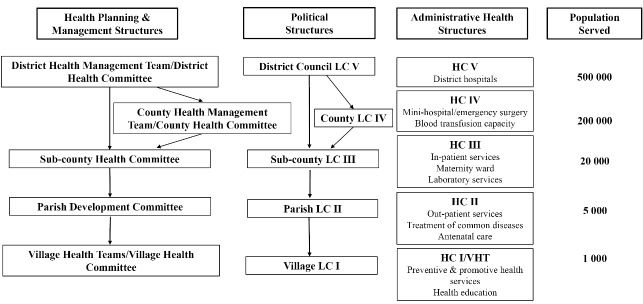
Decentralization of healthcare decision-making in Uganda led to the promotion of public participation. To facilitate this, participatory structures have been developed at sub-national levels. However, the degree to which the participation structures have contributed to improving the participation of vulnerable populations, specifically vulnerable women, remains unclear. We aim to understand whether and how vulnerable women participate in health-system priority setting; identify any barriers to vulnerable women's participation; and to establish how the barriers to vulnerable women's participation can be addressed.
We used a qualitative description study design involving interviews with district decision-makers (n=12), sub-county leaders (n=10), and vulnerable women (n=35) living in Tororo District, Uganda. Data was collected between May and June 2017. The analysis was conducting using an editing analysis style.
The vulnerable women expressed interest in participating in priority setting, believing they would make valuable contributions. However, both decision-makers and vulnerable women reported that vulnerable women did not consistently participate in decision-making, despite participatory structures that were instituted through decentralization. There are financial (transportation and lack of incentives), biomedical (illness/disability and menstruation), knowledge-based (lack of knowledge and/or information about participation), motivational (perceived disinterest, lack of feedback, and competing needs), socio-cultural (lack of decision-making power), and structural (hunger and poverty) barriers which hamper vulnerable women's participation.
The identified barriers hinder vulnerable women's participation in health-system priority setting. Some of the barriers could be addressed through the existing decentralization participatory structures. Respondents made both short-term, feasible recommendations and more systemic, ideational recommendations to improve vulnerable women's participation. Integrating the vulnerable women's creative and feasible ideas to enhance their participation in health-system decision-making should be prioritized.
乌干达的医疗决策去中心化促使公众参与度提高。为促进这一点,在次国家层面已经建立了参与性结构。然而,参与性结构对改善弱势群体,特别是弱势妇女的参与程度的贡献程度尚不清楚。我们旨在了解弱势妇女是否以及如何参与卫生系统优先事项的制定;确定弱势妇女参与的障碍;并确定如何解决弱势妇女参与的障碍。
我们采用定性描述研究设计,对乌干达托罗罗区的区决策者(n=12)、次县领导(n=10)和弱势妇女(n=35)进行了访谈。数据收集于 2017 年 5 月至 6 月进行。分析采用编辑分析方法。
弱势妇女表示有兴趣参与优先事项的制定,认为她们会做出有价值的贡献。然而,决策者和弱势妇女都报告说,尽管通过权力下放建立了参与性结构,但弱势妇女并没有始终参与决策。存在财务(交通和缺乏激励)、生物医学(疾病/残疾和月经)、知识型(缺乏知识和/或参与信息)、动机型(被认为不感兴趣、缺乏反馈和竞争需求)、社会文化型(缺乏决策权)和结构性(饥饿和贫困)障碍,阻碍了弱势妇女的参与。
确定的障碍阻碍了弱势妇女参与卫生系统优先事项的制定。一些障碍可以通过现有的权力下放参与性结构来解决。受访者提出了短期可行的建议和更系统的、理念性的建议,以改善弱势妇女的参与。应该优先考虑整合弱势妇女的创造性和可行的想法,以增强她们在卫生系统决策中的参与度。