Department of Infectious Disease Control and Prevention, Henan Province Center for Disease Control and Prevention, Zhengzhou, China.
College of Public Health, Zhengzhou University, Zhengzhou, China.
J Med Virol. 2021 Aug;93(8):4704-4713. doi: 10.1002/jmv.26877. Epub 2021 Mar 11.
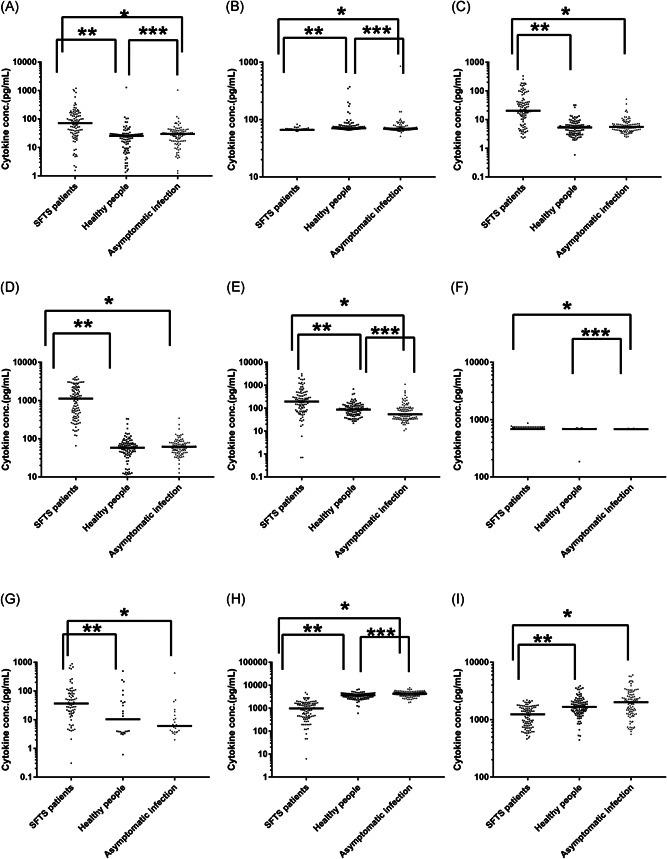
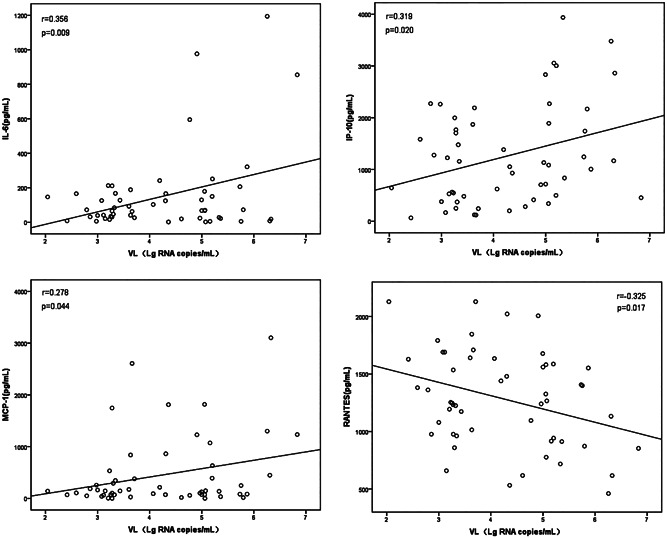
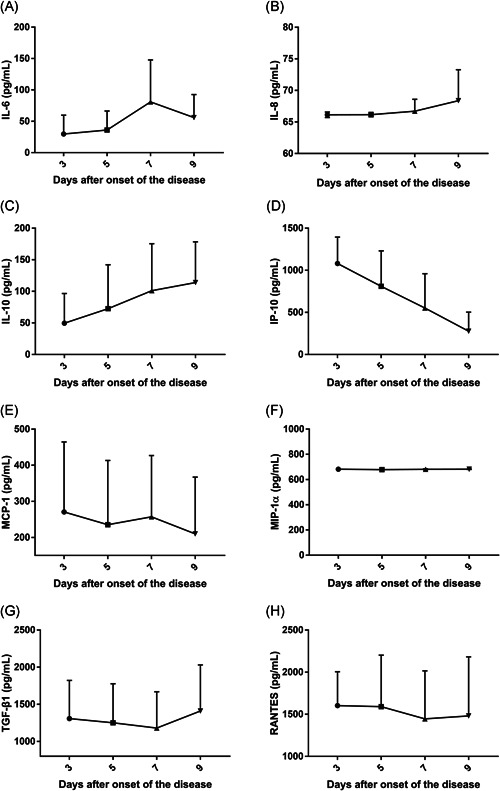
Severe fever with thrombocytopenia syndrome (SFTS) is recognized as an emerging infectious disease. This study aimed to investigate the pathogenic mechanism of SFTS. A total of 100 subjects were randomly included in the study. Cytokine levels were detected by enzyme-linked immunosorbent assay and the viral load was detected by micro drop digital PCR. The results showed that levels of interleukin-6 (IL-6), IL-8, IL-10, IFN-inducible protein-10 (IP-10), monocyte chemoattractant protein-1 (MCP-1), macrophage inflammatory protein-1α (MIP-1α), transforming growth factor-β1 (TGF-β1), and regulated upon activation normal T cell expressed and secreted factor (RANTES) differed significantly among the SFTS patient group, healthy people group, and asymptomatic infection group (p < .05). Compared to the healthy people group, the patient group had increased cytokine levels (IL-6, IL-10, IP-10, MCP-1, and IFN-γ) but reduced levels of IL-8, TGF-β1, and RANTES (p < .0167). IL-6, IL-8, IL-10, IP-10, MCP-1, MIP-1α, TGF-β1, and the RANTES levels had different trends after the onset of the disease. IL-6, IL-10, IP-10, and MCP-1 levels in severe patients were higher than those in mild patients (p < .05). There was a positive correlation between viral load and IL-6 and IP-10 but a negative correlation between viral load and RANTES. SFTSV could cause a cytokine change: the cytokine levels of patients had different degrees of fluctuation after the onset of the disease. The levels of IL-6 and IL-8 in the asymptomatic infection group were found between the SFTS patients group and the healthy people group. The levels of IL-6, IL-10, IP-10, and MCP-1 in the serum could reflect the severity of the disease, and the levels of IL-6, IP-10, and RANTES were correlated with the viral load.
严重发热伴血小板减少综合征(SFTS)被认为是一种新发传染病。本研究旨在探讨 SFTS 的发病机制。共纳入 100 例研究对象,采用酶联免疫吸附试验检测细胞因子水平,微滴数字 PCR 检测病毒载量。结果显示,SFTS 患者组、健康对照组和无症状感染组白细胞介素-6(IL-6)、IL-8、IL-10、干扰素诱导蛋白-10(IP-10)、单核细胞趋化蛋白-1(MCP-1)、巨噬细胞炎性蛋白-1α(MIP-1α)、转化生长因子-β1(TGF-β1)和调节激活正常 T 细胞表达和分泌因子(RANTES)水平差异有统计学意义(p<0.05)。与健康对照组相比,患者组细胞因子水平升高(IL-6、IL-10、IP-10、MCP-1 和 IFN-γ),而 IL-8、TGF-β1 和 RANTES 水平降低(p<0.0167)。疾病发作后,IL-6、IL-8、IL-10、IP-10、MCP-1、MIP-1α、TGF-β1 和 RANTES 水平呈不同趋势。重症患者的 IL-6、IL-10、IP-10 和 MCP-1 水平高于轻症患者(p<0.05)。病毒载量与 IL-6 和 IP-10 呈正相关,与 RANTES 呈负相关。SFTSV 可引起细胞因子变化:患者发病后细胞因子水平有不同程度的波动。无症状感染组的 IL-6 和 IL-8 水平处于 SFTS 患者组和健康对照组之间。血清中 IL-6、IL-10、IP-10 和 MCP-1 水平可反映疾病严重程度,IL-6、IP-10 和 RANTES 水平与病毒载量相关。