Mitteroecker Philipp, Stansfield Ekaterina
Department of Evolutionary Biology, University of Vienna, Vienna, Austria.
PLoS Comput Biol. 2021 Feb 16;17(2):e1008381. doi: 10.1371/journal.pcbi.1008381. eCollection 2021 Feb.
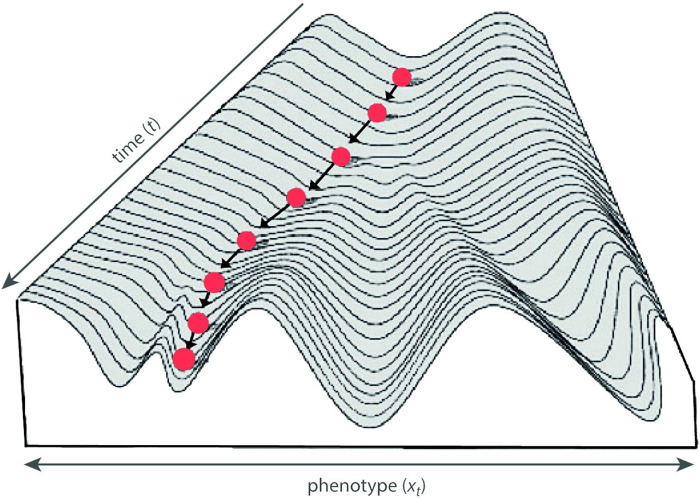
Developmental mechanisms that canalize or compensate perturbations of organismal development (targeted or compensatory growth) are widely considered a prerequisite of individual health and the evolution of complex life, but little is known about the nature of these mechanisms. It is even unclear if and how a "target trajectory" of individual development is encoded in the organism's genetic-developmental system or, instead, emerges as an epiphenomenon. Here we develop a statistical model of developmental canalization based on an extended autoregressive model. We show that under certain assumptions the strength of canalization and the amount of canalized variance in a population can be estimated, or at least approximated, from longitudinal phenotypic measurements, even if the target trajectories are unobserved. We extend this model to multivariate measures and discuss reifications of the ensuing parameter matrix. We apply these approaches to longitudinal geometric morphometric data on human postnatal craniofacial size and shape as well as to the size of the frontal sinuses. Craniofacial size showed strong developmental canalization during the first 5 years of life, leading to a 50% reduction of cross-sectional size variance, followed by a continual increase in variance during puberty. Frontal sinus size, by contrast, did not show any signs of canalization. Total variance of craniofacial shape decreased slightly until about 5 years of age and increased thereafter. However, different features of craniofacial shape showed very different developmental dynamics. Whereas the relative dimensions of the nasopharynx showed strong canalization and a reduction of variance throughout postnatal development, facial orientation continually increased in variance. Some of the signals of canalization may owe to independent variation in developmental timing of cranial components, but our results indicate evolved, partly mechanically induced mechanisms of canalization that ensure properly sized upper airways and facial dimensions.
引导或补偿机体发育扰动(定向或补偿性生长)的发育机制被广泛认为是个体健康和复杂生命进化的先决条件,但对这些机制的本质却知之甚少。甚至不清楚个体发育的“目标轨迹”是否以及如何编码在生物体的遗传发育系统中,或者相反,它是否作为一种附带现象出现。在这里,我们基于扩展自回归模型开发了一种发育引导的统计模型。我们表明,在某些假设下,即使目标轨迹未被观测到,也可以从纵向表型测量中估计或至少近似估计群体中引导的强度和引导方差的量。我们将此模型扩展到多变量测量,并讨论由此产生的参数矩阵的具体化。我们将这些方法应用于人类出生后颅面大小和形状以及额窦大小的纵向几何形态测量数据。颅面大小在生命的前5年表现出强烈的发育引导,导致横截面大小方差减少50%,随后在青春期方差持续增加。相比之下,额窦大小没有显示出任何引导迹象。颅面形状的总方差在大约5岁之前略有下降,此后增加。然而,颅面形状的不同特征显示出非常不同的发育动态。虽然鼻咽的相对尺寸在整个出生后发育过程中表现出强烈的引导和方差减少,但面部方位的方差持续增加。一些引导信号可能归因于颅骨组件发育时间的独立变化,但我们的结果表明存在进化的、部分由机械诱导的引导机制,这些机制确保上呼吸道和面部尺寸合适。