
2459例新型冠状病毒肺炎重症或危重症患者的临床特征:一项荟萃分析。
Clinical characteristics of 2,459 severe or critically ill COVID-19 patients: A meta-analysis.
作者信息
Zhong Zhimei, Li Hongyuan, Zhu Jieyun, Ji Pan, Li Bocheng, Pang Jielong, Zhang Jianfeng, Liang Xiangdong
机构信息
Department of Emergency Medicine.
Department of Respiratory and Critical Care Medicine, The Second Affiliated Hospital of Guangxi Medical University, Nanning, China.
出版信息
Medicine (Baltimore). 2021 Feb 5;100(5):e23781. doi: 10.1097/MD.0000000000023781.
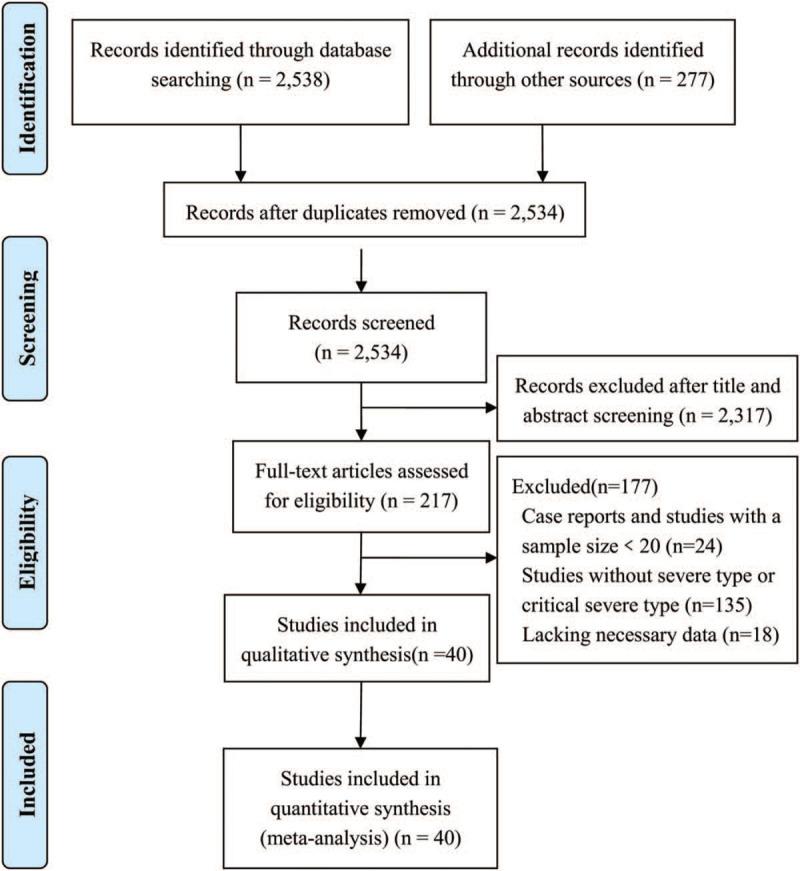
Our study aims to summarize the clinical characteristics of patients with severe or critically ill coronavirus disease 2019 (COVID-19).Five databases were electronically searched to collect studies describing clinical characteristics of severe or critically ill COVID-19 patients and published between January 1, 2020 and April 12, 2020. Three reviewers independently collected the literature, extracted the required data, and assessed the risk of publication bias of the included studies before including the studies in the meta-analysis.A total of 40 studies involving 2459 patients with severe or critically ill COVID-19 patients were included. Meta-analysis showed that a greater proportion of severe or critically COVID-19 patients were male (62.3%), and the 2 main clinical symptoms were fever (87.4%) and cough (66.3%). Other common clinical symptoms included dyspnea (45.3%), chest tightness (37.4%), fatigue (36.6%), and expectoration (31.9%). Minor symptoms included myalgia (19.5%), dizziness (11.5%), headache (11.4%), diarrhea (11.2%), pharyngalgia (11.0%), nausea, and vomiting (5.9%). Most patients showed elevated levels of C-reactive protein (83.5%) and D-dimer (73.3%), lymphopenia (70.3%), and normal leukocyte counts (56.9%). Other findings included abnormal levels of liver function (39.8%), elevated procalcitonin (36.6%), leukocytosis (21.7%), thrombocytopenia (19.0%), and leucopenia (18.2%). Most patients showed acute respiratory distress syndrome (60.8%). Other complications included acute cardiac injury (37.1%), shock (32.0%), and acute kidney injury (22.0%).The most common symptoms of severe or critically ill COVID-19 patients were fever and cough. Most patients showed lymphopenia, elevated levels of C-reactive protein and D-dimer. A large percentage of patients progress to ARDS, acute cardiac injury, acute kidney injury and shock were also common.
我们的研究旨在总结2019冠状病毒病(COVID-19)重症或危重症患者的临床特征。通过电子检索五个数据库,以收集描述2020年1月1日至2020年4月12日期间COVID-19重症或危重症患者临床特征的研究。三位审阅者独立收集文献、提取所需数据,并在将研究纳入荟萃分析之前评估纳入研究的发表偏倚风险。共纳入40项研究,涉及2459例COVID-19重症或危重症患者。荟萃分析显示,COVID-19重症或危重症患者中男性比例更高(62.3%),主要的两种临床症状为发热(87.4%)和咳嗽(66.3%)。其他常见临床症状包括呼吸困难(45.3%)、胸闷(37.4%)、乏力(36.6%)和咳痰(31.9%)。次要症状包括肌痛(19.5%)、头晕(11.5%)、头痛(11.4%)、腹泻(11.2%)、咽痛(11.0%)、恶心和呕吐(5.9%)。大多数患者C反应蛋白水平升高(83.5%)、D-二聚体水平升高(73.3%)、淋巴细胞减少(70.3%)且白细胞计数正常(56.9%)。其他发现包括肝功能异常(39.8%)、降钙素原升高(36.6%)、白细胞增多(21.7%)、血小板减少(19.0%)和白细胞减少(18.2%)。大多数患者出现急性呼吸窘迫综合征(60.8%)。其他并发症包括急性心脏损伤(37.1%)、休克(32.0%)和急性肾损伤(22.0%)。COVID-19重症或危重症患者最常见的症状是发热和咳嗽。大多数患者出现淋巴细胞减少、C反应蛋白和D-二聚体水平升高。很大一部分患者进展为急性呼吸窘迫综合征,急性心脏损伤、急性肾损伤和休克也很常见。



 Zotero 插件