School of Physical and Occupational Therapy, McGill University, Montreal, Canada.
Montreal General Hospital, McGill University Health Centre, 1650 Cedar Ave, Room L3-317, Montreal, QC, H3G 1A4, Canada.
Sci Rep. 2021 Feb 16;11(1):3892. doi: 10.1038/s41598-021-83482-9.
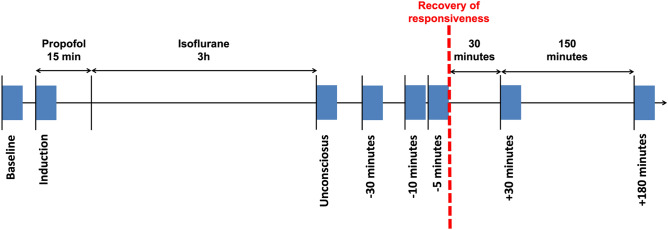
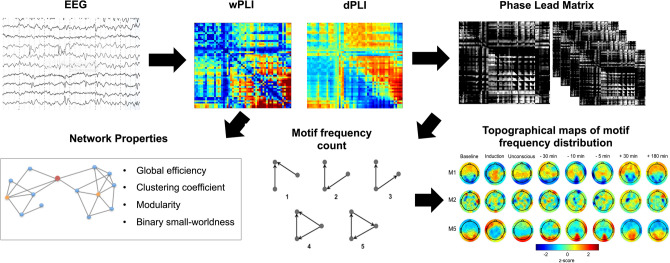
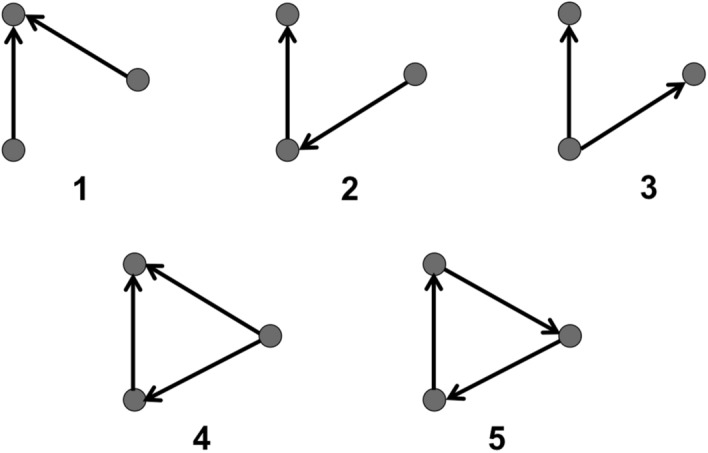
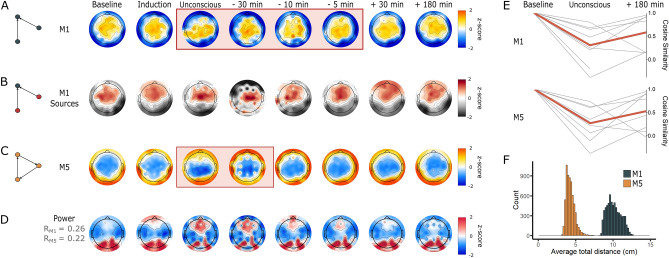
Motifs are patterns of inter-connections between nodes of a network, and have been investigated as building blocks of directed networks. This study explored the re-organization of 3-node motifs during loss and recovery of consciousness. Nine healthy subjects underwent a 3-h anesthetic protocol while 128-channel electroencephalography (EEG) was recorded. In the alpha (8-13 Hz) band, 5-min epochs of EEG were extracted for: Baseline; Induction; Unconscious; 30-, 10- and 5-min pre-recovery of responsiveness; 30- and 180-min post-recovery of responsiveness. We constructed a functional brain network using the weighted and directed phase lag index, on which we calculated the frequency and topology of 3-node motifs. Three motifs (motifs 1, 2 and 5) were significantly present across participants and epochs, when compared to random networks (p < 0.05). The topology of motifs 1 and 5 changed significantly between responsive and unresponsive epochs (p-values < 0.01; Kendall's W = 0.664 (motif 1) and 0.529 (motif 5)). Motif 1 was constituted of long-range chain-like connections, while motif 5 was constituted of short-range, loop-like connections. Our results suggest that anesthetic-induced unconsciousness is associated with a topological re-organization of network motifs. As motif topological re-organization may precede (motif 5) or accompany (motif 1) the return of responsiveness, motifs could contribute to the understanding of the neural correlates of consciousness.
基序是网络节点之间相互连接的模式,已被研究为有向网络的构建模块。本研究探索了意识丧失和恢复过程中 3 节点基序的重新组织。9 名健康受试者接受了 3 小时的麻醉方案,同时记录了 128 通道脑电图 (EEG)。在 alpha(8-13 Hz)频段,提取了 5 分钟的 EEG 片段,用于:基线;诱导;无意识;反应性恢复前 30、10 和 5 分钟;反应性恢复后 30 和 180 分钟。我们使用加权和有向相位滞后指数构建了一个功能大脑网络,在此网络上计算了 3 节点基序的频率和拓扑结构。与随机网络相比(p < 0.05),当比较参与者和时段时,存在三个基序(基序 1、2 和 5)。基序 1 和 5 的拓扑结构在有反应和无反应的时段之间发生了显著变化(p 值 < 0.01;Kendall 的 W = 0.664(基序 1)和 0.529(基序 5))。基序 1 由长程链状连接构成,而基序 5 由短程、环状连接构成。我们的结果表明,麻醉诱导的无意识与网络基序的拓扑重新组织有关。由于基序拓扑结构的重新组织可能先于(基序 5)或伴随(基序 1)反应性的恢复,因此基序可能有助于理解意识的神经相关物。