Environmental Change Institute, University of Oxford, Oxford, UK.
Oxford E-Research Centre, Department of Engineering Science, University of Oxford, Oxford, UK.
Sci Rep. 2021 Feb 16;11(1):3852. doi: 10.1038/s41598-021-83375-x.
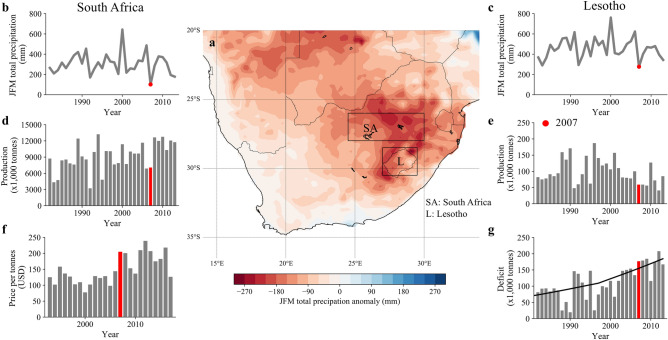
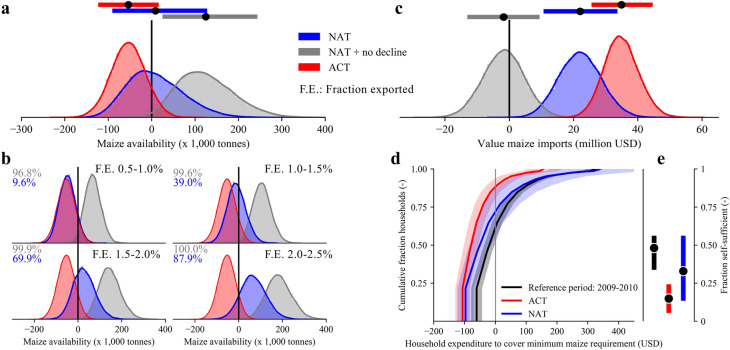
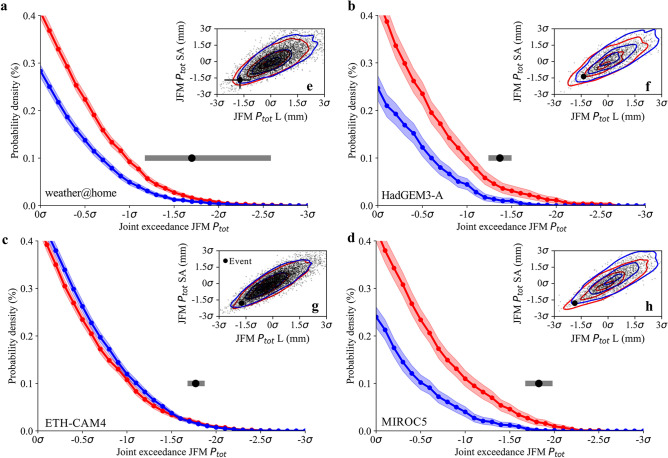
Climate-induced food production shocks, like droughts, can cause food shortages and price spikes, leading to food insecurity. In 2007, a synchronous crop failure in Lesotho and South Africa-Lesotho's sole trading partner-led to a period of severe food insecurity in Lesotho. Here, we use extreme event attribution to assess the role of climate change in exacerbating this drought, going on to evaluate sensitivity of synchronous crop failures to climate change and its implications for food security in Lesotho. Climate change was found to be a critical driver that led to the 2007 crisis in Lesotho, aggravating an ongoing decline in food production in the country. We show how a fragile agricultural system in combination with a large trade-dependency on a climatically connected trading partner can lead to a nonlinear response to climate change, which is essential information for building a climate-resilient food-supply system now and in the future.
气候引起的粮食生产冲击,如干旱,可能导致粮食短缺和价格飙升,从而引发粮食不安全。2007 年,莱索托和南非-莱索托唯一的贸易伙伴同时发生作物歉收,导致莱索托经历了一段严重的粮食不安全时期。在这里,我们使用极端事件归因来评估气候变化在加剧这场干旱中的作用,进而评估同步作物歉收对气候变化的敏感性及其对莱索托粮食安全的影响。气候变化是导致 2007 年莱索托危机的关键驱动因素,加剧了该国粮食生产的持续下降。我们展示了脆弱的农业系统与对气候相关贸易伙伴的高度贸易依存度相结合,如何导致对气候变化的非线性响应,这对于建立一个有弹性的粮食供应系统至关重要,无论是现在还是未来。