Department of Upper Gastrointestinal Surgery, Northwick Park Hospital, London North West University Healthcare NHS Trust, Watford Road, Harrow, London, HA1 3UJ, UK.
Defence Medical Services, Birmingham, UK.
Langenbecks Arch Surg. 2021 Jun;406(4):1149-1154. doi: 10.1007/s00423-020-02045-0. Epub 2021 Feb 17.
The transcystic approach to laparoscopic common bile duct exploration has gained popularity for the single-stage management of choledocholithiasis with concomitant gallstones. Our team previously described the use of a porcine aorta segment to simulate the common bile duct during laparoscopic skill training.
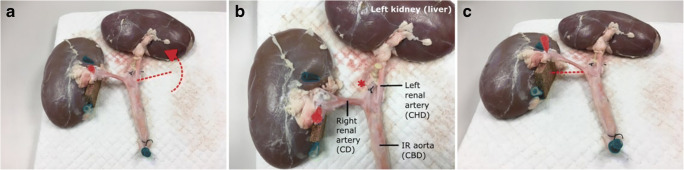
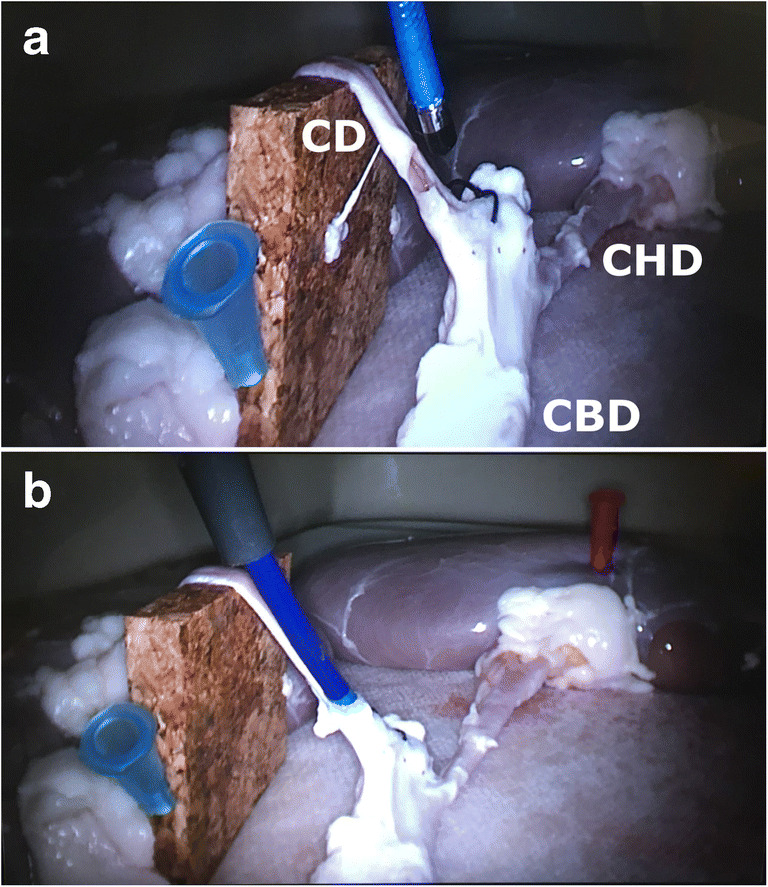
With the advent of the transcystic approach as a contender for the first-line technique of accessing the common bile duct, we present an evolution of the laparoscopic training model using a Porcine Aorta-Renal Artery (PARA) specimen to simulate the structural integrity, dimensions and spatial distribution of both the human cystic and common bile ducts.
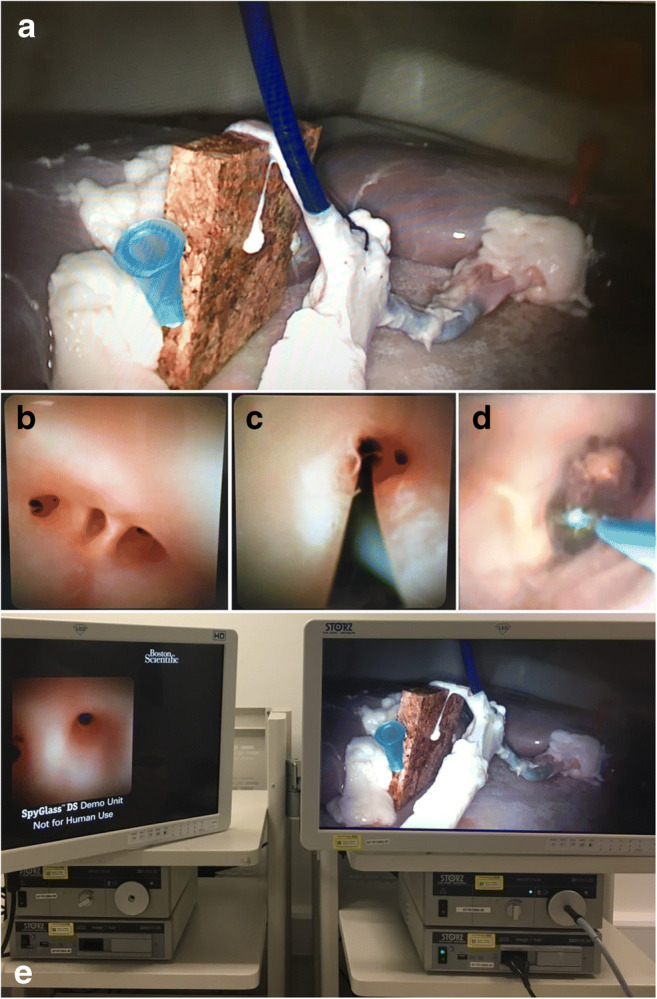
This training model allows the use of a choledochoscope for transcystic exploration of the biliary tree. It combines fidelity and reproducibility required for a simulated training model to offer experience in laparoscopic transcystic common bile duct exploration. Validation of the model was demonstrated by 21 surgeons who completed a questionnaire after performing the simulated procedure. In all sections assessing reliability, face validity and content validity of the model, mean rating scores were between 4 and 5 out of five (good or excellent).
We present the evolution of an established training model for laparoscopic common bile duct exploration which focusses the attention on the transcystic approach to the common bile duct and the use of lithotripsy techniques. The need for such a model reflects the shift in the current practice of the laparoendoscopic management of choledocholithiasis with concomitant gallstones from transductal to transcystic approach.
经胆囊管途径的腹腔镜胆总管探查术已成为治疗胆总管结石合并胆囊结石的首选方法。我们团队之前曾描述过使用猪主动脉段在腹腔镜技能训练中模拟胆总管。
随着经胆囊管途径作为进入胆总管的一线技术的出现,我们提出了一种使用猪主动脉-肾动脉(PARA)标本模拟人类胆囊管和胆总管的结构完整性、尺寸和空间分布的腹腔镜训练模型的演变。
该培训模型允许使用胆道镜进行经胆囊管的胆道探查。它结合了模拟培训模型所需的保真度和可重复性,为腹腔镜经胆囊管胆总管探查提供了经验。21 名外科医生在完成模拟手术后完成了一份问卷,对模型进行了验证。在评估模型可靠性、表面有效性和内容有效性的所有部分中,平均评分均为 5 分(良好或优秀)。
我们提出了一种腹腔镜胆总管探查训练模型的演变,该模型将重点放在经胆囊管途径进入胆总管和使用碎石技术上。对这种模型的需求反映了当前治疗伴有胆囊结石的胆总管结石的腹腔镜内镜管理实践从经胆管到经胆囊管途径的转变。