Adejuwon Kikelomo P, Osundahunsi Oluwatooyin F, Akinola Stephen A, Oluwamukomi Matthew O, Mwanza Mulunda
Department of Nutrition and Health Promotion Ondo State Primary Healthcare Development Agency Akure Nigeria.
Department of Food Science and Technology Federal University of Technology Akure Ondo State Nigeria.
Food Sci Nutr. 2020 Dec 8;9(2):639-650. doi: 10.1002/fsn3.2013. eCollection 2021 Feb.
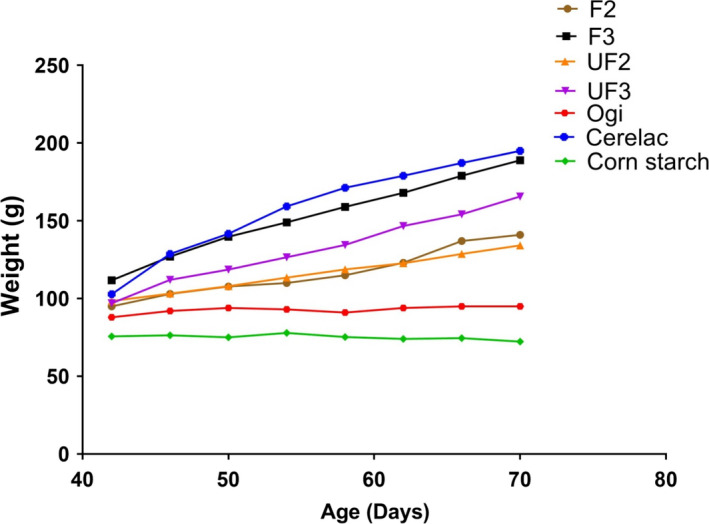
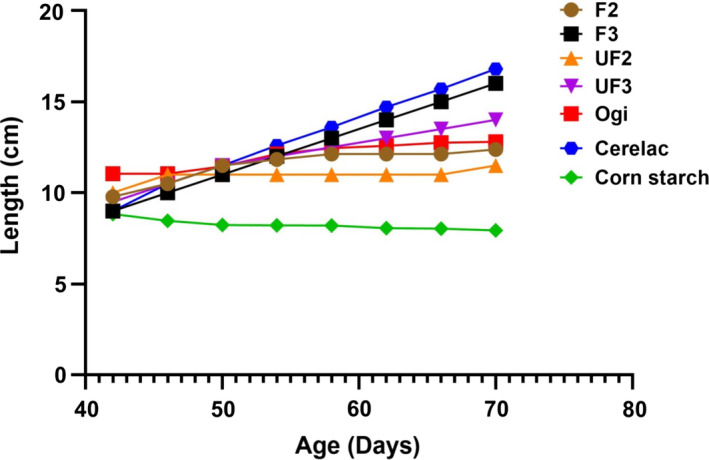
The protein quality of complementary foods developed from fermented and unfermented sorghum, soybeans, and orange-fleshed sweet potato (OFSP) flour blends was evaluated using rat model. The test diet was as follows: UF2: unfermented sorghum (56%), soybean (17%), and OFSP (27%); UF3: unfermented sorghum (59%), soybean (31%), and OFSP (10%); F2: fermented sorghum (56%), soybean (17%), and OFSP (27%); and F3: fermented sorghum (59%), soybean (31%), and OFSP (10%), while cerelac served as positive control, corn starch (basal diet), and (negative control). Forty-nine Wistar albino rats were grouped and fed with diets for 28 days. The growth, hematological, serum parameters of animals, protein quality, and proximate composition of developed diet were determined. Fermentation significantly improved the protein content and nutritional indices of experimental animals. Moisture content ranged from 2.5% to 9.24%, protein (7.09%-25.29%), ash (1.09%-3.71%), fat (10.28%-15.24%), and fiber (0.85%-3.17%). The biological values (BV) ranged from 75.11% to 78.44%. The weight gained in rat fed the formulated diet ranged from 46.0 g to 77.3 g and was highest in F3. The packed cell volume (PCV), hemoglobin concentration (HBC), red blood cell (RBC), and lymphocytes were highest in F3. Urea nitrogen and creatinine of the rats fed with formulated diets ranged from 3.58 to 15.32 mg/dl and 1.56 to 6.15 mg/dl, respectively. Sample F3 is a protein-rich complementary food that is comparable to ogi and suitable to manage malnutrition and support growth in children. However, clinical trials on the formulated diet are needed to further substantiate its nutritional potentials.
利用大鼠模型评估了由发酵和未发酵的高粱、大豆以及橙色肉甘薯(OFSP)面粉混合物制成的辅食的蛋白质质量。试验饮食如下:UF2:未发酵高粱(56%)、大豆(17%)和OFSP(27%);UF3:未发酵高粱(59%)、大豆(31%)和OFSP(10%);F2:发酵高粱(56%)、大豆(17%)和OFSP(27%);F3:发酵高粱(59%)、大豆(31%)和OFSP(10%),而婴儿米粉用作阳性对照,玉米淀粉(基础饮食)用作阴性对照。将49只Wistar白化大鼠分组并喂食这些饮食28天。测定了动物的生长、血液学、血清参数、蛋白质质量以及所开发饮食的近似组成。发酵显著提高了实验动物的蛋白质含量和营养指标。水分含量在2.5%至9.24%之间,蛋白质(7.09% - 25.29%),灰分(1.09% - 3.71%),脂肪(10.28% - 15.24%),纤维(0.85% - 3.17%)。生物价(BV)在75.11%至78.44%之间。喂食配方饮食的大鼠体重增加范围为46.0克至77.3克,F3组最高。F3组的红细胞压积(PCV)、血红蛋白浓度(HBC)、红细胞(RBC)和淋巴细胞数量最高。喂食配方饮食的大鼠尿素氮和肌酐分别在3.58至15.32毫克/分升和1.56至6.15毫克/分升之间。样品F3是一种富含蛋白质的辅食,可与奥吉相媲美,适合管理儿童营养不良并支持其生长。然而,需要对配方饮食进行临床试验以进一步证实其营养潜力。