Mannarapu Mastan, Dariya Begum, Bandapalli Obul Reddy
Department of Biotechnology, Dravidian University, Kuppam, Chittoor, Andra Pradesh, 517 426, India.
Department of Bioscience and Biotechnology, Banasthali University, Vanasthali, Rajasthan, 304022, India.
Mol Cell Biochem. 2021 Jun;476(6):2429-2437. doi: 10.1007/s11010-021-04095-4. Epub 2021 Feb 18.
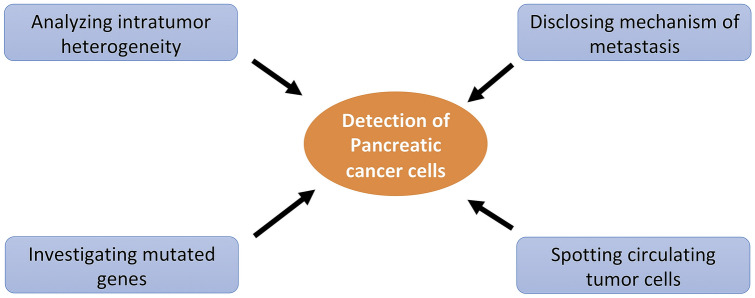
Pancreatic cancer (PC) is the third lethal disease for cancer-related mortalities globally. This is mainly because of the aggressive nature and heterogeneity of the disease that is diagnosed only in their advanced stages. Thus, it is challenging for researchers and clinicians to study the molecular mechanism involved in the development of this aggressive disease. The single-cell sequencing technology enables researchers to study each and every individual cell in a single tumor. It can be used to detect genome, transcriptome, and multi-omics of single cells. The current single-cell sequencing technology is now becoming an important tool for the biological analysis of cells, to find evolutionary relationship between multiple cells and unmask the heterogeneity present in the tumor cells. Moreover, its sensitivity nature is found progressive enabling to detect rare cancer cells, circulating tumor cells, metastatic cells, and analyze the intratumor heterogeneity. Furthermore, these single-cell sequencing technologies also promoted personalized treatment strategies and next-generation sequencing to predict the disease. In this review, we have focused on the applications of single-cell sequencing technology in identifying cancer-associated cells like cancer-associated fibroblast via detecting circulating tumor cells. We also included advanced technologies involved in single-cell sequencing and their advantages. The future research indeed brings the single-cell sequencing into the clinical arena and thus could be beneficial for diagnosis and therapy of PC patients.
胰腺癌(PC)是全球癌症相关死亡中的第三大致命疾病。这主要是因为该疾病具有侵袭性和异质性,往往在晚期才被诊断出来。因此,对于研究人员和临床医生来说,研究这种侵袭性疾病发展过程中涉及的分子机制具有挑战性。单细胞测序技术使研究人员能够研究单个肿瘤中的每一个细胞。它可用于检测单个细胞的基因组、转录组和多组学。当前的单细胞测序技术正成为细胞生物学分析的重要工具,以发现多个细胞之间的进化关系并揭示肿瘤细胞中存在的异质性。此外,其敏感性不断提高,能够检测罕见癌细胞、循环肿瘤细胞、转移细胞,并分析肿瘤内异质性。此外,这些单细胞测序技术还推动了个性化治疗策略以及用于预测疾病的下一代测序。在这篇综述中,我们重点关注了单细胞测序技术在通过检测循环肿瘤细胞来识别癌症相关细胞(如癌症相关成纤维细胞)方面的应用。我们还介绍了单细胞测序中涉及的先进技术及其优势。未来的研究确实将单细胞测序引入临床领域,从而可能对胰腺癌患者的诊断和治疗有益。