MMWR Morb Mortal Wkly Rep. 2021 Feb 19;70(7):254-257. doi: 10.15585/mmwr.mm7007e1.
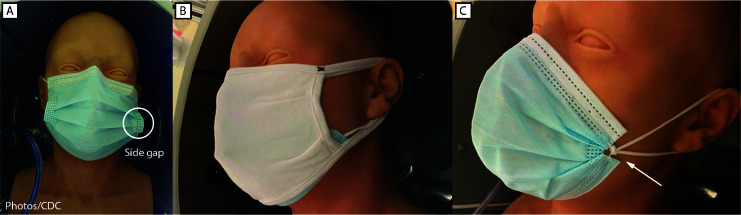
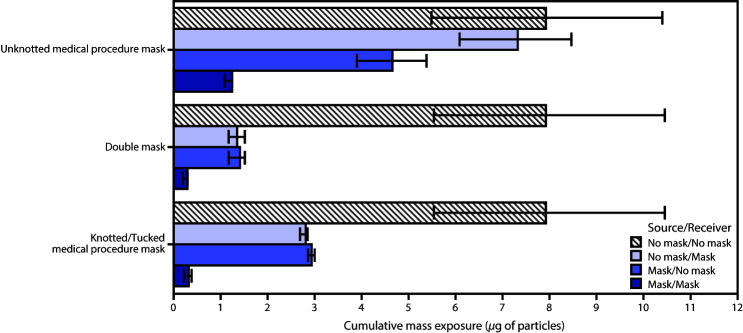
Universal masking is one of the prevention strategies recommended by CDC to slow the spread of SARS-CoV-2, the virus that causes coronavirus disease 2019 (COVID-19) (1). As of February 1, 2021, 38 states and the District of Columbia had universal masking mandates. Mask wearing has also been mandated by executive order for federal property* as well as on domestic and international transportation conveyances. Masks substantially reduce exhaled respiratory droplets and aerosols from infected wearers and reduce exposure of uninfected wearers to these particles. Cloth masks and medical procedure masks fit more loosely than do respirators (e.g., N95 facepieces). The effectiveness of cloth and medical procedure masks can be improved by ensuring that they are well fitted to the contours of the face to prevent leakage of air around the masks' edges. During January 2021, CDC conducted experimental simulations using pliable elastomeric source and receiver headforms to assess the extent to which two modifications to medical procedure masks, 1) wearing a cloth mask over a medical procedure mask (double masking) and 2) knotting the ear loops of a medical procedure mask where they attach to the mask's edges and then tucking in and flattening the extra material close to the face (knotted and tucked masks), could improve the fit of these masks and reduce the receiver's exposure to an aerosol of simulated respiratory droplet particles of the size considered most important for transmitting SARS-CoV-2. The receiver's exposure was maximally reduced (>95%) when the source and receiver were fitted with modified medical procedure masks. These laboratory-based experiments highlight the importance of good fit to optimize mask performance. Until vaccine-induced population immunity is achieved, universal masking is a highly effective means to slow the spread of SARS-CoV-2** when combined with other protective measures, such as physical distancing, avoiding crowds and poorly ventilated indoor spaces, and good hand hygiene. Innovative efforts to improve the fit of cloth and medical procedure masks to enhance their performance merit attention.
通用口罩是疾病预防控制中心(CDC)推荐的预防策略之一,旨在减缓导致 2019 年冠状病毒病(COVID-19)的 SARS-CoV-2 病毒的传播(1)。截至 2021 年 2 月 1 日,38 个州和哥伦比亚特区都颁布了通用口罩令。联邦财产(*)以及国内和国际运输工具也都通过行政命令强制佩戴口罩。口罩可大大减少感染者呼出的飞沫和气溶胶,并减少未感染者接触这些颗粒。与呼吸器(例如 N95 面罩)相比,布制口罩和医用口罩的贴合度较差。通过确保口罩贴合面部轮廓,防止口罩边缘周围空气泄漏,可以提高布制口罩和医用口罩的有效性。2021 年 1 月,疾病预防控制中心使用柔韧的弹性源和接收器头模进行了实验模拟,以评估对医用口罩进行两项修改的程度,1)在医用口罩上佩戴布制口罩(双层口罩),2)在医用口罩的耳带与口罩边缘相接的地方打个结,然后将多余的材料向内折叠并紧贴面部(打结和折叠口罩),这两种修改可以改善口罩的贴合度,并减少接收器暴露于模拟呼吸道飞沫颗粒气溶胶的程度,这些颗粒被认为对传播 SARS-CoV-2 最重要。当源和接收器都配备了改良的医用口罩时,接收器的暴露量最大程度地减少(>95%)。这些基于实验室的实验强调了良好贴合度对于优化口罩性能的重要性。在实现疫苗诱导的人群免疫力之前,通用口罩与其他保护措施(如保持身体距离、避免人群和通风不良的室内空间以及保持良好的手部卫生)相结合,是减缓 SARS-CoV-2 传播的非常有效的手段。提高布制口罩和医用口罩贴合度以增强其性能的创新努力值得关注。