• 文献检索
  • 文档翻译
  • 深度研究
  • 学术资讯
  • Suppr Zotero 插件Zotero 插件
  • 邀请有礼
  • 套餐&价格
  • 历史记录
应用&插件
Suppr Zotero 插件Zotero 插件浏览器插件Mac 客户端Windows 客户端微信小程序
定价
高级版会员购买积分包购买API积分包
服务
文献检索文档翻译深度研究API 文档MCP 服务
关于我们
关于 Suppr公司介绍联系我们用户协议隐私条款
关注我们

Suppr 超能文献

核心技术专利:CN118964589B侵权必究
粤ICP备2023148730 号-1Suppr @ 2026

文献检索

告别复杂PubMed语法,用中文像聊天一样搜索,搜遍4000万医学文献。AI智能推荐,让科研检索更轻松。

立即免费搜索

文件翻译

保留排版,准确专业,支持PDF/Word/PPT等文件格式,支持 12+语言互译。

免费翻译文档

深度研究

AI帮你快速写综述,25分钟生成高质量综述,智能提取关键信息,辅助科研写作。

立即免费体验

斯洛文尼亚运用多位点可变数目串联重复分析技术进行兔热病病例分析

Characterization of Tularemia Cases in Slovenia with Multiple-Locus Variable-Number Tandem Repeat Analysis.

机构信息

Institute of Microbiology and Immunology, Faculty of Medicine, University of Ljubljana, Ljubljana, Slovenia.

Slovenian Museum of Natural History, Ljubljana, Slovenia.

出版信息

Vector Borne Zoonotic Dis. 2021 May;21(5):351-357. doi: 10.1089/vbz.2020.2711. Epub 2021 Feb 18.

DOI:10.1089/vbz.2020.2711
PMID:33601964
原文链接:https://pmc.ncbi.nlm.nih.gov/articles/PMC8086403/
Abstract

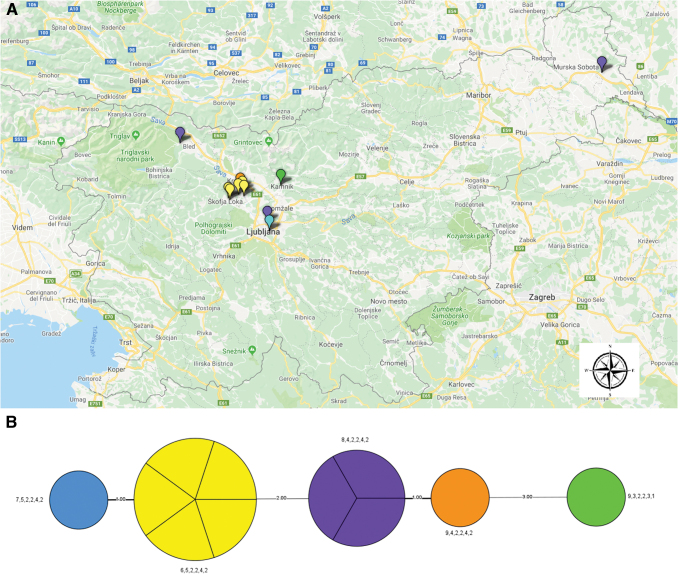
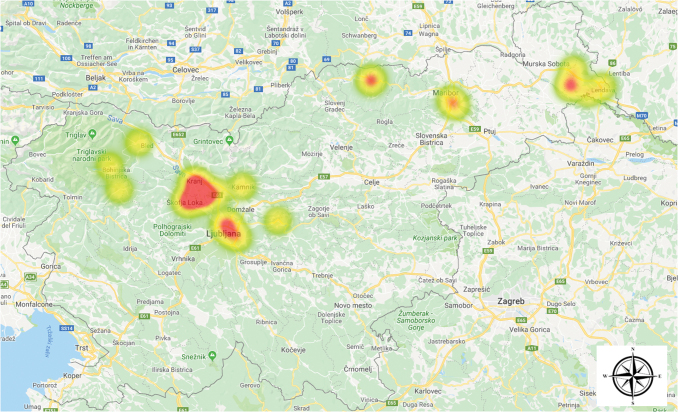
is the etiologic agent of tularemia, a bacterial zoonotic disease. The genome of shows a recent evolutionary change, especially in reservoirs. Variable number of tandem repeats (VNTR) is described as a high-speed molecular clock and can thus be used as a high-resolution typing system. The main objective of our study was to investigate the molecular diversity of strains and reveal possible sources of infection. Using real-time PCR targeting the IS2 region, we successfully amplified targeted DNA in 13/31 Slovenian patients with a clinical diagnosis of tularemia, and with PCR targeting the gene, we obtained 11/13 PCR products. Sequencing revealed that all samples were identified as subsp. . We successfully obtained one isolate from a lymph node aspirate by culture on chocolate agar. Our isolate was clustered into major clade B12 (subclade B43). We optimized VNTR typing to be used directly on clinical samples. Multiple-locus VNTR analysis (MLVA) revealed five unique MLVA types; 45.5% samples had the same MLVA type, another 27.3% shared a different MLVA type, and each of the remaining had a unique MLVA type. Most samples differed at only two VNTR markers (Ft-M03 and Ft-M06). Additionally, we investigated samples from small mammals ( = 532) and ticks ( = 232) captured in the same geographical area in which patients with tularemia were found. No DNA was detected in samples of small mammals or ticks. The diversity of MLVA types in Slovenia was high, despite the small region, but most of the samples from the same region shared the same MLVA type. Our results suggest that MLVA is a useful tool for quick molecular characterization of directly from patient samples, especially when investigating geographically localized outbreaks.

摘要

是土拉弗朗西斯菌的病原体,一种细菌性人畜共患病。 的基因组显示出最近的进化变化,特别是在储存库中。可变数目的串联重复(VNTR)被描述为高速分子钟,因此可以用作高分辨率的分型系统。我们研究的主要目的是调查 菌株的分子多样性,并揭示可能的感染源。使用针对 IS2 区域的实时 PCR,我们成功地扩增了 13/31 名斯洛文尼亚临床诊断为土拉弗朗西斯菌病的患者的目标 DNA,并且使用针对 基因的 PCR,我们获得了 11/13 的 PCR 产物。测序表明,所有样本均被鉴定为 亚种。我们通过在巧克力琼脂上培养成功地从淋巴结吸出物中获得了一个 分离株。我们的分离株聚类到主要分支 B12(子分支 B43)。我们成功地优化了 VNTR 分型,以便直接用于临床样本。多位点 VNTR 分析(MLVA)显示了五种独特的 MLVA 类型;45.5%的样本具有相同的 MLVA 类型,另外 27.3%的样本具有不同的 MLVA 类型,其余每个样本都具有独特的 MLVA 类型。大多数样本仅在两个 VNTR 标记(Ft-M03 和 Ft-M06)上存在差异。此外,我们还调查了在发现土拉弗朗西斯菌病患者的同一地理区域捕获的小哺乳动物( = 532)和 蜱( = 232)的样本。在小哺乳动物或 蜱样本中均未检测到 DNA。尽管斯洛文尼亚的 MLVA 类型多样性很高,但由于该地区较小,因此来自同一地区的大多数样本都具有相同的 MLVA 类型。我们的研究结果表明,MLVA 是一种从患者样本中快速进行 分子特征分析的有用工具,尤其是在调查地理位置局部爆发时。
https://cdn.ncbi.nlm.nih.gov/pmc/blobs/d10d/8086403/6b65150110cf/vbz.2020.2711_figure2.jpg
https://cdn.ncbi.nlm.nih.gov/pmc/blobs/d10d/8086403/f4e410497cdd/vbz.2020.2711_figure1.jpg
https://cdn.ncbi.nlm.nih.gov/pmc/blobs/d10d/8086403/6b65150110cf/vbz.2020.2711_figure2.jpg
https://cdn.ncbi.nlm.nih.gov/pmc/blobs/d10d/8086403/f4e410497cdd/vbz.2020.2711_figure1.jpg
https://cdn.ncbi.nlm.nih.gov/pmc/blobs/d10d/8086403/6b65150110cf/vbz.2020.2711_figure2.jpg

相似文献

1
Characterization of Tularemia Cases in Slovenia with Multiple-Locus Variable-Number Tandem Repeat Analysis.斯洛文尼亚运用多位点可变数目串联重复分析技术进行兔热病病例分析
Vector Borne Zoonotic Dis. 2021 May;21(5):351-357. doi: 10.1089/vbz.2020.2711. Epub 2021 Feb 18.
2
Detection of Francisella tularensis in ticks and identification of their genotypes using multiple-locus variable-number tandem repeat analysis.利用多位点可变数目串联重复序列分析检测蜱中兔热病弗朗西斯菌并鉴定其基因型。
BMC Microbiol. 2008 Sep 17;8:152. doi: 10.1186/1471-2180-8-152.
3
Presence of an emerging subclone of Francisella tularensis holarctica in Ixodes ricinus ticks from south-western Germany.在德国西南部的璃眼蜱中发现了一个新出现的土拉弗朗西斯菌holarctica 亚克隆。
Ticks Tick Borne Dis. 2013 Feb;4(1-2):93-100. doi: 10.1016/j.ttbdis.2012.09.001. Epub 2012 Nov 7.
4
Identification of the source of Francisella tularensis infection by multiple-locus variable-number tandem repeat analysis.应用多位点可变数目串联重复分析鉴定土拉弗朗西斯菌感染源。
Jpn J Infect Dis. 2013;66(6):543-5. doi: 10.7883/yoken.66.543.
5
Worldwide genetic relationships among Francisella tularensis isolates determined by multiple-locus variable-number tandem repeat analysis.通过多位点可变数目串联重复序列分析确定的土拉弗朗西斯菌分离株的全球遗传关系。
J Bacteriol. 2004 Sep;186(17):5808-18. doi: 10.1128/JB.186.17.5808-5818.2004.
6
Francisella tularensis strain typing using multiple-locus, variable-number tandem repeat analysis.利用多位点可变数目串联重复序列分析对土拉弗朗西斯菌进行菌株分型。
J Clin Microbiol. 2001 Sep;39(9):3186-92. doi: 10.1128/JCM.39.9.3186-3192.2001.
7
German Francisella tularensis isolates from European brown hares (Lepus europaeus) reveal genetic and phenotypic diversity.从欧洲野兔(Lepus europaeus)中分离出的德国土拉弗朗西斯菌分离株显示出遗传和表型多样性。
BMC Microbiol. 2013 Mar 21;13:61. doi: 10.1186/1471-2180-13-61.
8
Five cases of vector-borne Francisella tularensis holarctica infections in south-western Germany and genetic diversity.德国西南部五例由媒介传播的全北区土拉弗朗西斯菌感染病例及基因多样性
Ticks Tick Borne Dis. 2017 Aug;8(5):808-812. doi: 10.1016/j.ttbdis.2017.06.009. Epub 2017 Jul 1.
9
Population Genomics of subsp. and its Implication on the Eco-Epidemiology of Tularemia in Switzerland.瑞士小种及其在兔热病生态流行病学中的意义的种群基因组学研究。
Front Cell Infect Microbiol. 2018 Mar 22;8:89. doi: 10.3389/fcimb.2018.00089. eCollection 2018.
10
Francisella tularensis in the United States.美国的土拉弗朗西斯菌
Emerg Infect Dis. 2005 Dec;11(12):1835-41. doi: 10.3201/eid1112.050728.

引用本文的文献

1
Vector-Borne Tularemia: A Re-Emerging Cause of Cervical Lymphadenopathy.媒介传播的兔热病:一种再度出现的颈淋巴结病病因
Trop Med Infect Dis. 2022 Aug 16;7(8):189. doi: 10.3390/tropicalmed7080189.