Paul G Allen School for Global Health, Washington State University, Pullman, Washington, USA.
Washington State University Global `Health Program-Kenya, WSU, Nairobi, Kenya.
BMC Infect Dis. 2021 Feb 18;21(1):191. doi: 10.1186/s12879-021-05871-9.
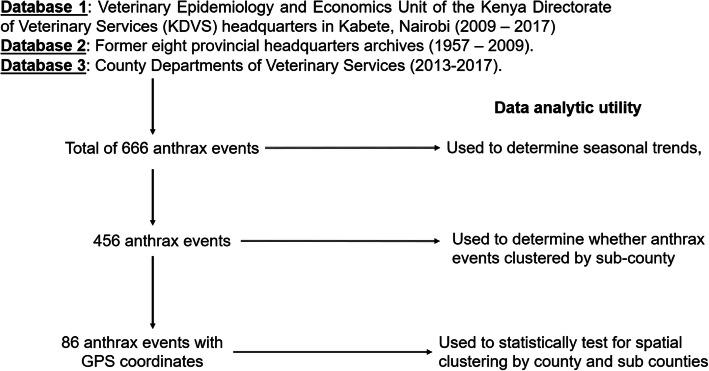
Developing disease risk maps for priority endemic and episodic diseases is becoming increasingly important for more effective disease management, particularly in resource limited countries. For endemic and easily diagnosed diseases such as anthrax, using historical data to identify hotspots and start to define ecological risk factors of its occurrence is a plausible approach. Using 666 livestock anthrax events reported in Kenya over 60 years (1957-2017), we determined the temporal and spatial patterns of the disease as a step towards identifying and characterizing anthrax hotspots in the region.
Data were initially aggregated by administrative unit and later analyzed by agro-ecological zones (AEZ) to reveal anthrax spatio-temporal trends and patterns. Variations in the occurrence of anthrax events were estimated by fitting Poisson generalized linear mixed-effects models to the data with AEZs and calendar months as fixed effects and sub-counties as random effects.
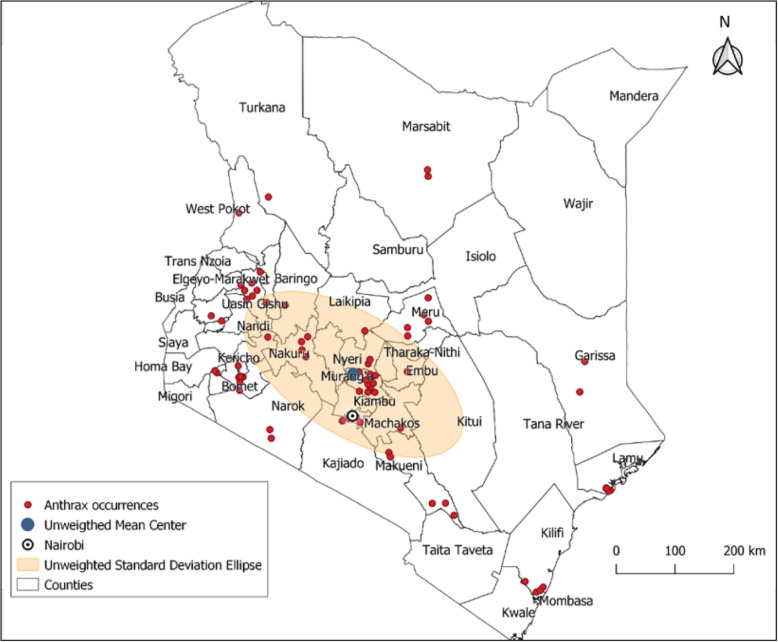
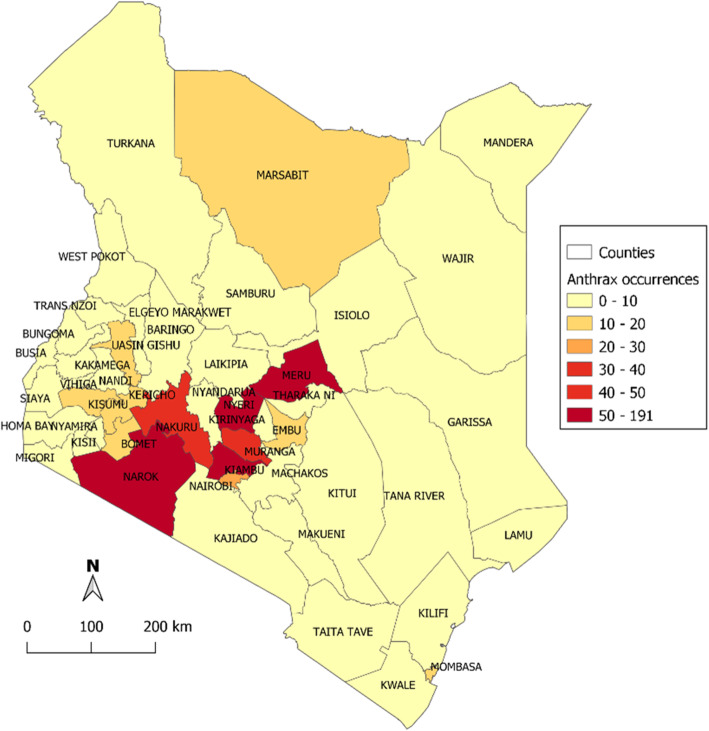
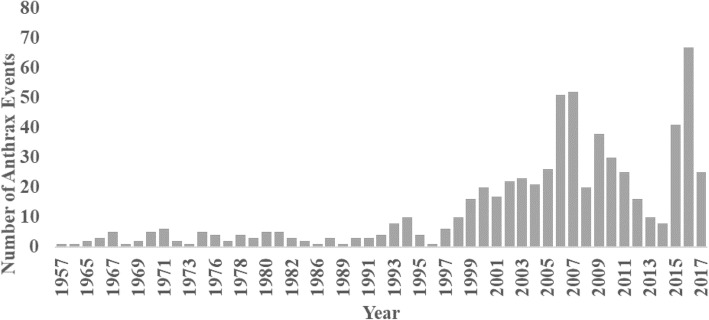
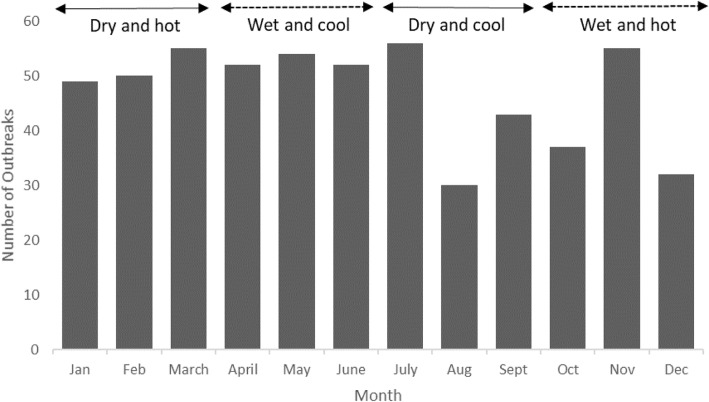
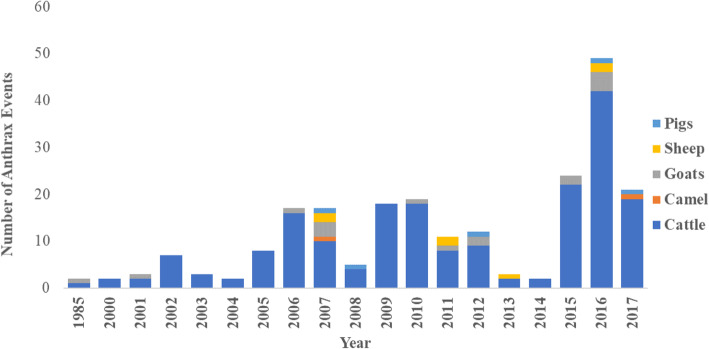
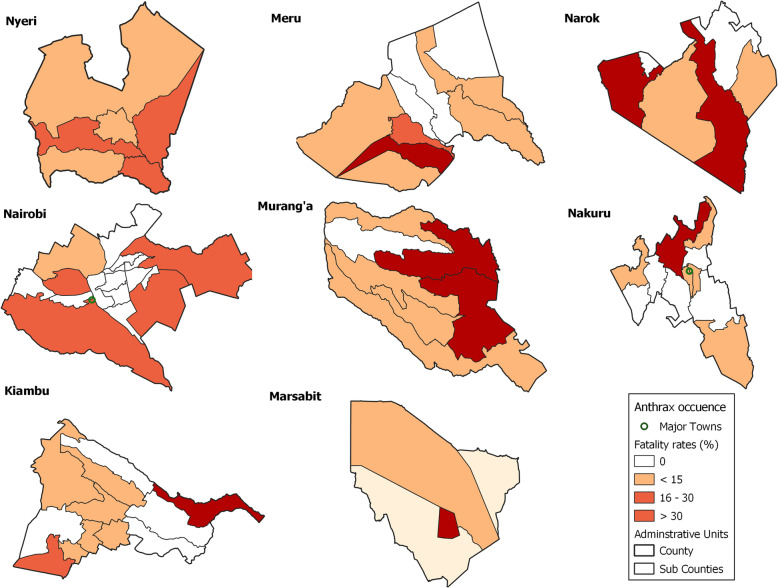
The country reported approximately 10 anthrax events annually, with the number increasing to as many as 50 annually by the year 2005. Spatial classification of the events in eight counties that reported the highest numbers revealed spatial clustering in certain administrative sub-counties, with 12% of the sub-counties responsible for over 30% of anthrax events, whereas 36% did not report any anthrax disease over the 60-year period. When segregated by AEZs, there was significantly greater risk of anthrax disease occurring in agro-alpine, high, and medium potential AEZs when compared to the agriculturally low potential arid and semi-arid AEZs of the country (p < 0.05). Interestingly, cattle were > 10 times more likely to be infected by B. anthracis than sheep, goats, or camels. There was lower risk of anthrax events in August (P = 0.034) and December (P = 0.061), months that follow long and short rain periods, respectively.
Taken together, these findings suggest existence of certain geographic, ecological, and demographic risk factors that promote B. anthracis persistence and trasmission in the disease hotspots.
为了更有效地进行疾病管理,为优先发生的地方性和偶发性疾病绘制疾病风险图变得越来越重要,特别是在资源有限的国家。对于炭疽等地方性和易于诊断的疾病,可以利用历史数据来确定热点,并开始确定其发生的生态风险因素,这是一种合理的方法。本研究利用肯尼亚 60 多年(1957-2017 年)期间报告的 666 起牲畜炭疽事件,通过确定疾病的时空模式,朝着确定和描述该地区炭疽热点的方向迈出了一步。
数据最初按行政区划单位进行汇总,然后按农业生态区(AEZ)进行分析,以揭示炭疽的时空趋势和模式。通过将泊松广义线性混合效应模型拟合到数据中,使用 AEZ 和日历月作为固定效应,次级县作为随机效应,估计炭疽事件的发生变化。
该国每年报告约 10 起炭疽事件,到 2005 年,每年报告的炭疽事件数量增加到多达 50 起。对报告炭疽事件最多的 8 个县进行事件的空间分类显示,某些行政次级县存在空间聚类,其中 12%的次级县负责超过 30%的炭疽事件,而 36%的次级县在 60 年期间没有报告任何炭疽疾病。按 AEZ 划分时,与该国农业低潜力干旱和半干旱 AEZ 相比,高山、高潜力和中潜力 AEZ 发生炭疽病的风险显著更高(p<0.05)。有趣的是,牛感染炭疽芽孢杆菌的可能性是绵羊、山羊或骆驼的 10 倍以上。8 月(P=0.034)和 12 月(P=0.061)炭疽事件的风险较低,这两个月分别是长雨期和短雨期之后的月份。
综上所述,这些发现表明存在某些地理、生态和人口风险因素,这些因素促进了炭疽病热点中炭疽芽孢杆菌的持续存在和传播。