Ergunay Koray, Mutinda Mathew, Bourke Brian, Justi Silvia A, Caicedo-Quiroga Laura, Kamau Joseph, Mutura Samson, Akunda Irene Karagi, Cook Elizabeth, Gakuya Francis, Omondi Patrick, Murray Suzan, Zimmerman Dawn, Linton Yvonne-Marie
Walter Reed Biosystematics Unit (WRBU), Smithsonian Institution Museum Support Center, Suitland, MD, United States.
One Health Branch, Walter Reed Army Institute of Research (WRAIR), Silver Spring, MD, United States.
Front Microbiol. 2022 Jul 1;13:932224. doi: 10.3389/fmicb.2022.932224. eCollection 2022.
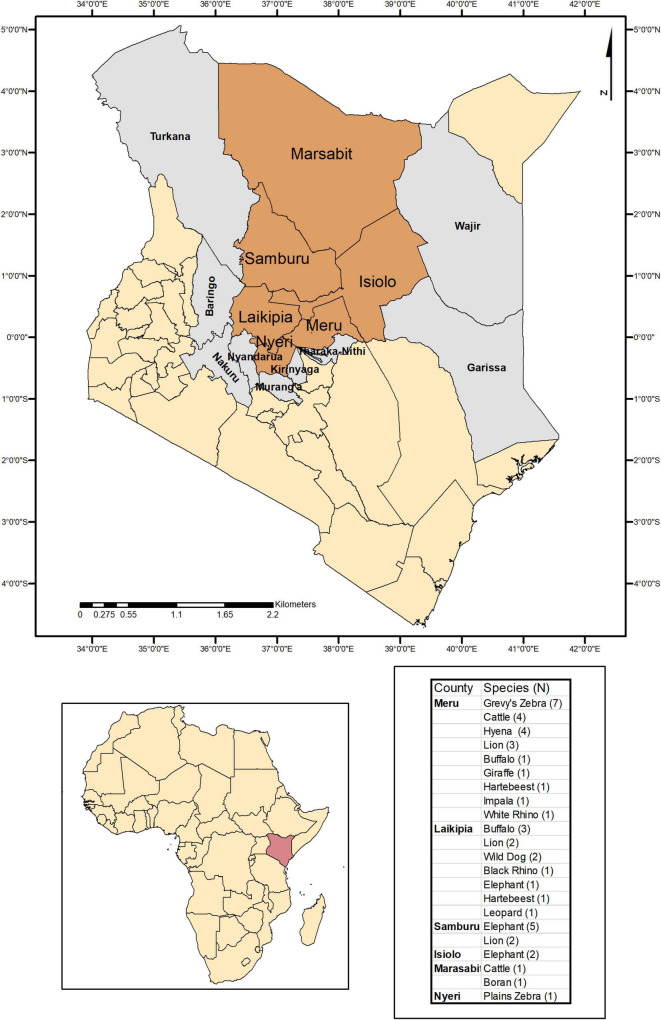
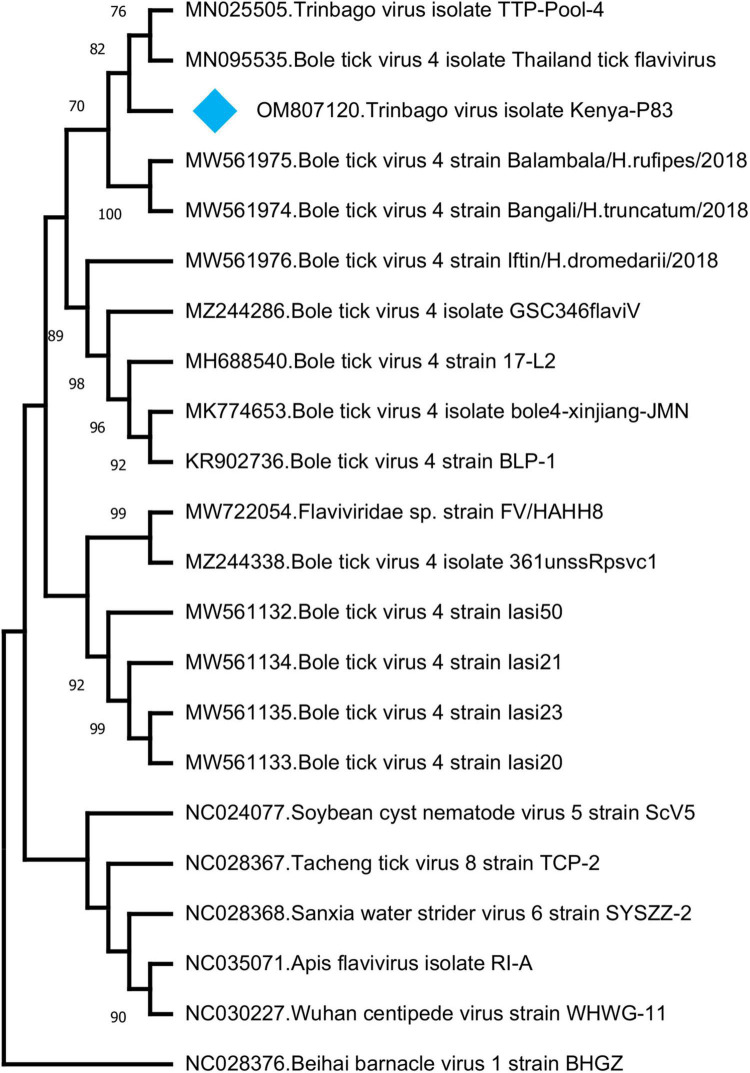
Focusing on the utility of ticks as xenosurveillance sentinels to expose circulating pathogens in Kenyan drylands, host-feeding ticks collected from wild ungulates [buffaloes, elephants, giraffes, hartebeest, impala, rhinoceros (black and white), zebras (Grévy's and plains)], carnivores (leopards, lions, spotted hyenas, wild dogs), as well as regular domestic and Boran cattle were screened for pathogens using metagenomics. A total of 75 host-feeding ticks [ (97.3%) and (2.7%)] collected from 15 vertebrate taxa were sequenced in 46 pools. Fifty-six pathogenic bacterial species were detected in 35 pools analyzed for pathogens and relative abundances of major phyla. The most frequently observed species was (62.8%), followed by (48.5%) and (45.7%). and Jingmen tick virus (JMTV) were detected in 14.2 and 13% of the pools, respectively, in ticks collected from wild animals and cattle. This is one of the first reports of JMTV in Kenya, and phylogenetic reconstruction revealed significant divergence from previously known isolates and related viruses. Eight fungal species with human pathogenicity were detected in 5 pools (10.8%). The vector-borne filarial pathogens (), protozoa ( spp., ), and environmental and water-/food-borne pathogens ( spp., , and ) were detected. Documented viruses included human mastadenovirus C, Epstein-Barr virus and bovine herpesvirus 5, Trinbago virus, and Guarapuava tymovirus-like virus 1. Our findings confirmed that host-feeding ticks are an efficient sentinel for xenosurveillance and demonstrate clear potential for wildlife-livestock-human pathogen transfer in the Kenyan landscape.
以蜱作为异源监测哨兵来揭示肯尼亚干旱地区传播的病原体的效用为重点,对从野生有蹄类动物(水牛、大象、长颈鹿、转角牛羚、黑斑羚、犀牛(黑犀和白犀)、斑马(细纹斑马和平原斑马))、食肉动物(豹、狮子、斑鬣狗、非洲野犬)以及普通家养牛和博拉纳牛身上采集的宿主寄生蜱进行宏基因组学病原体筛查。从15个脊椎动物类群中采集的总共75只宿主寄生蜱([占97.3%]和[占2.7%])被分成46组进行测序。在对35组进行病原体及主要门类相对丰度分析时检测到56种致病细菌。最常观察到的物种是(占62.8%),其次是(占48.5%)和(占45.7%)。在从野生动物和牛身上采集的蜱中,分别有14.2%和13%的组检测到了和荆门蜱病毒(JMTV)。这是肯尼亚首次报道JMTV,系统发育重建显示其与先前已知的分离株和相关病毒有显著差异。在5组(占10.8%)中检测到8种具有人类致病性的真菌。检测到了媒介传播的丝虫病原体()、原生动物( spp.,)以及环境和水/食物传播的病原体( spp.,,和)。记录在案的病毒包括人类腺病毒C、爱泼斯坦 - 巴尔病毒、牛疱疹病毒5、特立尼达病毒以及瓜拉普瓦瓦类番茄病毒1。我们的研究结果证实,宿主寄生蜱是异源监测的有效哨兵,并表明在肯尼亚的环境中野生动物 - 家畜 - 人类之间病原体转移具有明显的可能性。