Big Data Institute, Li Ka Shing Centre for Health Information and Discovery, University of Oxford, Oxford, OX3 7LF, UK.
Vector Biology Department, Liverpool School of Tropical Medicine, Pembroke Place, Liverpool, L3 5QA, UK.
Parasit Vectors. 2021 Feb 18;14(1):115. doi: 10.1186/s13071-021-04609-5.
It is important to understand whether the potential impact of pyrethroid resistance on malaria control can be mitigated by switching between different pyrethroids or whether cross-resistance within this insecticide class precludes this approach.
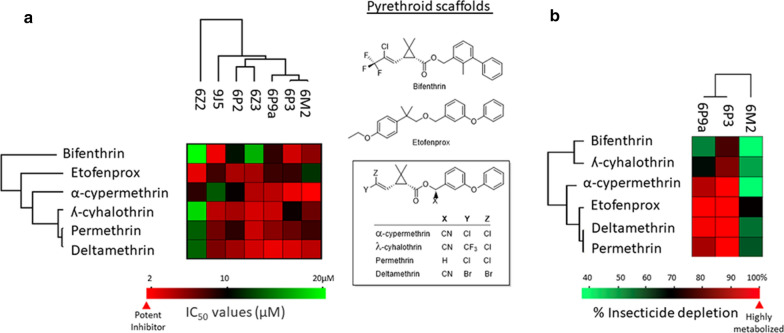
Here we assess the relationships among pyrethroids in terms of their binding affinity to, and depletion by, key cytochrome P450 enzymes (hereafter P450s) that are known to confer metabolic pyrethroid resistance in Anopheles gambiae (s.l.) and An. funestus, in order to identify which pyrethroids may diverge from the others in their vulnerability to resistance. We then investigate whether these same pyrethroids also diverge from the others in terms of resistance in vector populations.
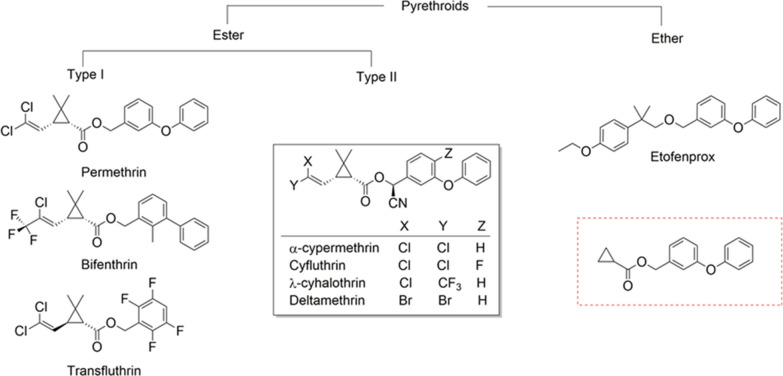
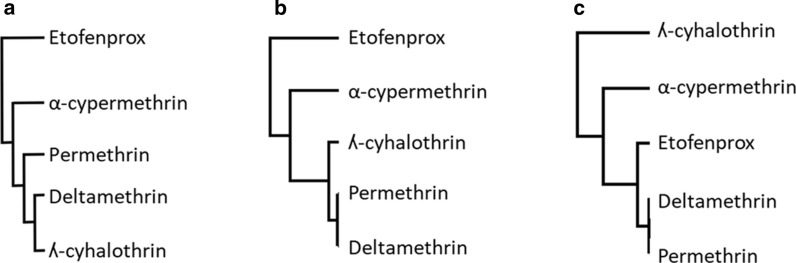
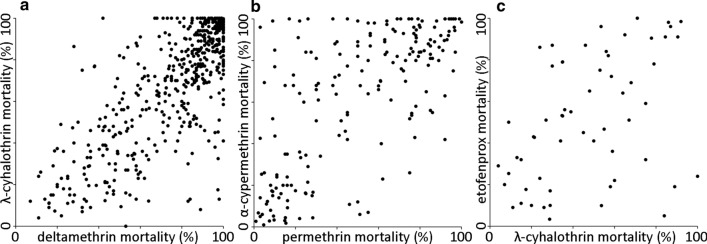
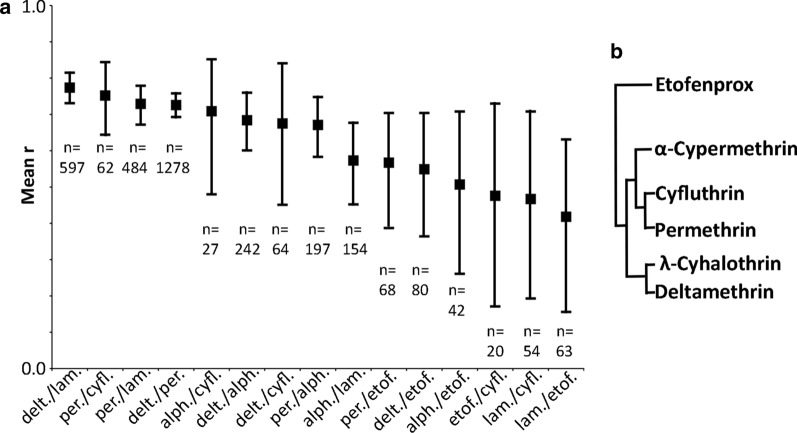
We found that the type I and II pyrethroids permethrin and deltamethrin, respectively, are closely related in terms of binding affinity to key P450s, depletion by P450s and resistance within vector populations. Bifenthrin, which lacks the common structural moiety of most pyrethroids, diverged from the other pyrethroids tested in terms of both binding affinity to key P450s and depletion by P450s, but resistance to bifenthrin has rarely been tested in vector populations and was not analysed here. Etofenprox, which also lacks the common structural moiety of most pyrethroids, diverged from the more commonly deployed pyrethroids in terms of binding affinity to key P450s and resistance in vector populations, but did not diverge from these pyrethroids in terms of depletion by the P450s. The analysis of depletion by the P450s indicated that etofenprox may be more vulnerable to metabolic resistance mechanisms in vector populations. In addition, greater resistance to etofenprox was found across Aedes aegypti populations, but greater resistance to this compound was not found in any of the malaria vector species analysed. The results for pyrethroid depletion by anopheline P450s in the laboratory were largely not repeated in the findings for resistance in malaria vector populations.
Importantly, the prevalence of resistance to the pyrethroids α-cypermethrin, cyfluthrin, deltamethrin, λ-cyhalothrin and permethrin was correlated across malaria vector populations, and switching between these compounds as a tool to mitigate against pyrethroid resistance is not advised without strong evidence supporting a true difference in resistance.
了解拟除虫菊酯抗性对疟疾控制的潜在影响是否可以通过在不同拟除虫菊酯之间切换来减轻,或者这种杀虫剂类别内的交叉抗性是否排除了这种方法,这一点很重要。
在这里,我们根据关键细胞色素 P450 酶(以下简称 P450)对其结合亲和力和耗竭程度来评估拟除虫菊酯之间的关系,这些 P450 酶已知可导致冈比亚按蚊(s.l.)和致倦库蚊对代谢性拟除虫菊酯产生抗性,以便确定哪些拟除虫菊酯在易感性方面可能与其他拟除虫菊酯不同。然后,我们研究了这些相同的拟除虫菊酯在蚊虫种群中的抗性方面是否也与其他拟除虫菊酯不同。
我们发现,作为 I 型和 II 型拟除虫菊酯的分别代表,氯菊酯和溴氰菊酯在与关键 P450 的结合亲和力、被 P450 耗竭以及在蚊虫种群中的抗性方面非常相似。双硫磷,缺乏大多数拟除虫菊酯的常见结构部分,在与关键 P450 的结合亲和力和被 P450 耗竭方面与所测试的其他拟除虫菊酯不同,但在蚊虫种群中很少测试到对双硫磷的抗性,因此这里没有进行分析。乙氰菊酯,也缺乏大多数拟除虫菊酯的常见结构部分,在与关键 P450 的结合亲和力和在蚊虫种群中的抗性方面与更常用的拟除虫菊酯不同,但在被 P450 耗竭方面与这些拟除虫菊酯没有不同。对 P450 耗竭的分析表明,乙氰菊酯可能更容易受到蚊虫种群中代谢抗性机制的影响。此外,在埃及伊蚊种群中发现了对乙氰菊酯更大的抗性,但在分析的所有疟疾媒介物种中都没有发现对这种化合物的更大抗性。在实验室中用按蚊 P450 对拟除虫菊酯的耗竭结果在很大程度上与疟疾媒介种群中的抗性结果不一致。
重要的是,对拟除虫菊酯 α-氯氰菊酯、氯氟氰菊酯、溴氰菊酯、氯氰菊酯和氯菊酯的抗性在疟疾媒介种群中呈相关性,在没有强有力的证据支持真正的抗性差异的情况下,不建议将这些化合物作为减轻拟除虫菊酯抗性的工具进行切换。