Sainsbury Laboratory, Cambridge University, Cambridge CB2 1LR, United Kingdom.
Institute for Chemical and Bioengineering, Department of Chemistry and Applied Biosciences, ETH Zürich, 8093 Zürich, Switzerland.
Proc Natl Acad Sci U S A. 2021 Feb 23;118(8). doi: 10.1073/pnas.1921960118.
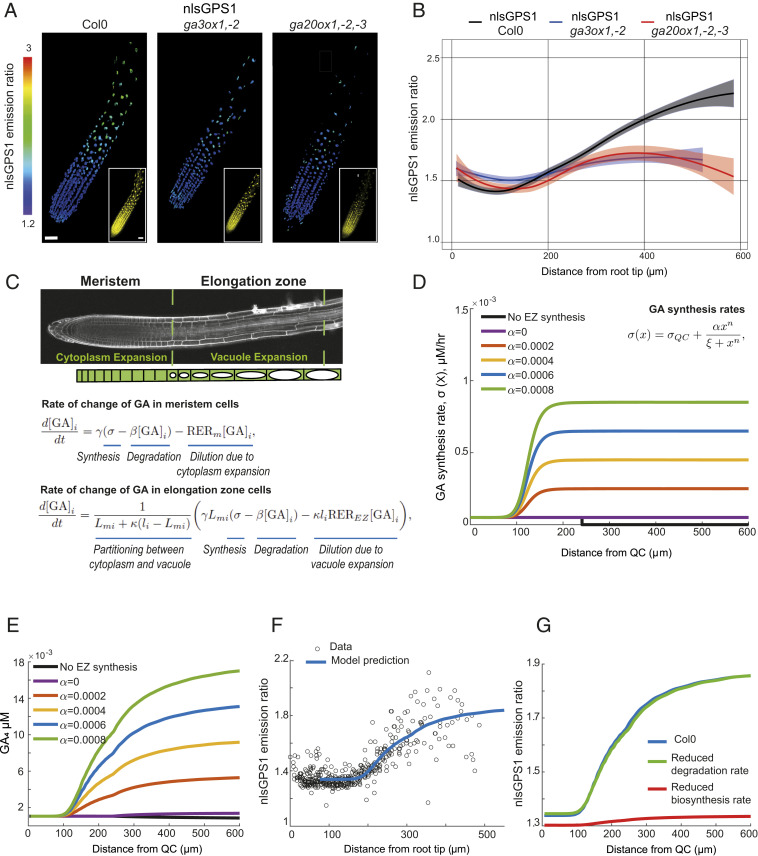
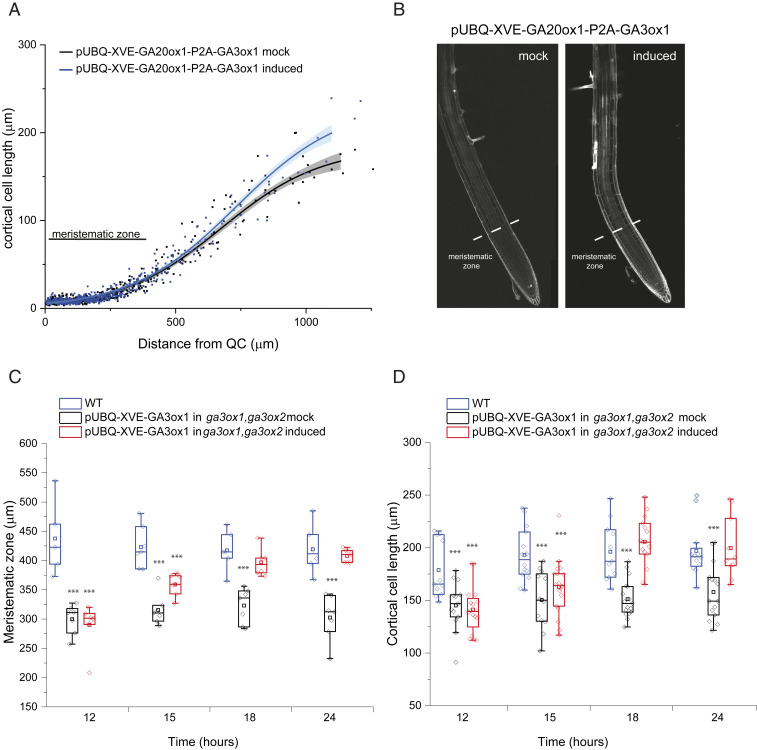
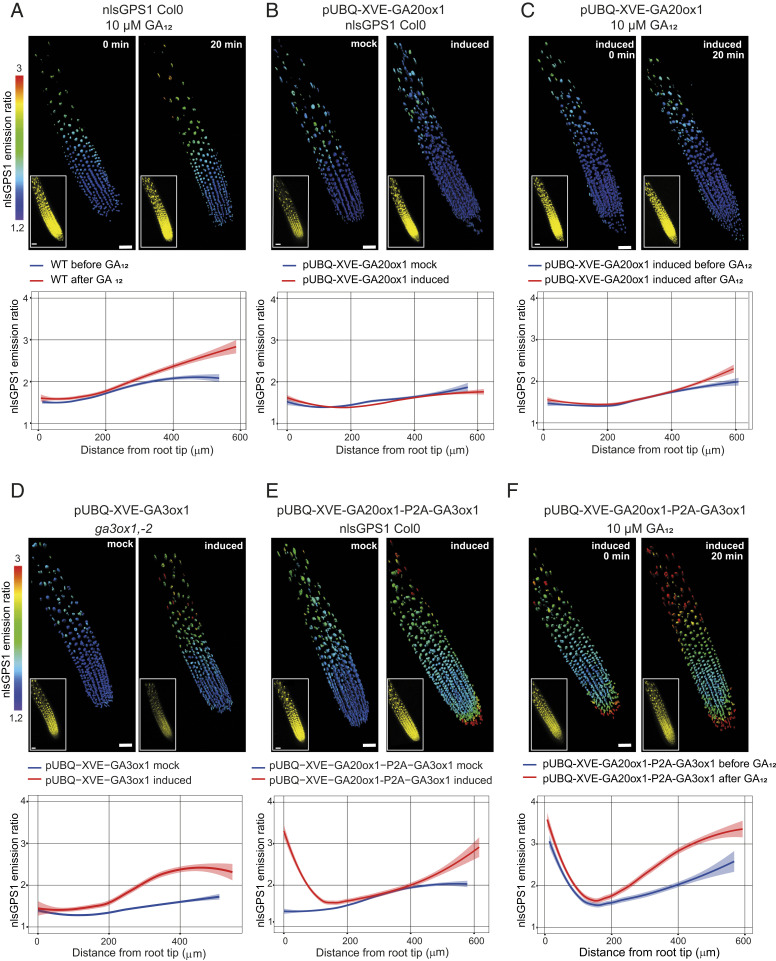
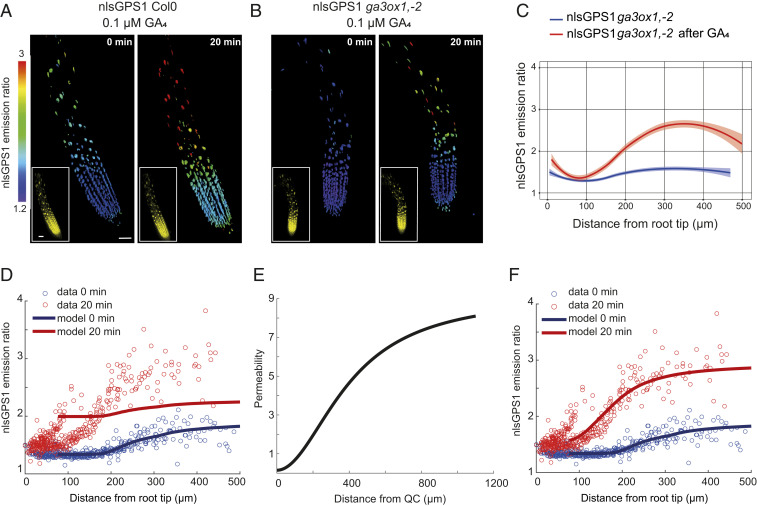
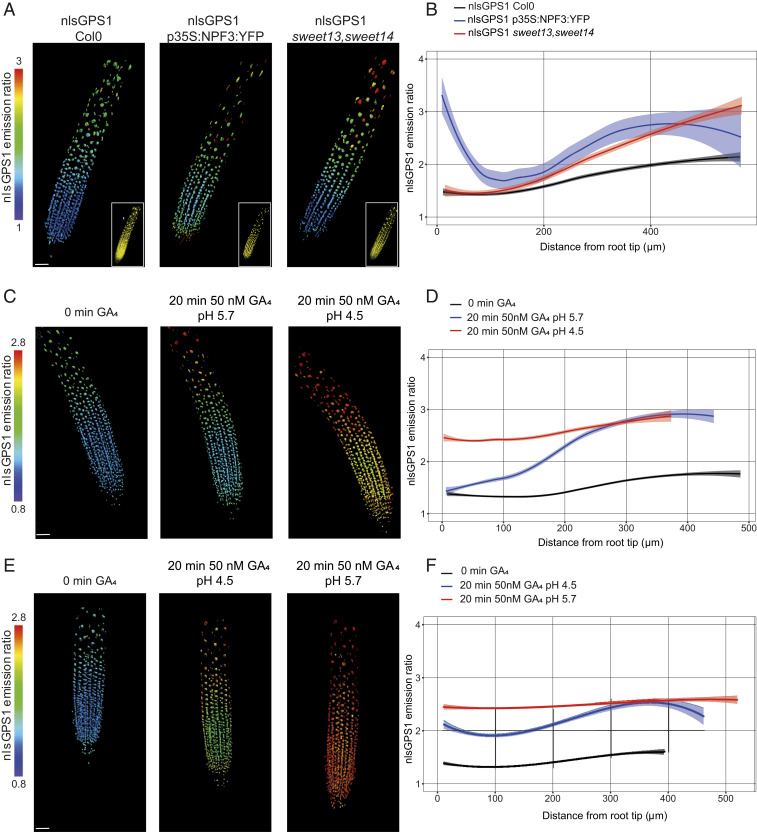
Control over cell growth by mobile regulators underlies much of eukaryotic morphogenesis. In plant roots, cell division and elongation are separated into distinct longitudinal zones and both division and elongation are influenced by the growth regulatory hormone gibberellin (GA). Previously, a multicellular mathematical model predicted a GA maximum at the border of the meristematic and elongation zones. However, GA in roots was recently measured using a genetically encoded fluorescent biosensor, nlsGPS1, and found to be low in the meristematic zone grading to a maximum at the end of the elongation zone. Furthermore, the accumulation rate of exogenous GA was also found to be higher in the elongation zone. It was still unknown which biochemical activities were responsible for these mobile small molecule gradients and whether the spatiotemporal correlation between GA levels and cell length is important for root cell division and elongation patterns. Using a mathematical modeling approach in combination with high-resolution GA measurements in vivo, we now show how differentials in several biosynthetic enzyme steps contribute to the endogenous GA gradient and how differential cellular permeability contributes to an accumulation gradient of exogenous GA. We also analyzed the effects of altered GA distribution in roots and did not find significant phenotypes resulting from increased GA levels or signaling. We did find a substantial temporal delay between complementation of GA distribution and cell division and elongation phenotypes in a GA deficient mutant. Together, our results provide models of how GA gradients are directed and in turn direct root growth.
移动调节剂对细胞生长的控制是真核形态发生的基础。在植物根中,细胞分裂和伸长被分隔成不同的纵向区域,分裂和伸长都受到生长调节激素赤霉素(GA)的影响。此前,一个多细胞数学模型预测在分生组织和伸长区的边界处存在 GA 最大值。然而,最近使用遗传编码荧光生物传感器 nlsGPS1 测量了根中的 GA,发现其在分生组织区的含量较低,在伸长区的末端达到最大值。此外,外源 GA 的积累率在伸长区也较高。目前尚不清楚哪些生化活性负责这些移动小分子梯度,以及 GA 水平与细胞长度之间的时空相关性是否对根细胞分裂和伸长模式很重要。我们现在使用数学建模方法结合体内高分辨率 GA 测量,展示了几种生物合成酶步骤的差异如何导致内源性 GA 梯度,以及细胞通透性的差异如何导致外源 GA 的积累梯度。我们还分析了改变根中 GA 分布的影响,并未发现由于 GA 水平或信号增加而导致明显的表型。我们确实发现 GA 分布和细胞分裂和伸长表型之间存在相当大的时间延迟,在 GA 缺陷突变体中。总之,我们的研究结果为 GA 梯度的定向提供了模型,并反过来指导根的生长。