Center for Health, Work & Environment, Colorado School of Public Health, University of Colorado, Aurora, CO, USA.
Department of Environmental and Occupational Health, Colorado School of Public Health, University of Colorado, Aurora, CO, USA.
J Expo Sci Environ Epidemiol. 2022 May;32(3):461-471. doi: 10.1038/s41370-021-00292-x. Epub 2021 Feb 18.
Exposure to environmental metals can cause nephrotoxicity. There is an international epidemic of chronic kidney disease of unknown cause (CKDu). Whether metal exposures contribute to kidney dysfunction in populations at risk for CKDu remains unresolved.
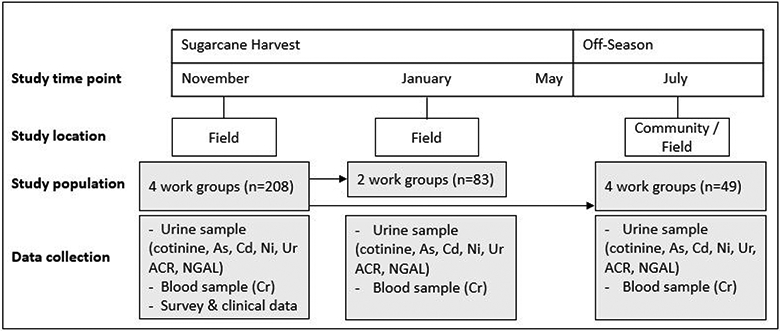
Urinary metals (arsenic, cadmium, nickel, and uranium) were examined in 222 sugarcane cutters in Guatemala at three time points over 1 year.
We explored the relationships between metal concentrations and markers of kidney function using multivariable linear mixed-effect models.
Arsenic, cadmium, and nickel were detected in the majority of the 340 urine samples and were generally within limits previously considered to be nonnephrotoxic. Nevertheless, higher urine cadmium was inversely associated with estimated glomerular filtration rate (eGFR) (β: -4.23, 95% confidence interval [CI]: -6.92, -1.54) and positively associated with neutrophil gelatinase-associated lipocalin (NGAL) (β: 2.92, 95% CI: 1.20, 4.64). Higher urine arsenic was also inversely associated with eGFR (β: -4.36, 95% CI: -7.07, -1.64).
Our findings suggest that exposures to metals, including cadmium and arsenic, might contribute to kidney toxicity seen in workers at risk for CKDu. These findings are consistent with the potential for metal nephrotoxicity at lower than expected levels in the setting of manual work in a very hot environment.
环境金属暴露可导致肾毒性。有一种原因不明的慢性肾病(CKDu)的国际流行。金属暴露是否会导致 CKDu 高危人群的肾功能障碍仍未解决。
在危地马拉的 222 名甘蔗切割工中,在一年的三个时间点上检查了尿液中的金属(砷、镉、镍和铀)。
我们使用多变量线性混合效应模型探索了金属浓度与肾功能标志物之间的关系。
在 340 个尿液样本中,大部分都检测到了砷、镉和镍,而且这些金属浓度通常在先前认为非肾毒性的范围内。然而,尿镉浓度越高,肾小球滤过率(eGFR)越低(β:-4.23,95%置信区间[CI]:-6.92,-1.54),中性粒细胞明胶酶相关脂质运载蛋白(NGAL)越高(β:2.92,95%CI:1.20,4.64)。尿砷浓度越高,eGFR 越低(β:-4.36,95%CI:-7.07,-1.64)。
我们的研究结果表明,包括镉和砷在内的金属暴露可能导致 CKDu 高危工人的肾毒性。这些发现与在非常热的环境中进行手工劳动时,金属肾毒性在低于预期水平的情况下发生的可能性一致。