Section of Tropical Medicine, Department of Pediatrics, Baylor College of Medicine and Texas Children's Hospital, Houston, TX, United States of America.
Department of Epidemiology & Biostatistics, School of Public Health, Texas A&M University, College Station, TX, United States of America.
PLoS One. 2020 Nov 10;15(11):e0240988. doi: 10.1371/journal.pone.0240988. eCollection 2020.
Although there are several hypothesized etiologies of Mesoamerican Nephropathy (MeN), evidence has not yet pointed to the underlying cause. Exposure to various trace elements can cause the clinical features observed in MeN.
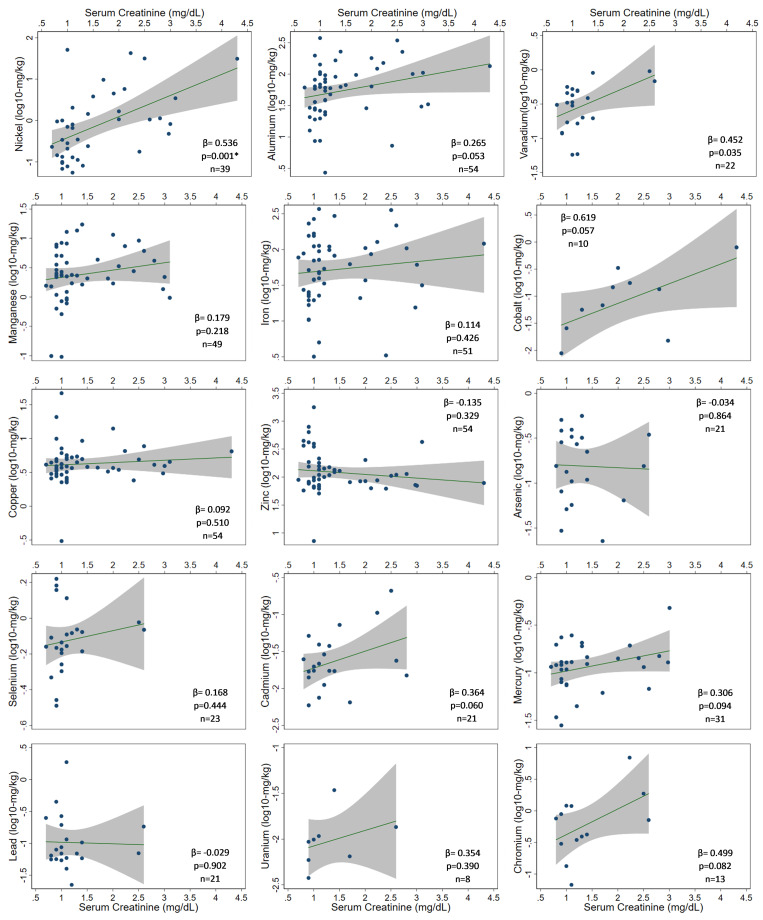
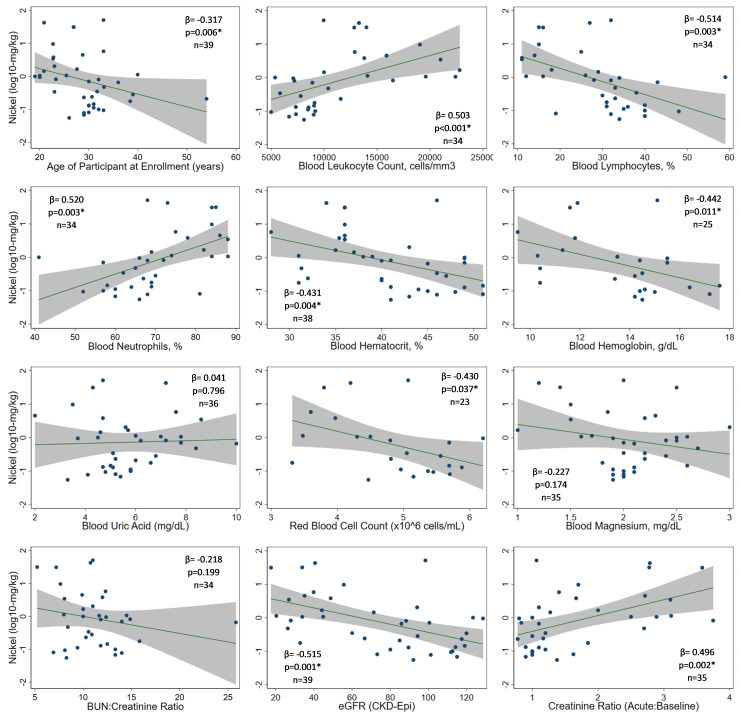
We measured 15 trace elements, including heavy metals, in renal case-patients (n = 18) and healthy controls (n = 36) in a MeN high-risk region of Nicaragua. Toenails clippings from study participants were analyzed using inductively coupled plasma mass spectrometry. A case-control analysis was performed, and concentrations were also analyzed over participant characteristics and clinical parameters. Nickel (Ni) concentrations were significantly higher in toenails from cases (1.554 mg/kg [0.176-42.647]) than controls (0.208 mg/kg [0.055-51.235]; p<0.001). Ni concentrations correlated positively with serum creatinine levels (p = 0.001) and negatively with eGFR (p = 0.001). Greater Ni exposure was also associated with higher leukocyte (p = 0.001) and neutrophil (p = 0.003) counts, fewer lymphocytes (p = 0.003), and lower hemoglobin (p = 0.004) and hematocrit (p = 0.011).
Low-dose, chronic environmental exposure to Ni is a possible health risk in this setting. Ni intoxication and resulting systemic and renal effects could explain the clinical signs observed during early MeN. This study provides compelling evidence for a role of Ni in the acute renal impairment observed in this MeN high-risk population. Additional work to assess exposure levels in a larger and heterogeneous population, identify environmental sources of Ni and exposure pathways, and evaluate the link between Ni and MeN pathogenesis are urgently needed.
虽然 Mesoamerican Nephropathy(MeN,中美洲肾病)有几种假说病因,但尚未有证据指向其根本原因。暴露于各种微量元素可导致 MeN 观察到的临床特征。
我们在尼加拉瓜 MeN 高危地区测量了 18 例肾病例患者(病例组)和 36 例健康对照者(对照组)的 15 种微量元素,包括重金属。使用电感耦合等离子体质谱法分析研究参与者的趾甲屑。进行病例对照分析,并根据参与者特征和临床参数分析浓度。病例组的趾甲镍(Ni)浓度明显高于对照组(1.554mg/kg [0.176-42.647] vs. 0.208mg/kg [0.055-51.235];p<0.001)。Ni 浓度与血清肌酐水平呈正相关(p=0.001),与 eGFR 呈负相关(p=0.001)。更高的 Ni 暴露还与更高的白细胞计数(p=0.001)和中性粒细胞计数(p=0.003)、更少的淋巴细胞计数(p=0.003)以及更低的血红蛋白(p=0.004)和红细胞压积(p=0.011)相关。
在这种情况下,低剂量、慢性环境暴露于 Ni 可能是一种健康风险。Ni 中毒及其导致的全身和肾脏影响可能可以解释 MeN 早期观察到的临床体征。本研究为 Ni 在 MeN 高危人群中观察到的急性肾损伤中的作用提供了有力证据。急需开展更多工作,以评估更大、更具异质性人群的暴露水平、确定 Ni 的环境来源和暴露途径,并评估 Ni 与 MeN 发病机制之间的联系。