Kindgren Erik, Quiñones Perez Antonia, Knez Rajna
Department of Pediatrics, Skaraborg Hospital, Skövde, Sweden.
Division of Pediatrics, Department of Biomedical and Clinical Sciences (BKV), Medical Faculty, Linköping University, Linköping, Sweden.
Neuropsychiatr Dis Treat. 2021 Feb 10;17:379-388. doi: 10.2147/NDT.S290494. eCollection 2021.
Hypermobility spectrum disorders (HSD) and hypermobile Ehlers-Danlos syndrome (hEDS) are both characterized by generalized hypermobility, in combination with pain, affected proprioception, and pronounced fatigue. Clinical observation indicates that behavioral problems, hyperactivity, and autistic traits are overrepresented in children with those conditions. The purpose of this retrospective study was to establish the prevalence of attention-deficit/hyperactivity disorder (ADHD) and autism spectrum disorder (ASD) among children with HSD and hEDS treated in our clinic since 2012.
Since Ehlers-Danlos syndrome (EDS) diagnostic criteria and international classification were changed in 2017, we equate the older diagnosis EDS hypermobility type with the newer hEDS and the older hypermobility syndrome with HSD. A registry search from the computerized medical record system found 201 children (88 boys, 113 girls) aged 6-18 years who were treated at our pediatrics department with the diagnoses HSD or EDS. All medical records (113 with HSD, 88 with EDS) were reviewed, and key symptoms such as fatigue and pain, as well as diagnosis of ADHD/ASD, were recorded.
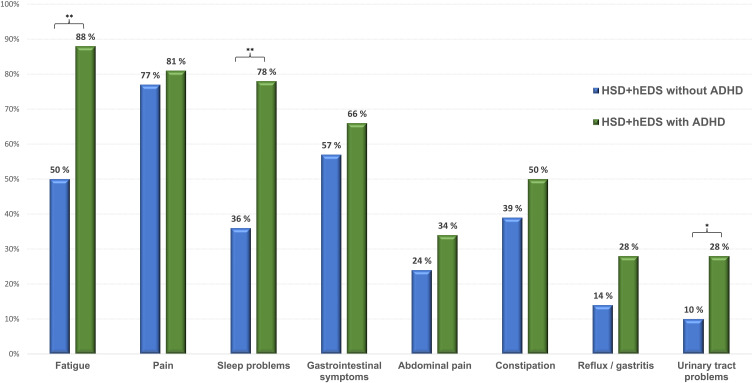
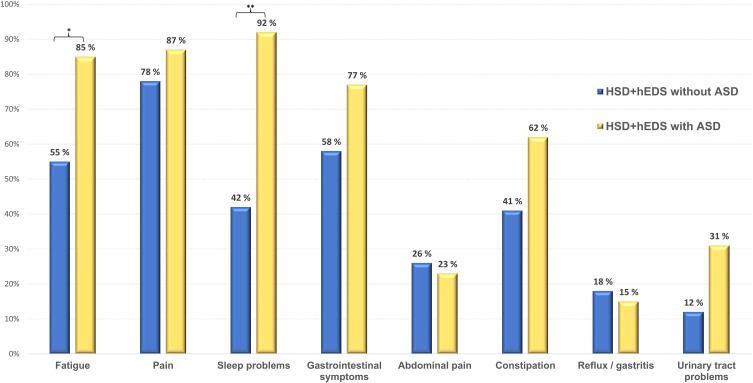
All EDS cases could be classified as hEDS. Of the entire study cohort, 16% had a verified ADHD diagnosis and a further 7% were undergoing ADHD diagnostic investigation. Significantly more children with hEDS had ADHD compared to children with HSD (p=0.02). In the age group 15-16 years, 35% of those with hEDS had ADHD and, among those aged 17-18 years, ADHD was present in 46%. Children with coexisting ADHD showed a significantly higher proportion of associated symptoms such as fatigue, sleep-problems, and urinary tract problems. ASD had been verified in 6% of the children. Of those with ASD, 92% had sleep problems.
This study shows a strong association between HSD or hEDS and ADHD or ASD. Therefore, children with HSD or hEDS may need to be routinely screened for neuropsychiatric symptoms.
关节活动过度谱系障碍(HSD)和活动过度型埃勒斯-当洛综合征(hEDS)均以全身关节活动过度为特征,并伴有疼痛、本体感觉受影响和明显疲劳。临床观察表明,行为问题、多动和自闭症特征在患有这些疾病的儿童中更为常见。这项回顾性研究的目的是确定自2012年以来在我们诊所接受治疗的HSD和hEDS儿童中注意力缺陷多动障碍(ADHD)和自闭症谱系障碍(ASD)的患病率。
由于2017年埃勒斯-当洛综合征(EDS)的诊断标准和国际分类发生了变化,我们将旧的EDS活动过度型诊断等同于新的hEDS,将旧的活动过度综合征等同于HSD。通过计算机化病历系统进行登记搜索,发现201名6至18岁的儿童(88名男孩,113名女孩)在我们儿科接受了HSD或EDS诊断治疗。查阅了所有病历(113例HSD,88例EDS),记录了疲劳和疼痛等关键症状以及ADHD/ASD的诊断情况。
所有EDS病例均可归类为hEDS。在整个研究队列中,16%的儿童确诊患有ADHD,另有7%的儿童正在接受ADHD诊断调查。与HSD儿童相比,hEDS儿童患ADHD的比例明显更高(p=0.02)。在15至16岁年龄组中,35%的hEDS儿童患有ADHD,在17至18岁年龄组中,46%的儿童患有ADHD。同时患有ADHD的儿童出现疲劳、睡眠问题和泌尿系统问题等相关症状的比例明显更高。6%的儿童确诊患有ASD。在患有ASD的儿童中,92%有睡眠问题。
本研究表明HSD或hEDS与ADHD或ASD之间存在密切关联。因此,可能需要对患有HSD或hEDS的儿童进行神经精神症状的常规筛查。