
群体感应调节的功能因丁香酚而减弱。 (你提供的原文“Quorum sensing-regulated functions of are reduced by eugenol.”中“of”后面缺少具体内容,以上译文是根据现有内容尽量完善后的翻译。)
Quorum sensing-regulated functions of are reduced by eugenol.
作者信息
Fekrirad Zahra, Gattali Basira, Kashef Nasim
机构信息
Department of Microbiology, School of Biology, College of Sciences, University of Tehran, Tehran, Iran.
出版信息
Iran J Microbiol. 2020 Oct;12(5):451-459. doi: 10.18502/ijm.v12i5.4607.
BACKGROUND AND OBJECTIVES
has emerged as a nosocomial pathogen responsible for human infections, where antibiotic resistance further complicates the treatments. In , biofilm formation and virulence factor production are controlled via quorum sensing (QS) system. QS is a signaling system that enables gene regulation to control diverse physiological functions in bacteria. Essential oils have shown to be potential in diminishing the pathogenicity and virulence of drug-resistant bacteria. This study was performed to determine whether eugenol would affect QS system, biofilm formation and virulence factor production of
MATERIALS AND METHODS
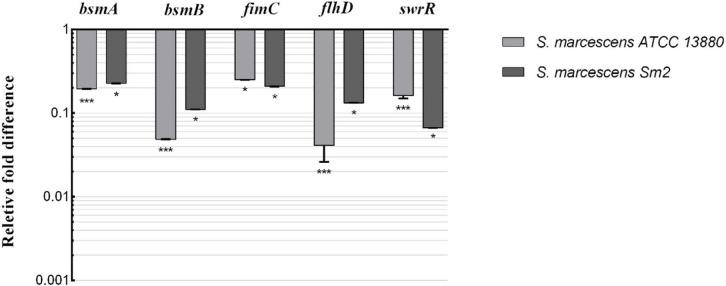
Biofilm formation, extracellular virulence factor production (hemolysin and protease), swarming motility and pigment formation of ATCC 13880 and Sm2 were assessed after eugenol exposure at 1.25 and 2.5 µg/ml concentrations. The expression of genes involved in motility , attachment , biofilm formation , and QS regulatory were also evaluated.
RESULTS
Eugenol treatment at 1.25 and 2.5 µg/ml concentrations caused a significant reduction in biofilm formation. The pigment, hemolysin and protease production of two studied strains, also reduced significantly by eugenol treatments (p<0.05). The and genes were down-regulated after eugenol treatment. The gene expression was also reduced significantly by eugenol in both strains (<0.05).
CONCLUSION
Eugenol inhibited quorum sensing-regulated functions of two studied strains.
背景与目的
已成为引起人类感染的医院病原体,抗生素耐药性使治疗更加复杂。在[具体内容缺失]中,生物膜形成和毒力因子产生通过群体感应(QS)系统控制。QS是一种信号系统,能使基因调控控制细菌的多种生理功能。精油已显示出降低耐药细菌致病性和毒力的潜力。本研究旨在确定丁香酚是否会影响[具体细菌名称缺失]的QS系统、生物膜形成和毒力因子产生。
材料与方法
在丁香酚以1.25和2.5μg/ml浓度处理后,评估[具体细菌名称缺失]ATCC 13880和[具体细菌名称缺失]Sm2的生物膜形成、细胞外毒力因子产生(溶血素和蛋白酶)、群集运动和色素形成。还评估了参与运动性、附着、生物膜形成和QS调控的基因表达。
结果
1.25和2.5μg/ml浓度的丁香酚处理导致生物膜形成显著减少。丁香酚处理也使两种研究的[具体细菌名称缺失]菌株的色素、溶血素和蛋白酶产生显著降低(p<0.05)。丁香酚处理后,[具体基因名称缺失]和[具体基因名称缺失]基因下调。丁香酚在两种[具体细菌名称缺失]菌株中也显著降低了[具体基因名称缺失]基因表达(<0.05)。
结论
丁香酚抑制了两种研究的[具体细菌名称缺失]菌株的群体感应调节功能。


 Zotero 插件