Nowicki Grzegorz Józef, Ślusarska Barbara, Prystupa Andrzej, Blicharska Eliza, Adamczuk Agnieszka, Czernecki Tomasz, Jankowski Krzysztof Jacek
Department of Family Medicine and Community Nursing, Medical University of Lublin, Lublin, Poland.
Department of Internal Medicine, Medical University of Lublin, Lublin, Poland.
Cardiol Res Pract. 2021 Jan 31;2021:9546358. doi: 10.1155/2021/9546358. eCollection 2021.
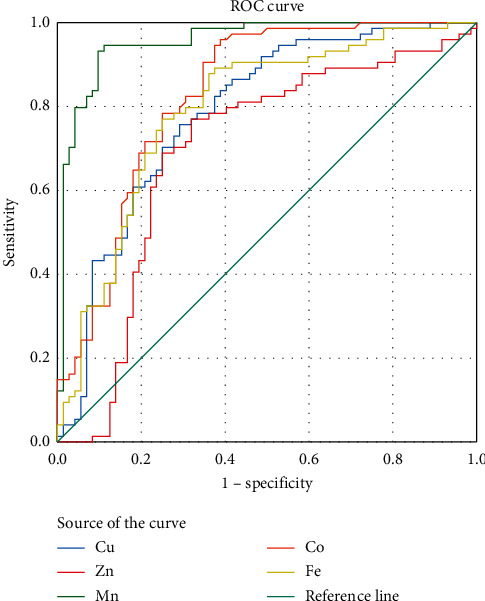
Cardiovascular diseases (CVDs) constitute the first cause of death among the population of developing and developed countries. Atherosclerosis, which is a disorder with multifactorial etiopathogenesis, underlies most CVDs. The available literature includes ample research studies on the influence of classic cardiovascular (CV) risk factors. However, environmental exposure to heavy metals, among other substances, is still an unappreciated risk factor of CVDs. This study aimed to assess the concentration of some heavy metals (copper (Cu), zinc (Zn), manganese (Mn), cobalt (Co), and iron (Fe)) in the blood serum of postmyocardial infarction (post-MI) patients and patients free from myocardial infarction (MI) as well as estimate the relationship between the occurrence of MI and increased concentration of heavy metals. The concentration of heavy metals (Cu, Zn, Mn, Co, and Fe) was assessed using the inductively coupled plasma mass spectrometry technique in a group of 146 respondents divided into two groups: post-MI group (study group (SG), = 74) and group without cardiovascular event (CVE) having a low CV risk (control group (CG), = 72). The concentration of the analyzed heavy metals was higher in SG. All the heavy metals showed a significant diagnostic value ( < 0.001). The highest value of area under the curve (AUC) was observed for manganese (Mn) (0.955; 95% confidence interval (CI) = 0.922-0.988), while the lowest value was found for zinc (Zn) (0.691; 95% CI = 0.599-0.782). In one-dimensional models, high concentrations of each of the analyzed heavy metals significantly increased the chances of having MI from 7-fold (Cu) to 128-fold (Mn). All the models containing a particular metal showed a significant and high discrimination value for MI occurrence (AUC 0.72-0.92). Higher concentrations of Cu, Zn, Mn, Co, and Fe were found to considerably increase the chances of having MI. Considering the increasingly higher environmental exposure to heavy metals in recent times, their concentrations can be distinguished as a potential risk factor of CVDs.
心血管疾病(CVDs)是发展中国家和发达国家人口死亡的首要原因。动脉粥样硬化是一种具有多因素病因发病机制的疾病,是大多数心血管疾病的基础。现有文献中有大量关于经典心血管(CV)危险因素影响的研究。然而,除其他物质外,环境中重金属暴露仍是心血管疾病一个未得到充分认识的危险因素。本研究旨在评估心肌梗死后(post-MI)患者和无心肌梗死(MI)患者血清中某些重金属(铜(Cu)、锌(Zn)、锰(Mn)、钴(Co)和铁(Fe))的浓度,并估计心肌梗死的发生与重金属浓度升高之间的关系。采用电感耦合等离子体质谱技术对146名受访者进行分组评估重金属(Cu、Zn、Mn、Co和Fe)的浓度,分为两组:心肌梗死后组(研究组(SG),n = 74)和无心血管事件(CVE)且心血管风险较低的组(对照组(CG),n = 72)。研究组中分析的重金属浓度较高。所有重金属均显示出显著的诊断价值(P < 0.001)。曲线下面积(AUC)最高值出现在锰(Mn)(0.955;95%置信区间(CI)= 0.922 - 0.988),而最低值出现在锌(Zn)(0.691;95% CI = 0.599 - 0.782)。在一维模型中,每种分析的重金属高浓度显著增加患心肌梗死的几率,从7倍(Cu)到128倍(Mn)。所有包含特定金属的模型对心肌梗死的发生均显示出显著且高的判别价值(AUC 0.72 - 0.92)。发现较高浓度的Cu、Zn、Mn、Co和Fe会显著增加患心肌梗死的几率。考虑到近年来环境中重金属暴露日益增加,其浓度可被视为心血管疾病的潜在危险因素。