Chowdhury Rajiv, Ramond Anna, O'Keeffe Linda M, Shahzad Sara, Kunutsor Setor K, Muka Taulant, Gregson John, Willeit Peter, Warnakula Samantha, Khan Hassan, Chowdhury Susmita, Gobin Reeta, Franco Oscar H, Di Angelantonio Emanuele
Department of Public Health and Primary Care, University of Cambridge, Strangeways Research Laboratory, Cambridge CB1 8RN, UK.
MRC Integrative Epidemiology Unit, University of Bristol, Bristol, UK.
BMJ. 2018 Aug 29;362:k3310. doi: 10.1136/bmj.k3310.
To conduct a systematic review and meta-analysis of epidemiological studies investigating the association of arsenic, lead, cadmium, mercury, and copper with cardiovascular disease.
Systematic review and meta-analysis.
PubMed, Embase, and Web of Science searched up to December 2017.
Studies reporting risk estimates for total cardiovascular disease, coronary heart disease, and stroke for levels of arsenic, lead, cadmium, mercury, or copper were included. Two investigators independently extracted information on study characteristics and outcomes in accordance with PRISMA and MOOSE guidelines. Relative risks were standardised to a common scale and pooled across studies for each marker using random effects meta-analyses.
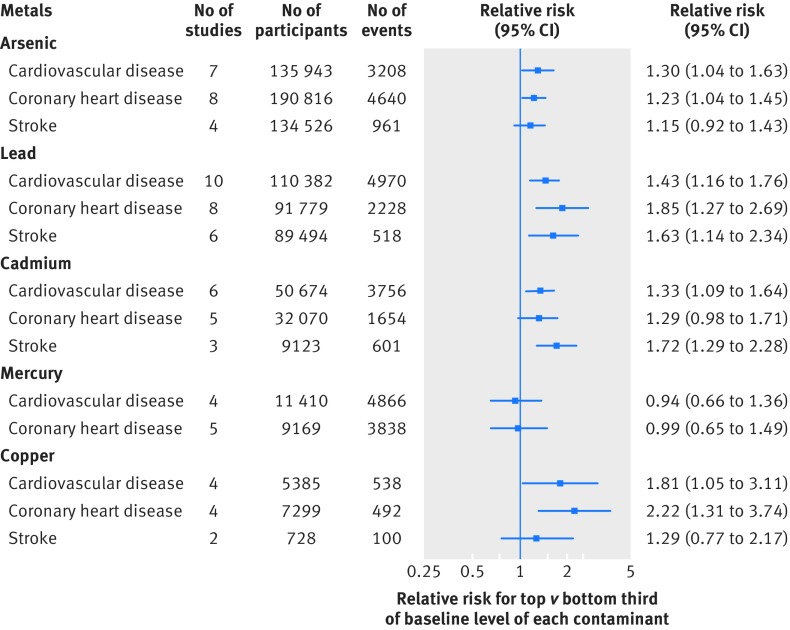
The review identified 37 unique studies comprising 348 259 non-overlapping participants, with 13 033 coronary heart disease, 4205 stroke, and 15 274 cardiovascular disease outcomes in aggregate. Comparing top versus bottom thirds of baseline levels, pooled relative risks for arsenic and lead were 1.30 (95% confidence interval 1.04 to 1.63) and 1.43 (1.16 to 1.76) for cardiovascular disease, 1.23 (1.04 to 1.45) and 1.85 (1.27 to 2.69) for coronary heart disease, and 1.15 (0.92 to 1.43) and 1.63 (1.14 to 2.34) for stroke. Relative risks for cadmium and copper were 1.33 (1.09 to 1.64) and 1.81 (1.05 to 3.11) for cardiovascular disease, 1.29 (0.98 to 1.71) and 2.22 (1.31 to 3.74) for coronary heart disease, and 1.72 (1.29 to 2.28) and 1.29 (0.77 to 2.17) for stroke. Mercury had no distinctive association with cardiovascular outcomes. There was a linear dose-response relation for arsenic, lead, and cadmium with cardiovascular disease outcomes.
Exposure to arsenic, lead, cadmium, and copper is associated with an increased risk of cardiovascular disease and coronary heart disease. Mercury is not associated with cardiovascular risk. These findings reinforce the importance of environmental toxic metals in cardiovascular risk, beyond the roles of conventional behavioural risk factors.
对调查砷、铅、镉、汞和铜与心血管疾病之间关联的流行病学研究进行系统评价和荟萃分析。
系统评价和荟萃分析。
截至2017年12月检索PubMed、Embase和Web of Science。
纳入报告了砷、铅、镉、汞或铜水平与总心血管疾病、冠心病和中风风险估计值的研究。两名研究者根据PRISMA和MOOSE指南独立提取有关研究特征和结果的信息。将相对风险标准化至共同尺度,并使用随机效应荟萃分析对每个标志物的研究进行汇总。
该综述确定了37项独特研究,包括348259名无重叠参与者,总计有13033例冠心病、4205例中风和15274例心血管疾病结果。比较基线水平的上三分之一与下三分之一,砷和铅导致心血管疾病的汇总相对风险分别为1.30(95%置信区间1.04至1.63)和1.43(1.16至1.76),导致冠心病的分别为1.23(1.04至1.45)和1.85(1.27至2.69),导致中风的分别为1.15(0.92至1.43)和1.63(1.14至2.34)。镉和铜导致心血管疾病的相对风险分别为1.33(1.09至1.64)和1.81(1.05至3.11),导致冠心病的分别为1.29(0.98至1.7"1)和2.22(1.31至3.74),导致中风的分别为1.72(1.29至2.28)和1.29(0.77至2.17)。汞与心血管疾病结果无明显关联。砷、铅和镉与心血管疾病结果呈线性剂量反应关系。
接触砷、铅、镉和铜会增加患心血管疾病和冠心病的风险。汞与心血管风险无关。这些发现强化了环境有毒金属在心血管风险中的重要性,其重要性超出了传统行为风险因素的作用。