Leonard Kelly A, Simon Janet E, Yom Jae, Grooms Dustin R
Nationwide Children's Hospital.
Ohio University.
Int J Sports Phys Ther. 2021 Feb 1;16(1):96-105. doi: 10.26603/001c.18717.
Anterior Cruciate Ligament (ACL) injury prevention interventions have used trained experts to ensure quality feedback. Dyad (peer) feedback may be a more cost-effective method to deliver feedback to athletes.
To determine the immediate effects of dyad versus expert feedback on drop landing kinematics and kinetics in female athletes.
Cohort study.
College gymnasium.
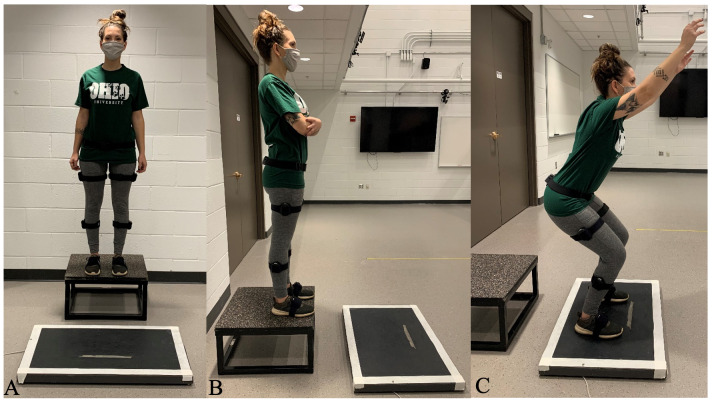
Two teams (one female basketball and one female volleyball), from a local college, were team randomized to dyad feedback (volleyball team) or expert feedback (basketball team) (13 expert, 19±0.87years, 1.7±0.09m, 68.04±7.21kg) (10 dyad 19.4±1.07years, 1.73±0.08m, 72.18±11.23kg). Participants completed drop vertical jumps at two different time points (pre- and post-feedback). Knee flexion and abduction displacement were assessed with Inertial Measurement Units (IMUs) and vertical ground reaction force (vGRF) was assessed with a force plate during the landing phase of the drop vertical jump and compared across groups and condition (pre- and post-feedback) with a repeated measures ANCOVA α <0.02 was set for multiple tests conducted.
There were no significant differences between groups for flexion displacement. There was a significant change pre- to post- (decrease 4.65˚ p=0.01) in abduction displacement, with no group effect. There was a significant interaction of group by condition (p=0.01) for vGRF with no difference between groups before feedback (p>0.05). Between groups there was a decrease of vGRF in the expert group (difference 0.45 Nbw-1, p=0.01) at post-feedback relative to dyad. Within the expert group there was a significant difference between pre- and post-feedback (difference 0.72 Nbw-1, p=0.01), while the dyad group did not change pre- to post-feedback (difference 0.18 N*bw-1, p=0.67).
Movement screening experts giving real-time feedback were successful in improving key injury-risk kinematics and kinetics in female athletes, while dyad feedback only improved kinematics, indicating that expert feedback may be needed to ensure changes in kinematics and kinetics.
前交叉韧带(ACL)损伤预防干预措施一直依靠训练有素的专家来确保提供高质量的反馈。同伴(双人)反馈可能是一种向运动员提供反馈的更具成本效益的方法。
确定同伴反馈与专家反馈对女性运动员落地动作运动学和动力学的即时影响。
队列研究。
大学体育馆。
来自当地一所大学的两支队伍(一支女子篮球队和一支女子排球队)被随机分为同伴反馈组(排球队)或专家反馈组(篮球队)(专家组13人,年龄19±0.87岁,身高1.7±0.09米,体重68.04±7.21千克)(同伴组10人,年龄19.4±1.07岁,身高1.73±0.08米,体重72.18±11.23千克)。参与者在两个不同时间点(反馈前和反馈后)完成纵跳落地动作。在纵跳落地阶段,使用惯性测量单元(IMU)评估膝关节屈曲和外展位移,使用测力台评估垂直地面反作用力(vGRF),并通过重复测量协方差分析对组间和条件(反馈前和反馈后)进行比较,设定α<0.02用于进行多次检验。
两组在屈曲位移方面无显著差异。外展位移在反馈前到反馈后有显著变化(减少4.65˚,p = 0.01),且无组间效应。对于vGRF,组与条件之间存在显著交互作用(p = 0.01),反馈前两组之间无差异(p>0.05)。在反馈后,专家组的vGRF相对于同伴组有所下降(差异为0.45 Nbw-1,p = 0.01)。在专家组内,反馈前和反馈后存在显著差异(差异为0.72 Nbw-1,p = 0.01),而同伴组在反馈前到反馈后没有变化(差异为0.18 N*bw-1,p = 0.67)。
提供实时反馈的运动筛查专家成功改善了女性运动员关键的损伤风险运动学和动力学指标,而同伴反馈仅改善了运动学指标,这表明可能需要专家反馈来确保运动学和动力学的改变。
2级。