Singh Harjiv, Gokeler Alli, Benjaminse Anne
Kinesiology and Nutrition Sciences, University of Nevada Las Vegas.
Department Exercise & Health, Exercise Science and Neuroscience, University of Paderborn; Department of Public and Occupational Health, Amsterdam Movement Sciences, VU University Medical Center; OCON Centre of Orthopaedic Surgery and Sports Medicine.
Int J Sports Phys Ther. 2021 Dec 2;16(6):1575-1585. doi: 10.26603/001c.29848. eCollection 2021.
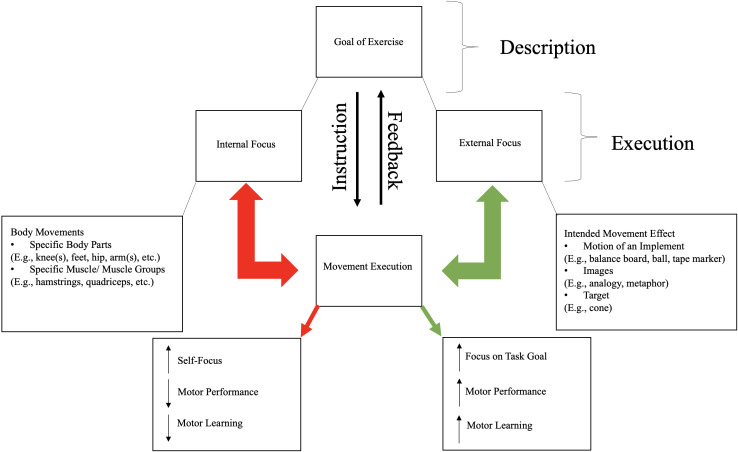
Individuals after anterior cruciate ligament reconstruction (ACLR) have a high rate of reinjury upon return to competitive sports. Deficits in motor control may influence reinjury risk and can be addressed during rehabilitation with motor learning strategies. When instructing patients in performing motor tasks after ACLR, an external focus of attention directed to the intended movement effect has been shown to be more effective in reducing reinjury risk than an internal focus of attention on body movements. While this concept is mostly agreed upon, recent literature has made it clear that the interpretation and implementation of an external focus of attention within ACLR rehabilitation needs to be better described. The purpose of this commentary is to provide a clinical framework for the application of attentional focus strategies and guide clinicians towards effectively utilizing an external focus of attention in rehabilitation after ACLR.
前交叉韧带重建(ACLR)后的个体在恢复竞技运动时再次受伤的发生率很高。运动控制缺陷可能会影响再次受伤的风险,并且可以在康复过程中通过运动学习策略加以解决。在指导ACLR术后患者执行运动任务时,与关注身体动作的内部注意力焦点相比,将外部注意力焦点指向预期的运动效果已被证明在降低再次受伤风险方面更有效。虽然这一概念已得到广泛认可,但最近的文献表明,ACLR康复中外部注意力焦点的解释和实施需要更明确的描述。本评论的目的是提供一个应用注意力焦点策略的临床框架,并指导临床医生在ACLR术后康复中有效利用外部注意力焦点。
5级。