• 文献检索
  • 文档翻译
  • 深度研究
  • 学术资讯
  • Suppr Zotero 插件Zotero 插件
  • 邀请有礼
  • 套餐&价格
  • 历史记录
应用&插件
Suppr Zotero 插件Zotero 插件浏览器插件Mac 客户端Windows 客户端微信小程序
定价
高级版会员购买积分包购买API积分包
服务
文献检索文档翻译深度研究API 文档MCP 服务
关于我们
关于 Suppr公司介绍联系我们用户协议隐私条款
关注我们

Suppr 超能文献

核心技术专利:CN118964589B侵权必究
粤ICP备2023148730 号-1Suppr @ 2026

文献检索

告别复杂PubMed语法,用中文像聊天一样搜索,搜遍4000万医学文献。AI智能推荐,让科研检索更轻松。

立即免费搜索

文件翻译

保留排版,准确专业,支持PDF/Word/PPT等文件格式,支持 12+语言互译。

免费翻译文档

深度研究

AI帮你快速写综述,25分钟生成高质量综述,智能提取关键信息,辅助科研写作。

立即免费体验

食物过敏高危婴儿预测模型的开发。

Development of a prediction model for infants at high risk of food allergy.

作者信息

Sugiura Shiro, Hiramitsu Yoshimichi, Futamura Masaki, Kamioka Naomi, Yamaguchi Chikae, Umemura Harue, Ito Komei, Camargo Carlos A

机构信息

Committee for the Prevention of Pediatric Allergic Disease, Nagoya City, Japan.

Harvard T.H. Chan School of Public Health, Boston, MA, USA.

出版信息

Asia Pac Allergy. 2021 Jan 22;11(1):e5. doi: 10.5415/apallergy.2021.11.e5. eCollection 2021 Jan.

DOI:10.5415/apallergy.2021.11.e5
PMID:33604275
原文链接:https://pmc.ncbi.nlm.nih.gov/articles/PMC7870367/
Abstract

BACKGROUND

Identification of risk factors for food allergy (FA) in infants is an active research area. An important reason is to identify optimal target infants for early introduction of specific food antigens. Although eczema has been used for this purpose, multivariable prediction scores have not been reported.

OBJECTIVE

The aim of this research is to develop a multivariable prediction score for infants at high risk of FA.

METHODS

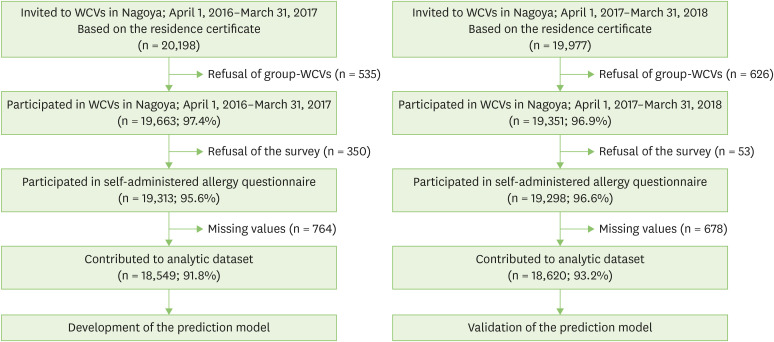
We performed a cross-sectional analysis of a self-administered questionnaire for the parents of 18-month-old children at well-child visits between April 2016 and March 2017 (development dataset) and between April 2017 and March 2018 (validation dataset). We developed and validated the prediction score.

RESULTS

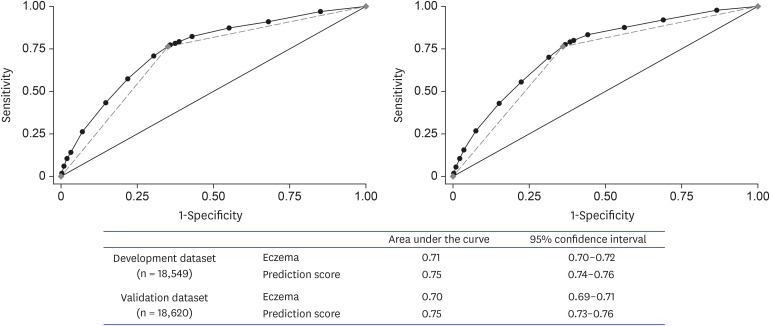
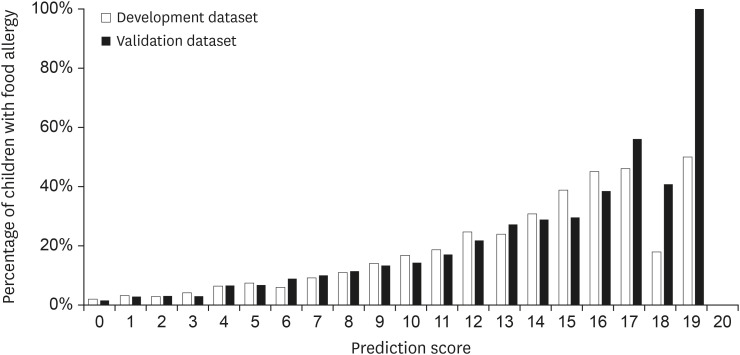
The questionnaire collection rate was 18,549 of 20,198 (92%) in the development dataset and 18,620 of 19,977 (93%) in the validation dataset. Risk factors for FA were being born in August-December, first child, eczema, atopic dermatitis in father and mother, and FA in mother and sibling(s). For identifying infants with FA, the developed multivariable prediction score showed higher discrimination ability (area under the curve [AUC] = 0.75) than focusing on eczema (AUC = 0.70) in the validation dataset. The score was also useful for identifying infants with a history of anaphylaxis (AUC = 0.73) than focusing on eczema (AUC = 0.67) in the validation dataset.

CONCLUSION

The new prediction score enables more efficient identification of infants at high risk of FA, who may be the optimal target group for the early introduction of specific antigens.

摘要

背景

识别婴儿食物过敏(FA)的风险因素是一个活跃的研究领域。一个重要原因是确定早期引入特定食物抗原的最佳目标婴儿。虽然湿疹已被用于此目的,但多变量预测评分尚未见报道。

目的

本研究旨在为FA高危婴儿开发一种多变量预测评分。

方法

我们对2016年4月至2017年3月(开发数据集)以及2017年4月至2018年3月(验证数据集)健康儿童访视时18个月大儿童的父母自行填写的问卷进行了横断面分析。我们开发并验证了预测评分。

结果

开发数据集中问卷收集率为20198份中的18549份(92%),验证数据集中为19977份中的18620份(93%)。FA的风险因素包括8 - 12月出生、头胎、湿疹、父母患有特应性皮炎以及母亲和兄弟姐妹患有FA。在验证数据集中,对于识别FA婴儿,所开发的多变量预测评分显示出比单纯关注湿疹更高的辨别能力(曲线下面积[AUC]=0.75)(AUC = 0.70)。在验证数据集中,该评分对于识别有过敏反应史的婴儿也比单纯关注湿疹更有用(AUC = 0.73)(AUC = 0.67)。

结论

新的预测评分能够更有效地识别FA高危婴儿,这些婴儿可能是早期引入特定抗原的最佳目标群体。
https://cdn.ncbi.nlm.nih.gov/pmc/blobs/4285/7870367/514df1a84f70/apa-11-e5-g003.jpg
https://cdn.ncbi.nlm.nih.gov/pmc/blobs/4285/7870367/371a7d6b37e8/apa-11-e5-g001.jpg
https://cdn.ncbi.nlm.nih.gov/pmc/blobs/4285/7870367/2edf46ce12d8/apa-11-e5-g002.jpg
https://cdn.ncbi.nlm.nih.gov/pmc/blobs/4285/7870367/514df1a84f70/apa-11-e5-g003.jpg
https://cdn.ncbi.nlm.nih.gov/pmc/blobs/4285/7870367/371a7d6b37e8/apa-11-e5-g001.jpg
https://cdn.ncbi.nlm.nih.gov/pmc/blobs/4285/7870367/2edf46ce12d8/apa-11-e5-g002.jpg
https://cdn.ncbi.nlm.nih.gov/pmc/blobs/4285/7870367/514df1a84f70/apa-11-e5-g003.jpg

相似文献

1
Development of a prediction model for infants at high risk of food allergy.食物过敏高危婴儿预测模型的开发。
Asia Pac Allergy. 2021 Jan 22;11(1):e5. doi: 10.5415/apallergy.2021.11.e5. eCollection 2021 Jan.
2
Estimating the prevalence of aero-allergy and/or food allergy in infants, children and young people with moderate-to-severe atopic eczema/dermatitis in primary care: multi-centre, cross-sectional study.在初级保健中对患有中重度特应性湿疹/皮炎的婴儿、儿童和年轻人进行气源性过敏和/或食物过敏患病率的评估:多中心横断面研究。
J R Soc Med. 2015 Jun;108(6):229-36. doi: 10.1177/0141076814562982. Epub 2015 Jan 7.
3
Food allergy and anaphylaxis in infants and preschool-age children.婴幼儿及学龄前儿童的食物过敏和过敏反应
Clin Pediatr (Phila). 2014 Jun;53(7):652-7. doi: 10.1177/0009922814527502. Epub 2014 Mar 18.
4
Prevalence of parent-reported immediate hypersensitivity food allergy in Chilean school-aged children.智利学龄儿童中家长报告的速发型超敏反应性食物过敏患病率。
Allergol Immunopathol (Madr). 2014 Nov-Dec;42(6):527-32. doi: 10.1016/j.aller.2013.09.006. Epub 2014 Jan 2.
5
Development of a prediction model of severe reaction in boiled egg challenges.煮鸡蛋挑战中严重反应的预测模型的建立。
Allergol Int. 2016 Jul;65(3):293-9. doi: 10.1016/j.alit.2016.01.005. Epub 2016 Feb 26.
6
Skin barrier impairment at birth predicts food allergy at 2 years of age.出生时皮肤屏障受损可预测 2 岁时的食物过敏。
J Allergy Clin Immunol. 2016 Apr;137(4):1111-1116.e8. doi: 10.1016/j.jaci.2015.12.1312.
7
Predicting food allergy: The value of patient history reinforced.预测食物过敏:患者病史的价值得到增强。
Allergy. 2021 May;76(5):1454-1462. doi: 10.1111/all.14583. Epub 2020 Sep 24.
8
Use of partially hydrolysed formula in infancy and incidence of eczema, respiratory symptoms or food allergies in toddlers from the ELFE cohort.婴儿时期使用部分水解配方与幼儿特应性皮炎、呼吸道症状或食物过敏的相关性:ELFE 队列研究。
Pediatr Allergy Immunol. 2019 Sep;30(6):614-623. doi: 10.1111/pai.13094. Epub 2019 Jul 24.
9
Two-step egg introduction for prevention of egg allergy in high-risk infants with eczema (PETIT): a randomised, double-blind, placebo-controlled trial.两步法鸡蛋引入预防湿疹高风险婴儿鸡蛋过敏(PETIT):一项随机、双盲、安慰剂对照试验。
Lancet. 2017 Jan 21;389(10066):276-286. doi: 10.1016/S0140-6736(16)31418-0. Epub 2016 Dec 9.
10
Parent-reported prevalence of food allergy in Mexican schoolchildren: A population-based study.家长报告的墨西哥学龄儿童食物过敏患病率:一项基于人群的研究。
Allergol Immunopathol (Madr). 2016 Nov-Dec;44(6):563-570. doi: 10.1016/j.aller.2016.03.003. Epub 2016 Jul 27.

引用本文的文献

1
Artificial intelligence in pediatric allergy research.人工智能在儿科过敏研究中的应用
Eur J Pediatr. 2024 Dec 21;184(1):98. doi: 10.1007/s00431-024-05925-5.
2
Redefining the Role of Nutrition in Infant Food Allergy Prevention: A Narrative Review.重新定义营养在婴儿食物过敏预防中的作用:叙事性综述。
Nutrients. 2024 Mar 14;16(6):838. doi: 10.3390/nu16060838.

本文引用的文献

1
The health and economic outcomes of early egg introduction strategies.早期引入鸡蛋策略的健康和经济结果。
Allergy. 2018 Nov;73(11):2214-2223. doi: 10.1111/all.13565.
2
"To screen or not to screen": Comparing the health and economic benefits of early peanut introduction strategies in five countries.“筛查还是不筛查”:比较五个国家早期引入花生策略的健康和经济效益。
Allergy. 2018 Aug;73(8):1707-1714. doi: 10.1111/all.13446. Epub 2018 May 24.
3
Birth order and paediatric allergic disease: A nationwide longitudinal survey.出生顺序与儿科过敏性疾病:一项全国性纵向调查。
Clin Exp Allergy. 2018 May;48(5):577-585. doi: 10.1111/cea.13100. Epub 2018 Feb 27.
4
Vitamin D deficiency exacerbates sensitization and allergic diarrhea in a murine food allergy model.维生素D缺乏会加剧小鼠食物过敏模型中的致敏作用和过敏性腹泻。
Allergol Int. 2018 Apr;67(2):289-291. doi: 10.1016/j.alit.2017.08.010. Epub 2017 Sep 19.
5
Development of a prediction model for severe wheat allergy.严重小麦过敏预测模型的开发。
Pediatr Allergy Immunol. 2018 Feb;29(1):93-96. doi: 10.1111/pai.12806. Epub 2017 Oct 5.
6
Addendum guidelines for the prevention of peanut allergy in the United States: Report of the National Institute of Allergy and Infectious Diseases-sponsored expert panel.美国预防花生过敏补充指南:美国国立过敏与传染病研究所资助的专家小组报告
J Allergy Clin Immunol. 2017 Jan;139(1):29-44. doi: 10.1016/j.jaci.2016.10.010.
7
Development of a prediction model for a severe reaction in cow's milk challenges.牛奶激发试验中严重反应预测模型的开发。
Allergol Int. 2017 Jul;66(3):493-494. doi: 10.1016/j.alit.2016.11.005. Epub 2016 Dec 23.
8
Two-step egg introduction for prevention of egg allergy in high-risk infants with eczema (PETIT): a randomised, double-blind, placebo-controlled trial.两步法鸡蛋引入预防湿疹高风险婴儿鸡蛋过敏(PETIT):一项随机、双盲、安慰剂对照试验。
Lancet. 2017 Jan 21;389(10066):276-286. doi: 10.1016/S0140-6736(16)31418-0. Epub 2016 Dec 9.
9
Maternal dietary folate, folic acid and vitamin D intakes during pregnancy and lactation and the risk of cows' milk allergy in the offspring.孕期和哺乳期母亲的膳食叶酸、叶酸和维生素D摄入量与后代患牛奶过敏的风险
Br J Nutr. 2016 Aug;116(4):710-8. doi: 10.1017/S0007114516002464. Epub 2016 Jun 28.
10
Understanding the feasibility and implications of implementing early peanut introduction for prevention of peanut allergy.了解实施早期花生引入预防花生过敏的可行性和影响。
J Allergy Clin Immunol. 2016 Oct;138(4):1131-1141.e2. doi: 10.1016/j.jaci.2016.04.011. Epub 2016 May 2.