Bogdan Christian
Mikrobiologisches Institut - klinische Mikrobiologie, Immunologie und Hygiene, Universitätsklinikum Erlangen and Friedrich-Alexander-Universität (FAU) Erlangen-Nürnberg, D-91054 Erlangen, Germany.
Medical Immunology Campus Erlangen, FAU Erlangen-Nürnberg, D-91054 Erlangen, Germany.
Cytokine X. 2020 Oct 12;2(4):100041. doi: 10.1016/j.cytox.2020.100041. eCollection 2020 Dec.
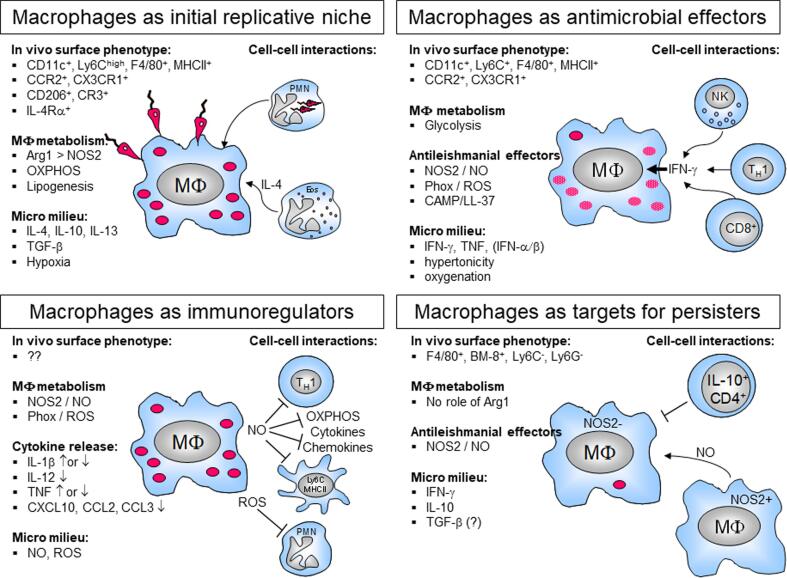
are protozoan parasites that predominantly reside in myeloid cells within their mammalian hosts. Monocytes and macrophages play a central role in the pathogenesis of all forms of leishmaniasis, including cutaneous and visceral leishmaniasis. The present review will highlight the diverse roles of macrophages in leishmaniasis as initial replicative niche, antimicrobial effectors, immunoregulators and as safe hideaway for parasites persisting after clinical cure. These multiplex activities are either ascribed to defined subpopulations of macrophages (e.g., Ly6CCCR2 inflammatory monocytes/monocyte-derived dendritic cells) or result from different activation statuses of tissue macrophages (e.g., macrophages carrying markers of of classical [M1] or alternative activation [M2]). The latter are shaped by immune- and stromal cell-derived cytokines (e.g., IFN-γ, IL-4, IL-10, TGF-β), micro milieu factors (e.g., hypoxia, tonicity, amino acid availability), host cell-derived enzymes, secretory products and metabolites (e.g., heme oxygenase-1, arginase 1, indoleamine 2,3-dioxygenase, NOS2/NO, NOX2/ROS, lipids) as well as by parasite products (e.g., leishmanolysin/gp63, lipophosphoglycan). Exciting avenues of current research address the transcriptional, epigenetic and translational reprogramming of macrophages in a species- and tissue context-dependent manner.
是原生动物寄生虫,主要寄居于其哺乳动物宿主的髓细胞内。单核细胞和巨噬细胞在包括皮肤利什曼病和内脏利什曼病在内的所有形式利什曼病的发病机制中起核心作用。本综述将重点介绍巨噬细胞在利什曼病中的多种作用,如作为初始复制微环境、抗菌效应器、免疫调节因子以及临床治愈后持续存在的寄生虫的安全藏身之处。这些多重活动要么归因于巨噬细胞的特定亚群(如Ly6CCCR2炎性单核细胞/单核细胞衍生的树突状细胞),要么源于组织巨噬细胞的不同激活状态(如携带经典[M1]或替代激活[M2]标志物的巨噬细胞)。后者由免疫细胞和基质细胞衍生的细胞因子(如IFN-γ、IL-4、IL-10、TGF-β)、微环境因素(如缺氧、张力、氨基酸可用性)、宿主细胞衍生的酶、分泌产物和代谢物(如血红素加氧酶-1、精氨酸酶1、吲哚胺2,3-双加氧酶、NOS2/NO、NOX2/ROS、脂质)以及寄生虫产物(如利什曼溶素/gp63、脂磷壁酸聚糖)塑造。当前研究令人兴奋的方向是以物种和组织背景依赖的方式探讨巨噬细胞的转录、表观遗传和翻译重编程。