Silvia Sommariva, MPA, MSc, and Jenna Mote, MPH, are Consultants, Communication for Development (C4D), United Nations Children's Fund (UNICEF) Eastern and Southern Africa Regional Office, New York, NY. Helena Ballester Bon, MA, and Massimiliano Sani, MA, are Specialists, C4D, UNICEF Eastern and Southern Africa Regional Office, Nairobi, Kenya. Herisoa Razafindraibe, MRes, is a Specialist and Domoina Ratovozanany, MA, is an Officer, C4D, UNICEF Madagascar Country Office, Antananarivo, Madagascar. Vanou Rasoamanana, MA, is a Specialist, C4D, UNICEF Comoros Country Office, Moroni, Comoros. Surangani Abeyesekera, PG, is a Manager, C4D, UNICEF Kenya Country Office, Nairobi, Kenya. Parvina Muhamedkhojaeva, PhD, is a Manager, C4D, UNICEF Malawi Country Office, Lilongwe, Malawi. Tasmia Bashar, MSc, MA, is a Specialist, C4D; and John James, MSc, is Chief, Communications; both in the UNICEF Zambia Country Office, Lusaka, Zambia.
Health Secur. 2021 Jan-Feb;19(1):57-64. doi: 10.1089/hs.2020.0226.
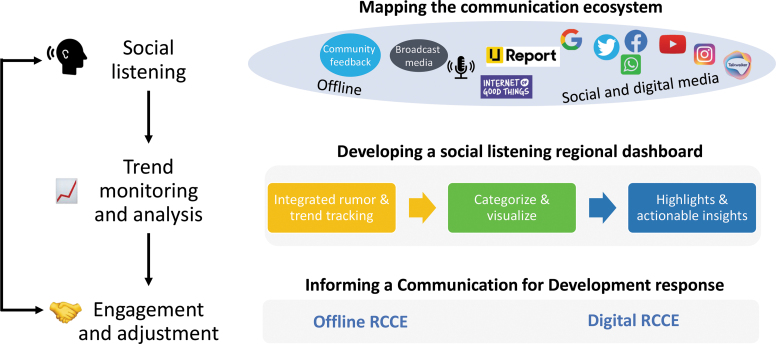
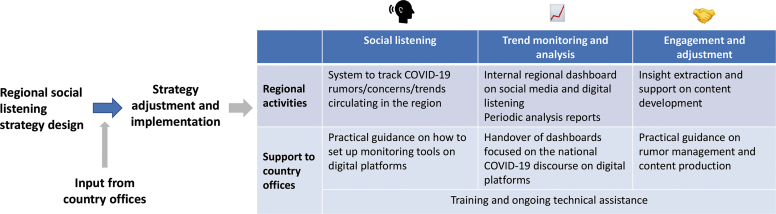
The coronavirus disease 2019 (COVID-19) pandemic has been closely tied with what has been called an infodemic, a "second disease" that occurs when massive information volumes (particularly with a high prevalence of false information) hinder the public health response. In this context, social listening, the process of monitoring and analyzing conversations to inform strategic activities both online and offline, becomes an even more essential component of risk communication and engagement strategies. In the Eastern and Southern Africa region, the United Nations Children's Fund (UNICEF) and partners in the response have activated their capacity to gather insights on the information needs of the populations served to better inform and engage with local communities. We describe the social listening approach taken at the Eastern and Southern Africa regional level to respond to COVID-19 and highlight efforts by the Comoros, Kenya, Madagascar, Malawi, and Zambia UNICEF country offices to implement digital and nondigital social listening to inform risk communication and community engagement. The analysis highlights channels leveraged, types of data monitored, and provides examples of social listening data use, as well as early challenges and lessons learned.
2019 年冠状病毒病(COVID-19)大流行与所谓的信息疫情密切相关,这是一种“第二疾病”,当大量信息(特别是虚假信息大量存在)阻碍公共卫生应对时,就会发生这种疾病。在这种情况下,社会舆情监测,即监测和分析对话以在线下提供战略活动信息的过程,成为风险沟通和参与战略的一个更重要组成部分。在东非和南非地区,联合国儿童基金会(儿童基金会)及其应对伙伴已经启动了能力,以收集有关所服务人群信息需求的见解,以便更好地为当地社区提供信息并与之互动。我们描述了在东非和南非区域一级为应对 COVID-19 而采取的社会舆情监测方法,并强调了科摩罗、肯尼亚、马达加斯加、马拉维和赞比亚儿基会国家办事处为实施数字和非数字社会舆情监测以促进风险沟通和社区参与而做出的努力。该分析强调了利用的渠道、监测的数据类型,并提供了社会舆情监测数据使用的示例,以及早期的挑战和经验教训。