Department of Cardiology, The Second Medical Center, Chinese PLA General Hospital, No. 28, Fu Xing Road, Hai Dian, Beijing, China.
Beijing Key Laboratory of Chronic Heart Failure Precision Medicine, Beijing, China.
Cardiovasc Diabetol. 2021 Feb 19;20(1):49. doi: 10.1186/s12933-021-01244-3.
Soluble suppression of tumorigenesis-2 (sST2) is implicated in myocardial overload and has long been recognized as an inflammatory marker related to heart failure and acute coronary syndrome, but data on the prognostic value of sST2 in patients with coronary artery disease (CAD) remain limited. This study sought to investigate the prognostic value of sST2 in patients with established CAD and its predictive value in CAD patients with and without type 2 diabetes mellitus (T2DM).
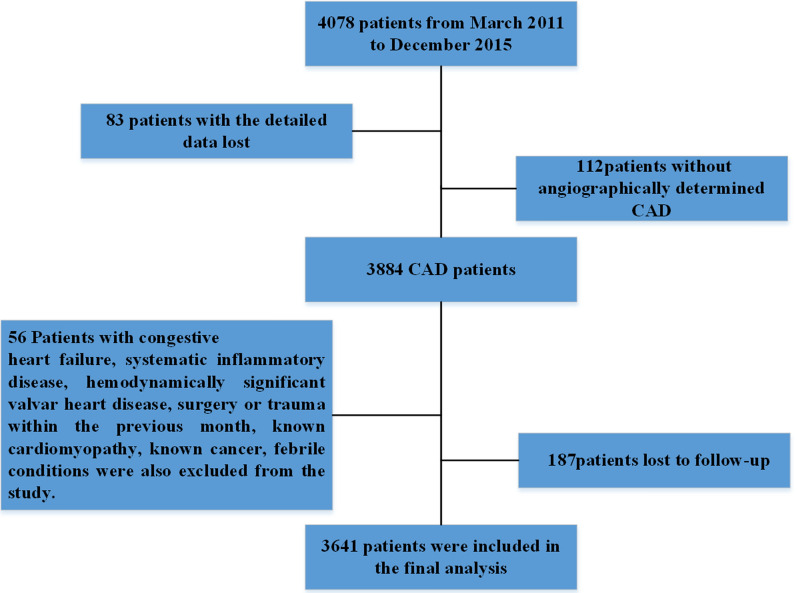
A total of 3641 consecutive patients were included in this prospective cohort study. The primary end point was major adverse cardiovascular events (MACEs). The secondary end point was all-cause death. The association between sST2 and outcomes was investigated using multivariable Cox regression.
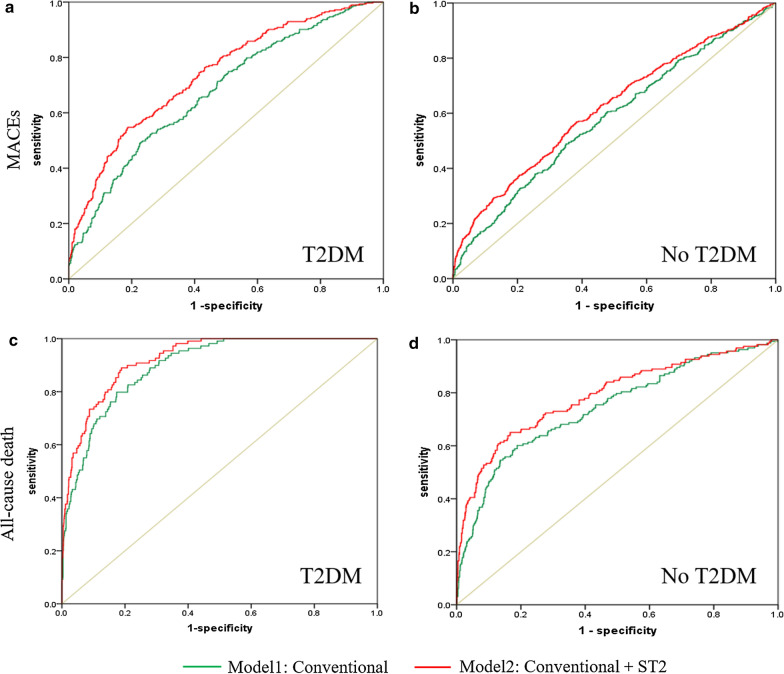
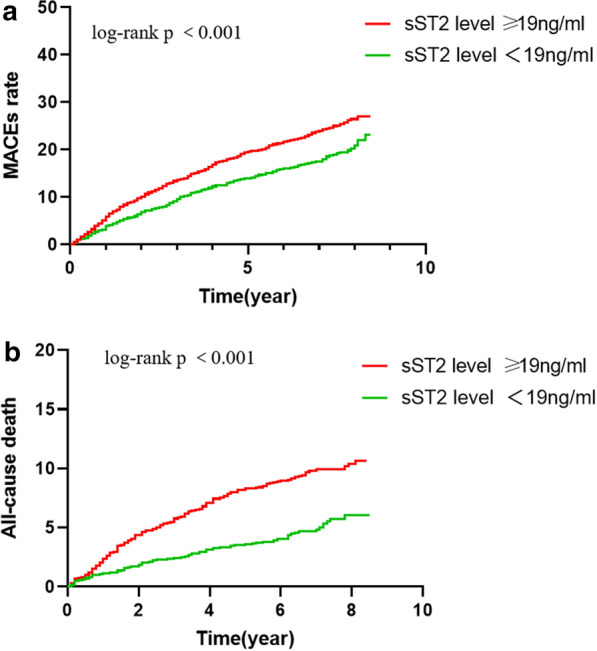
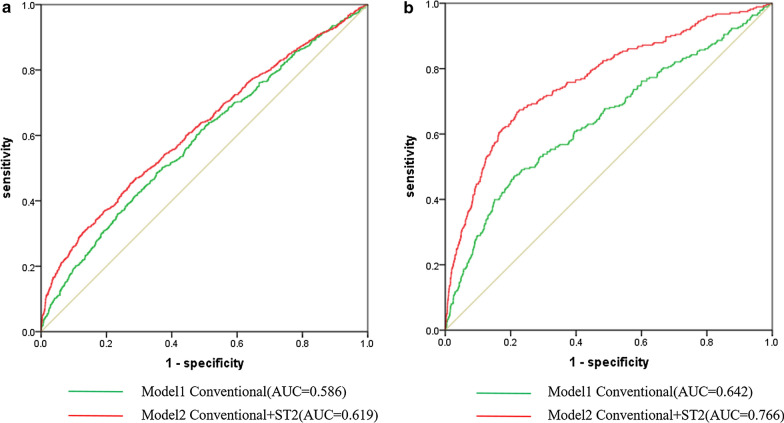
During a median follow-up of 6.4 years, MACEs occurred in 775 patients, and 275 patients died. Multiple Cox regression models showed that a higher level of sST2 was an independent predictor of MACEs development (HR = 1.36, 95% CI 1.17-1.56, p < 0.001) and all-cause death (HR = 2.01, 95% CI 1.56-2.59, p < 0.001). The addition of sST2 to established risk factors significantly improved risk prediction of the composite outcome of MACEs and all-cause death (C-index, net reclassification index, and integrated discrimination improvement, all p < 0.05). In subgroup analysis depending on diabetes status, the diabetes group had a significantly higher level of sST2, which remained a significant predictor of MACEs and all-cause death in patients with and without T2DM in multivariable models. The area under the curve (AUC) of CAD patients with diabetes mellitus was significantly higher than that of those without T2DM. For MACEs, the AUC was 0.737 (patients with T2DM) vs 0.620 (patients without T2DM). For all-cause death, the AUC was 0.923 (patients with T2DM) vs 0.789 (patients without T2DM).
A higher level of sST2 is significantly associated with long-term MACEs and all-cause death in CAD patients with and without T2DM. sST2 has strong predictive value for cardiovascular adverse events in CAD patients with T2DM, and these results provide new evidence for the role of sST2.
可溶性抑制肿瘤发生 2 型(sST2)与心肌过载有关,长期以来一直被认为是与心力衰竭和急性冠状动脉综合征相关的炎症标志物,但 sST2 在冠状动脉疾病(CAD)患者中的预后价值的数据仍然有限。本研究旨在探讨 sST2 在已确诊 CAD 患者中的预后价值及其在伴有和不伴有 2 型糖尿病(T2DM)的 CAD 患者中的预测价值。
这项前瞻性队列研究共纳入 3641 例连续患者。主要终点是主要不良心血管事件(MACEs)。次要终点是全因死亡。使用多变量 Cox 回归分析 sST2 与结局之间的关系。
在中位随访 6.4 年期间,775 例患者发生 MACEs,275 例患者死亡。多变量 Cox 回归模型显示,较高的 sST2 水平是 MACEs 发展的独立预测因子(HR=1.36,95%CI 1.17-1.56,p<0.001)和全因死亡(HR=2.01,95%CI 1.56-2.59,p<0.001)。将 sST2 添加到既定风险因素中,显著提高了 MACEs 和全因死亡复合结局的风险预测(C 指数、净重新分类指数和综合判别改善,均 p<0.05)。根据糖尿病状态进行亚组分析时,糖尿病组的 sST2 水平明显更高,在多变量模型中,sST2 仍然是伴有和不伴有 T2DM 的患者 MACEs 和全因死亡的显著预测因子。患有糖尿病的 CAD 患者的曲线下面积(AUC)明显高于不患有 T2DM 的患者。对于 MACEs,AUC 为 0.737(患有 T2DM 的患者)vs 0.620(不患有 T2DM 的患者)。对于全因死亡,AUC 为 0.923(患有 T2DM 的患者)vs 0.789(不患有 T2DM 的患者)。
较高的 sST2 水平与伴有和不伴有 T2DM 的 CAD 患者的长期 MACEs 和全因死亡显著相关。sST2 对伴有 T2DM 的 CAD 患者的心血管不良事件具有很强的预测价值,这些结果为 sST2 的作用提供了新的证据。