Gene Therapy Program, Department of Medicine, Perelman School of Medicine, University of Pennsylvania, Philadelphia, PA 19104, USA.
Department of Biostatistics, Epidemiology and Informatics, Perelman School of Medicine, University of Pennsylvania, Philadelphia, PA 19104, USA.
Mol Ther. 2021 Jun 2;29(6):2019-2029. doi: 10.1016/j.ymthe.2021.02.020. Epub 2021 Feb 18.
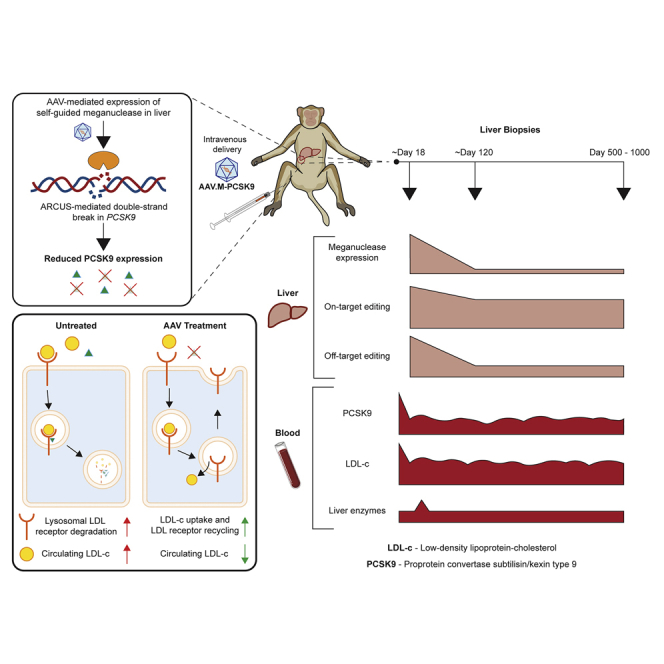
Gene disruption via programmable, sequence-specific nucleases represents a promising gene therapy strategy in which the reduction of specific protein levels provides a therapeutic benefit. Proprotein convertase subtilisin/kexin type 9 (PCSK9), an antagonist of the low-density lipoprotein (LDL) receptor, is a suitable target for nuclease-mediated gene disruption as an approach to treat hypercholesterolemia. We sought to determine the long-term durability and safety of PCSK9 knockdown in non-human primate (NHP) liver by adeno-associated virus (AAV)-delivered meganuclease following our initial report on the feasibility of this strategy. Six previously treated NHPs and additional NHPs administered AAV-meganuclease in combination with corticosteroid treatment or an alternative AAV serotype were monitored for a period of up to 3 years. The treated NHPs exhibited a sustained reduction in circulating PCSK9 and LDL cholesterol (LDL-c) through the course of the study concomitant with stable gene editing of the PCSK9 locus. Low-frequency off-target editing remained stable, and no obvious adverse changes in histopathology of the liver were detected. We demonstrate similar on-target nuclease activity in primary human hepatocytes using a chimeric liver-humanized mouse model. These studies demonstrate that targeted in vivo gene disruption exerts a lasting therapeutic effect and provide pivotal data for safety considerations, which support clinical translation.
通过可编程的、序列特异性的核酸酶进行基因敲除代表了一种有前途的基因治疗策略,通过降低特定蛋白质水平提供治疗益处。前蛋白转化酶枯草溶菌素/克胰蛋白酶 9(PCSK9)是一种 LDL 受体的拮抗剂,是核酸酶介导的基因敲除的合适靶点,作为治疗高胆固醇血症的一种方法。我们试图通过腺相关病毒(AAV)递送的巨核酸酶在非人灵长类动物(NHP)肝脏中确定 PCSK9 敲低的长期耐久性和安全性,这是我们最初报告的该策略可行性的后续研究。我们对六只先前接受过治疗的 NHP 以及另外六只接受 AAV-巨核酸酶联合皮质类固醇治疗或替代 AAV 血清型治疗的 NHP 进行了长达 3 年的监测。在研究过程中,受治疗的 NHP 表现出循环 PCSK9 和 LDL 胆固醇(LDL-c)的持续降低,同时 PCSK9 基因座的基因编辑稳定。低频脱靶编辑保持稳定,未检测到肝脏组织病理学的明显不良反应变化。我们在使用嵌合肝人源化小鼠模型的原发性人肝细胞中证明了类似的靶核酸酶活性。这些研究表明,靶向体内基因敲除产生持久的治疗效果,并为安全性考虑提供了关键数据,支持临床转化。