Department of Rheumatology, Allergy and Immunology, Tan Tock Seng Hospital, Singapore.
Department of Rheumatology and Immunology, Peking University Third Hospital, Beijing, China.
Autoimmun Rev. 2021 Apr;20(4):102778. doi: 10.1016/j.autrev.2021.102778. Epub 2021 Feb 18.
The impact of rheumatic diseases on COVID-19 infection remains poorly investigated. Here we performed a systematic review and meta-analysis to evaluate the outcomes of COVID-19 in patients with rheumatic diseases.
We systematically searched PubMed, Embase, Cochrane Library, Scopus and preprint database up to 29th August 2020, for publications with confirmed COVID-19 infection in patients with rheumatic diseases. The primary outcomes were the rates of hospitalization, oxygen support, intensive care unit (ICU) admission and death. A meta-analysis of effect sizes using the random-effects models was performed, and meta-regression analyses were performed to explore heterogeneity. The data from the COVID-19 Global Rheumatology Alliance physician registry (the COVID-19 GRA) was used as a reference.
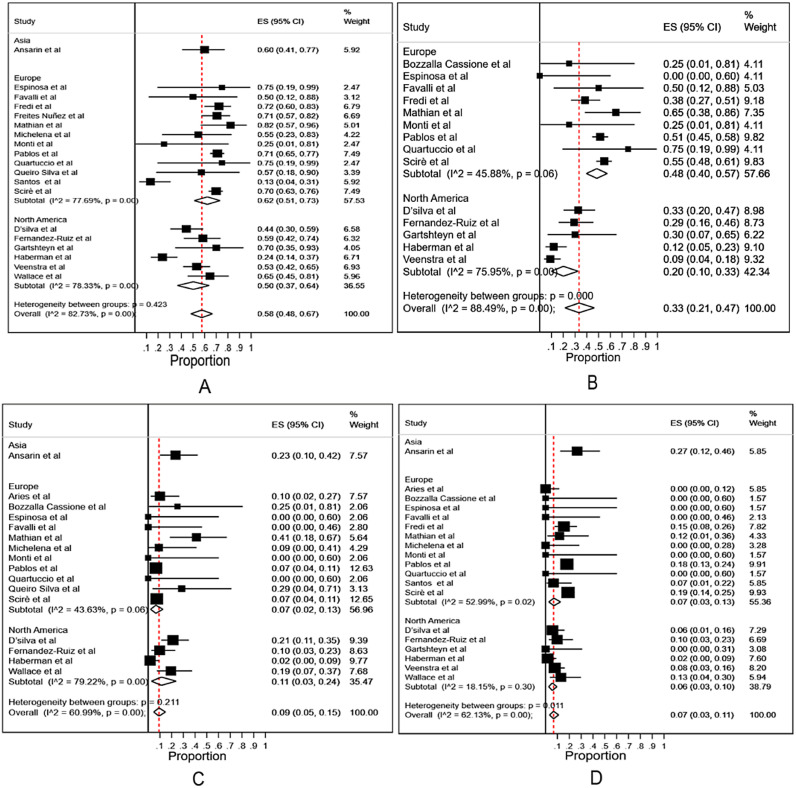
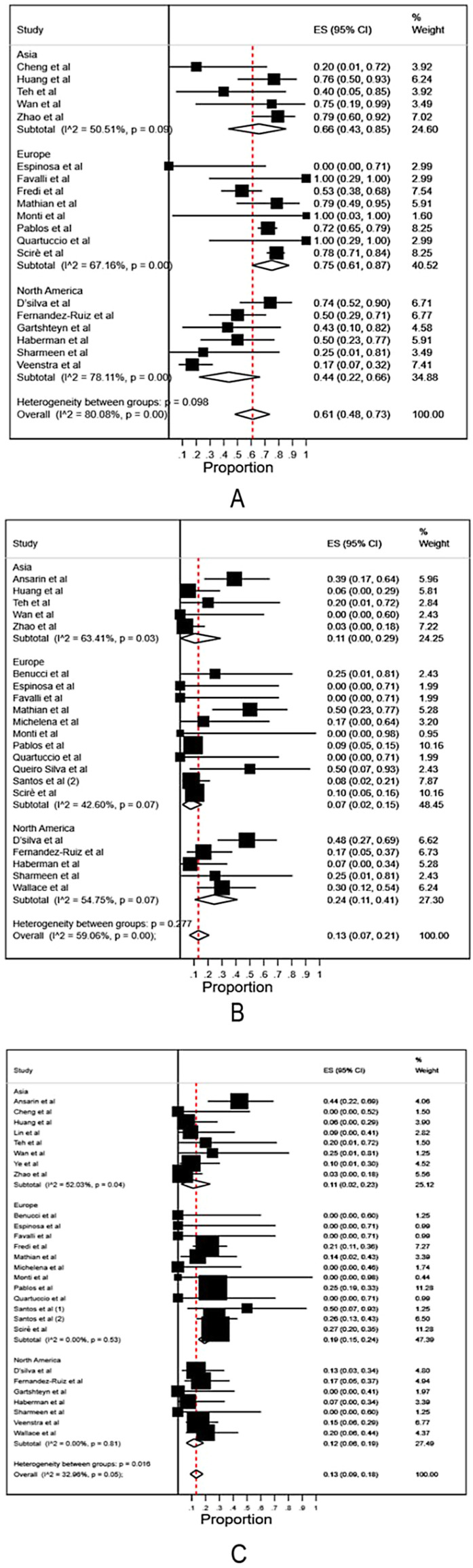
A total of 31 articles involving 1138 patients were included in this systematic review and meta-analysis. The publications were from Europe, Asia and North America, but none from other continents. The overall rates of hospitalization, oxygen support, ICU admission and fatality among COVID-19 infected patients with rheumatic diseases were 0.58 (95% confidence interval (CI) 0.48-0.67), 0.33 (95% CI 0.21-0.47), 0.09 (95% CI 0.05-0.15) and 0.07 (95% CI 0.03-0.11), respectively. The rate of oxygen support in Europe (0.48, 95% CI 0.4-0.57) was higher than that in other continents. Among all hospitalized patients, the rates of oxygen support, ICU admission and fatality were 0.61 (95% CI 0.48-0.73), 0.13 (95% CI 0.07-0.21) and 0.13 (95% CI 0.09-0.18), respectively. The fatality rate was highest in Europe (0.19, 95% CI 0.15-0.24). The fatality rate was higher both in this meta-analysis and the COVID-19 GRA (7.0% and 6.7%, respectively) than that (3.4%) in WHO database, although the age, gender and comorbidity were not matched.
Patients with rheumatic diseases remain vulnerable with substantial rates of severe outcomes and a geographic variation. More studies were urgently needed to elucidate the risk factors of severe outcomes in this population.
风湿性疾病对 COVID-19 感染的影响仍研究不足。在此,我们进行了一项系统评价和荟萃分析,以评估风湿性疾病患者 COVID-19 的结局。
我们系统地检索了 PubMed、Embase、Cochrane 图书馆、Scopus 和预印本数据库,截至 2020 年 8 月 29 日,以获取风湿性疾病患者确诊 COVID-19 感染的出版物。主要结局指标为住院、吸氧支持、重症监护病房(ICU)入院和死亡的发生率。使用随机效应模型对效应大小进行荟萃分析,并进行荟萃回归分析以探索异质性。使用 COVID-19 全球风湿病联盟医生登记处(COVID-19 GRA)的数据作为参考。
本系统评价和荟萃分析共纳入 31 篇文章,涉及 1138 例患者。这些出版物来自欧洲、亚洲和北美,但没有来自其他大陆的。COVID-19 感染的风湿性疾病患者住院、吸氧支持、ICU 入院和死亡的总体发生率分别为 0.58(95%置信区间(CI)0.48-0.67)、0.33(95%CI 0.21-0.47)、0.09(95%CI 0.05-0.15)和 0.07(95%CI 0.03-0.11)。欧洲吸氧支持率(0.48,95%CI 0.4-0.57)高于其他大陆。在所有住院患者中,吸氧支持、ICU 入院和死亡的发生率分别为 0.61(95%CI 0.48-0.73)、0.13(95%CI 0.07-0.21)和 0.13(95%CI 0.09-0.18)。欧洲的死亡率最高(0.19,95%CI 0.15-0.24)。本荟萃分析和 COVID-19 GRA 的死亡率(分别为 7.0%和 6.7%)均高于世卫组织数据库(3.4%),尽管年龄、性别和合并症未匹配。
风湿性疾病患者仍然脆弱,严重结局发生率高且存在地域差异。迫切需要更多的研究来阐明该人群发生严重结局的危险因素。