Tesema Hailemariam Getachew, Lema Girmay Fitiwi, Mesfin Nebiyu, Fentie Demeke Yilkal, Arefayne Nurhussien Rezik
Department of Anesthesia, College of Medicine and Health Sciences, Dilla University, Dilla, Ethiopia.
Department of Anesthesia, College of Medicine and Health Sciences, University of Gondar, Gondar, Ethiopia.
Glob Adv Health Med. 2021 Feb 2;10:2164956121989258. doi: 10.1177/2164956121989258. eCollection 2021.
The intensive care unit (ICU) is a health care delivery service for patients who are in critical condition with potentially recoverable diseases. Patients can benefit from more detailed observation, monitoring and advanced treatment than other wards or department. The care is advancing but in resource-limited settings, it is lagging far behind and mortality is still higher due to various reasons. Therefore, we aimed to determine the admission patterns, clinical outcomes and associated factors among patients admitted medical intensive care unit (MICU).
A retrospective cross-sectional study was conducted based on a record review of logbook and charts of patients admitted from September, 2015 to April, 2019. Data were entered and analysed using SPSS version 20. Both bivariate and multivariate logistic regression analyses were used and a P-value < 0.05 was considered statistically significant.
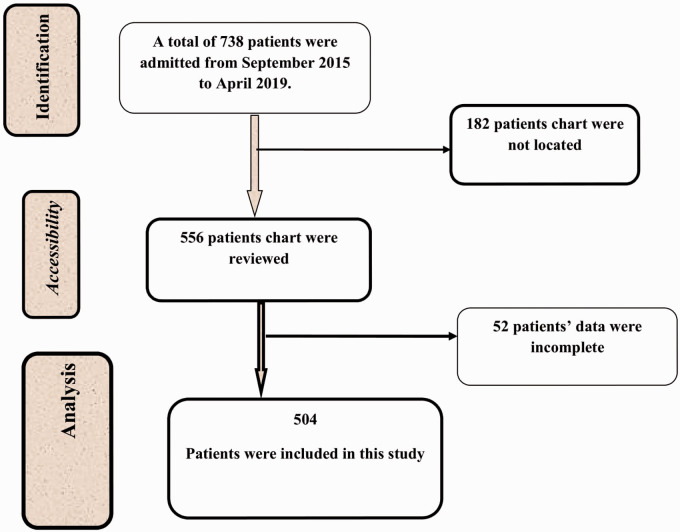
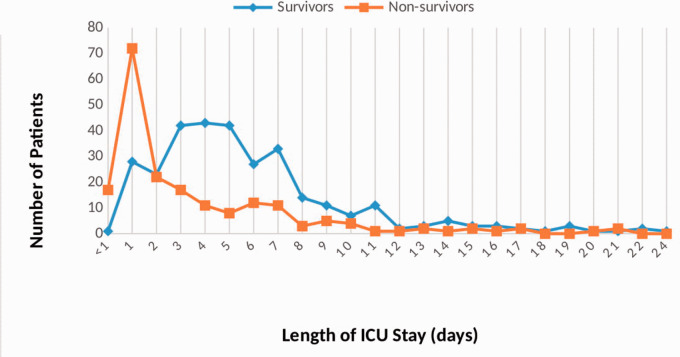
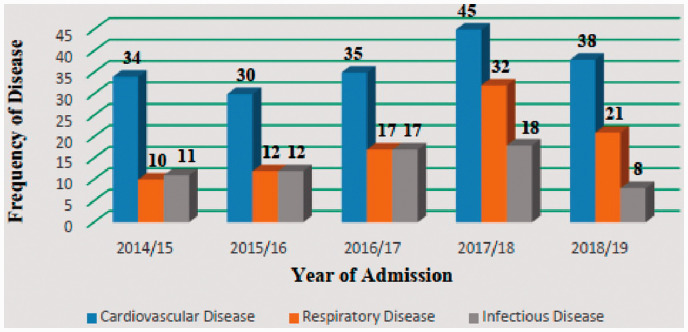
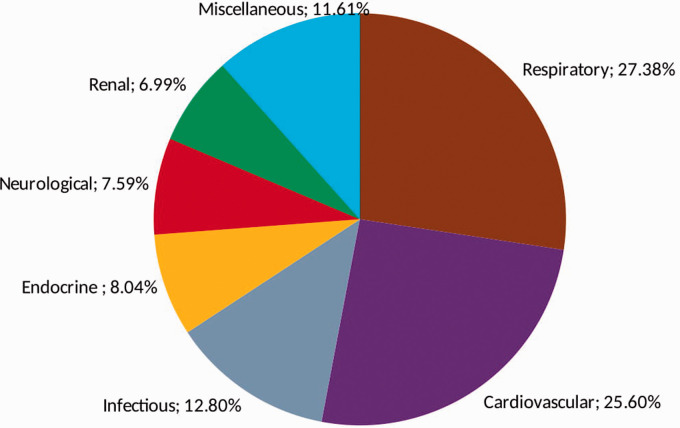
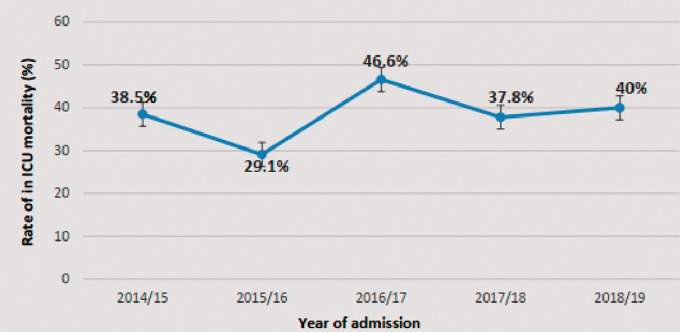
A total of 738 patients were admitted to medical intensive care unit (MICU) during September, 2015 - April, 2019. Five hundred and four patients (68%) of all intensive care unit (ICU) admissions had complete data. Out of the 504 patients, 268 (53.2%) patients were females. Cardiovascular disease 182(36.1%) was the commonest categorical admission diagnosis. The overall mortality rate was 38.7%. In the multivariate analysis, mortality was associated with need for mechanical ventilation (AOR = 5.87, 95% CI: 3.24 - 10.65) and abnormal mental status at admission (AOR = 2.8, 95% CI: 1.83-4.29). Patients who had stay less than four days in MICU were 5 times more likely to die than those who has stay longer time (AOR= 5.58, 95% CI: 3.58- 8.69).
The overall mortality was considerably high and cardiovascular diseases were the most common cause of admission in MICU. Need for mechanical ventilator, length of intensive care unit stay and mental status at admission were strongly associated with clinical outcome of patients admitted to medical intensive care unit.
重症监护病房(ICU)是为患有潜在可治愈疾病的危重症患者提供的医疗服务。与其他病房或科室相比,患者能从更详细的观察、监测和先进治疗中获益。医疗护理在不断进步,但在资源有限的环境中,其发展仍远远滞后,且由于各种原因死亡率依然较高。因此,我们旨在确定入住内科重症监护病房(MICU)患者的入院模式、临床结局及相关因素。
基于对2015年9月至2019年4月入院患者的日志和病历记录回顾进行了一项回顾性横断面研究。数据录入并使用SPSS 20版进行分析。采用双变量和多变量逻辑回归分析,P值<0.05被认为具有统计学意义。
2015年9月至2019年4月期间,共有738例患者入住内科重症监护病房(MICU)。所有重症监护病房(ICU)入院患者中有504例(68%)拥有完整数据。在这504例患者中,268例(53.2%)为女性。心血管疾病182例(36.1%)是最常见的分类入院诊断。总体死亡率为38.7%。在多变量分析中,死亡率与机械通气需求(调整后比值比[AOR]=5.87,95%置信区间[CI]:3.24 - 10.65)和入院时精神状态异常(AOR=2.8,95%CI:1.83 - 4.29)相关。在内科重症监护病房停留时间少于4天的患者死亡可能性是停留时间较长患者的5倍(AOR=5.58,95%CI:3.58 - 8.69)。
总体死亡率相当高,心血管疾病是内科重症监护病房最常见的入院原因。机械通气需求、重症监护病房停留时间和入院时精神状态与入住内科重症监护病房患者的临床结局密切相关。