Yibirin Marcel, De Oliveira Diana, Valera Roberto, Plitt Andrea E, Lutgen Sophia
Department of Infectious Diseases, Infection Control, and Employee Health, University of Texas MD Anderson Cancer Center, Houston, USA.
Department of Research, Foundation for Clinic, Public Health, and Epidemiological Research of Venezuela (FISPEVEN), Caracas, VEN.
Cureus. 2021 Jan 18;13(1):e12759. doi: 10.7759/cureus.12759.
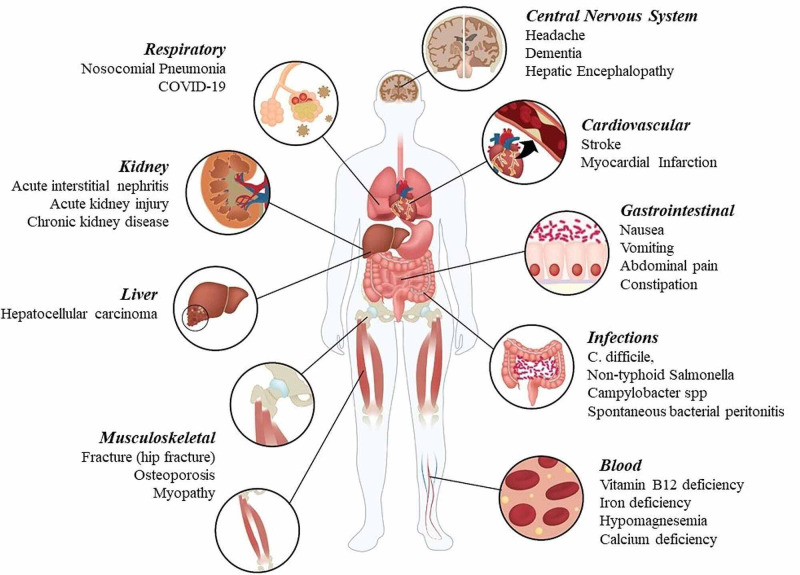
Proton pump inhibitors (PPIs) marked a before and after in the management of gastric acid-related disorders since their introduction to the market in 1989. Due to a novel, highly effective mechanism of action blocking the last converging step of gastric acid secretion by parietal cells and very few and mostly tolerable side effects, these drugs quickly displaced other pharmacological compounds such as H2 antagonists as the first treatment choice for peptic ulcer disease, gastroesophageal ulcers, Zollinger-Ellison syndrome, nonsteroidal anti-inflammatory drug-associated ulcers, and eradication of Helicobacter pylori, leading to an exponential increase in their prescription up to now. However, widespread PPI use has led to emerging evidence of long-term adverse effects not described previously, including increased risk of kidney, liver, and cardiovascular disease, dementia, enteroendocrine tumors of the gastrointestinal tract, susceptibility to respiratory and gastrointestinal infections, and impaired absorption of nutrients. Although the evidence published thus far has not established strong correlations, it has been relevant enough to raise new questions about PPIs' safety profile and reconsideration of their clinical indications. Hence, the aim of this review is to evaluate the association between PPI use and the risk of serious adverse effects given increasing concerns about the overuse of PPIs in the general population.
自1989年质子泵抑制剂(PPIs)上市以来,它们在胃酸相关疾病的治疗方面开创了一个新纪元。由于其作用机制新颖、高效,能阻断壁细胞胃酸分泌的最后一个汇聚步骤,且副作用极少且大多可以耐受,这些药物迅速取代了其他药理化合物,如H2拮抗剂,成为消化性溃疡病、胃食管溃疡、卓艾综合征、非甾体抗炎药相关性溃疡以及根除幽门螺杆菌的首选治疗药物,导致其处方量至今呈指数级增长。然而,PPIs的广泛使用已出现了先前未描述的长期不良反应的证据,包括肾脏、肝脏和心血管疾病风险增加、痴呆、胃肠道肠内分泌肿瘤、易患呼吸道和胃肠道感染以及营养吸收受损。尽管迄今为止发表的证据尚未建立起强有力的相关性,但这些证据已足以引发关于PPIs安全性的新问题,并促使人们重新考虑其临床适应证。因此,鉴于人们对普通人群中PPIs过度使用的担忧日益增加,本综述的目的是评估使用PPIs与严重不良反应风险之间的关联。