• 文献检索
  • 文档翻译
  • 深度研究
  • 学术资讯
  • Suppr Zotero 插件Zotero 插件
  • 邀请有礼
  • 套餐&价格
  • 历史记录
应用&插件
Suppr Zotero 插件Zotero 插件浏览器插件Mac 客户端Windows 客户端微信小程序
定价
高级版会员购买积分包购买API积分包
服务
文献检索文档翻译深度研究API 文档MCP 服务
关于我们
关于 Suppr公司介绍联系我们用户协议隐私条款
关注我们

Suppr 超能文献

核心技术专利:CN118964589B侵权必究
粤ICP备2023148730 号-1Suppr @ 2026

文献检索

告别复杂PubMed语法,用中文像聊天一样搜索,搜遍4000万医学文献。AI智能推荐,让科研检索更轻松。

立即免费搜索

文件翻译

保留排版,准确专业,支持PDF/Word/PPT等文件格式,支持 12+语言互译。

免费翻译文档

深度研究

AI帮你快速写综述,25分钟生成高质量综述,智能提取关键信息,辅助科研写作。

立即免费体验

在线健康社区中的健康隐私信息自披露。

Health Privacy Information Self-Disclosure in Online Health Community.

机构信息

School of Economics and Business Administration, Hubei University of Arts and Science, Xiangyang, China.

Economics and Management School, Wuhan University, Wuhan, China.

出版信息

Front Public Health. 2021 Feb 4;8:602792. doi: 10.3389/fpubh.2020.602792. eCollection 2020.

DOI:10.3389/fpubh.2020.602792
PMID:33614566
原文链接:https://pmc.ncbi.nlm.nih.gov/articles/PMC7890189/
Abstract

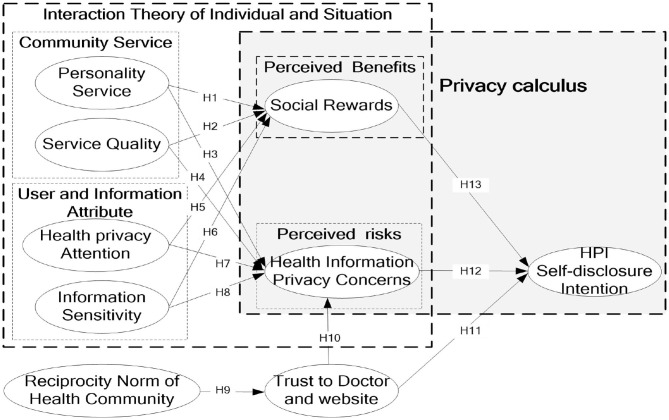
The scarcity of medical resources is a fundamental problem worldwide; the development of information technology and the Internet has given birth to online health care, which has alleviated the above problem. The survival and sustainable development of the online health community requires users to continuously disclose their health and privacy. Therefore, it is a great practical significance to find out the factors and mechanisms that promote users' self-disclosure in the online health community. From the perspective of individual and situation interaction, this study constructed influencing factors model of health privacy information self-disclosure. Finally, we collected 264 valid samples from the online health community through online and offline questionnaire surveys and then use the SPSS20.0 and AMOS21.0 to conduct exploratory factor analysis, confirmatory factor analysis, scale reliability and validity analysis, and structural equation model analysis. The main findings are as follows: trust in websites and trust in doctors reduce the privacy concern. The privacy trade-off will not occur when trust is enough to offset the privacy concerns caused by personalized services, reciprocity norms, and other factors. Second, reciprocity norms are inevitably compulsive, which will increase privacy concerns. However, based on voluntariness, reciprocity norms can enhance user trust. Third, service quality caused by personalized services not only enhance the social rewards of users but also eliminate the privacy concern. Fourth, users' health privacy attention and information sensitivity are too high to decrease the influence of user' privacy concerns on personal health privacy information disclosure. The conclusions of this paper will help us to supplement privacy calculus theory and the application scope of the attention-based view. The proposed strategy of this article can be used to stimulate the information contribution behavior of users and improve the medical service capabilities in online health community.

摘要

医疗资源的稀缺是一个全球性的基本问题;信息技术和互联网的发展催生了在线医疗保健,这缓解了上述问题。在线健康社区的生存和可持续发展需要用户不断披露他们的健康和隐私信息。因此,找出促进用户在在线健康社区中自我披露的因素和机制具有重要的现实意义。本研究从个体和情境交互的角度出发,构建了健康隐私信息自我披露的影响因素模型。最后,我们通过在线和线下问卷调查从在线健康社区收集了 264 个有效样本,然后使用 SPSS20.0 和 AMOS21.0 进行探索性因子分析、验证性因子分析、量表信度和效度分析以及结构方程模型分析。主要发现如下:对网站和医生的信任会降低隐私顾虑。当信任足以抵消个性化服务、互惠规范等因素引起的隐私顾虑时,隐私权衡就不会发生。其次,互惠规范不可避免地具有强制性,这会增加隐私顾虑。然而,基于自愿性,互惠规范可以增强用户信任。第三,个性化服务带来的服务质量不仅增强了用户的社会回报,而且消除了用户的隐私顾虑。第四,用户的健康隐私关注度和信息敏感度过高,降低了用户隐私顾虑对个人健康隐私信息披露的影响。本文的结论将有助于补充隐私计算理论和注意基础观的应用范围。本文提出的策略可以用来激发用户的信息贡献行为,提高在线健康社区的医疗服务能力。
https://cdn.ncbi.nlm.nih.gov/pmc/blobs/f8ed/7890189/cb48a2b6376c/fpubh-08-602792-g0002.jpg
https://cdn.ncbi.nlm.nih.gov/pmc/blobs/f8ed/7890189/0c3ec3954937/fpubh-08-602792-g0001.jpg
https://cdn.ncbi.nlm.nih.gov/pmc/blobs/f8ed/7890189/cb48a2b6376c/fpubh-08-602792-g0002.jpg
https://cdn.ncbi.nlm.nih.gov/pmc/blobs/f8ed/7890189/0c3ec3954937/fpubh-08-602792-g0001.jpg
https://cdn.ncbi.nlm.nih.gov/pmc/blobs/f8ed/7890189/cb48a2b6376c/fpubh-08-602792-g0002.jpg

相似文献

1
Health Privacy Information Self-Disclosure in Online Health Community.在线健康社区中的健康隐私信息自披露。
Front Public Health. 2021 Feb 4;8:602792. doi: 10.3389/fpubh.2020.602792. eCollection 2020.
2
Determining factors affecting the user's intention to disclose privacy in online health communities: a dual-calculus model.影响用户在在线健康社区中披露隐私意愿的决定因素:双计算模型。
Front Public Health. 2023 Jul 19;11:1109093. doi: 10.3389/fpubh.2023.1109093. eCollection 2023.
3
UISTD: A Trust-Aware Model for Diverse Item Personalization in Social Sensing with Lower Privacy Intrusion.UISTD:一种在社交感知中具有较低隐私入侵的、多样化项目个性化的信任感知模型。
Sensors (Basel). 2018 Dec 11;18(12):4383. doi: 10.3390/s18124383.
4
Privacy Concerns About Health Information Disclosure in Mobile Health: Questionnaire Study Investigating the Moderation Effect of Social Support.移动健康中健康信息披露的隐私问题:问卷调查研究社会支持的调节作用。
JMIR Mhealth Uhealth. 2021 Feb 8;9(2):e19594. doi: 10.2196/19594.
5
Are You Willing to Self-Disclose for Science? Effects of Privacy Awareness and Trust in Privacy on Self-Disclosure of Personal and Health Data in Online Scientific Studies-An Experimental Study.你愿意为了科学而自我披露信息吗?隐私意识和对隐私的信任对在线科学研究中个人及健康数据自我披露的影响——一项实验研究
Front Big Data. 2021 Dec 24;4:763196. doi: 10.3389/fdata.2021.763196. eCollection 2021.
6
Examining the Intention of Authorization via Apps: Personality Traits and Expanded Privacy Calculus Perspectives.通过应用程序审视授权意图:人格特质与扩展隐私计算视角
Behav Sci (Basel). 2022 Jun 29;12(7):218. doi: 10.3390/bs12070218.
7
Trust Me, I'm a Doctor: Examining Changes in How Privacy Concerns Affect Patient Withholding Behavior.相信我,我是医生:审视隐私担忧影响患者隐瞒行为方式的变化。
J Med Internet Res. 2017 Jan 4;19(1):e2. doi: 10.2196/jmir.6296.
8
Factors Influencing the Sharing of Personal Health Data Based on the Integrated Theory of Privacy Calculus and Theory of Planned Behaviors Framework: Results of a Cross-Sectional Study of Chinese Patients in the Yangtze River Delta.基于隐私计算综合理论和计划行为理论框架的个人健康数据共享影响因素分析:来自长三角地区中国患者的横断面研究结果
J Med Internet Res. 2023 Jul 6;25:e46562. doi: 10.2196/46562.
9
Privacy Concerns and Self-Disclosure in Private and Public Uses of Social Media.社交媒体的私人和公共使用中的隐私问题和自我披露。
Cyberpsychol Behav Soc Netw. 2018 Jul;21(7):418-428. doi: 10.1089/cyber.2017.0709.
10
A Study of Reasons for Self-Disclosure on Social Media among Chinese COVID-19 Patients: Based on the Theory of Planned Behavior Model.中国新冠肺炎患者在社交媒体上自我披露原因的研究:基于计划行为理论模型
Healthcare (Basel). 2023 May 22;11(10):1509. doi: 10.3390/healthcare11101509.

引用本文的文献

1
Research on the Impact of an AI Voice Assistant's Gender and Self-Disclosure Strategies on User Self-Disclosure in Chinese Postpartum Follow-Up Phone Calls.人工智能语音助手的性别和自我披露策略对中国产后随访电话中用户自我披露的影响研究
Behav Sci (Basel). 2025 Feb 10;15(2):184. doi: 10.3390/bs15020184.
2
Research on user's highly sensitive privacy disclosure intention in home intelligent health service system: A perspective from trust enhancement mechanism.家庭智能健康服务系统中用户高度敏感隐私披露意愿的研究:基于信任增强机制的视角
Digit Health. 2023 Dec 13;9:20552076231219444. doi: 10.1177/20552076231219444. eCollection 2023 Jan-Dec.
3

本文引用的文献

1
Examining individuals' adoption of healthcare wearable devices: An empirical study from privacy calculus perspective.从隐私计算角度审视个人对医疗可穿戴设备的采用:一项实证研究
Int J Med Inform. 2016 Apr;88:8-17. doi: 10.1016/j.ijmedinf.2015.12.010. Epub 2016 Jan 8.
2
Pricing and disseminating customer data with privacy awareness.在保护隐私的前提下定价和传播客户数据。
Decis Support Syst. 2014 Mar 1;59:63-73. doi: 10.1016/j.dss.2013.10.006.
3
Building trusting relationships in online health communities.建立在线健康社区中的信任关系。
Online health community-An empirical analysis based on grounded theory and entropy weight TOPSIS method to evaluate the service quality.
在线健康社区——基于扎根理论和熵权TOPSIS法的服务质量实证分析
Digit Health. 2023 Oct 11;9:20552076231207201. doi: 10.1177/20552076231207201. eCollection 2023 Jan-Dec.
4
Determining factors affecting the user's intention to disclose privacy in online health communities: a dual-calculus model.影响用户在在线健康社区中披露隐私意愿的决定因素:双计算模型。
Front Public Health. 2023 Jul 19;11:1109093. doi: 10.3389/fpubh.2023.1109093. eCollection 2023.
5
Research on the influencing factors of users' information processing in online health communities based on heuristic-systematic model.基于启发式系统模型的在线健康社区用户信息处理影响因素研究
Front Psychol. 2022 Oct 17;13:966033. doi: 10.3389/fpsyg.2022.966033. eCollection 2022.
6
Public Attitudes Regarding Trade-offs Between the Functional Aspects of a Contact-Confirming App for COVID-19 Infection Control and the Benefits to Individuals and Public Health: Cross-sectional Survey.公众对用于新冠病毒感染防控的接触确认应用程序功能方面与个人及公共卫生益处之间权衡的态度:横断面调查
JMIR Form Res. 2022 Jul 20;6(7):e37720. doi: 10.2196/37720.
7
Self-disclosure during the COVID-19 emergency: Effects of narcissism traits, time perspective, virtual presence, and hedonic gratification.COVID-19疫情期间的自我表露:自恋特质、时间观、虚拟在场和享乐满足的影响
Comput Human Behav. 2022 May;130:107154. doi: 10.1016/j.chb.2021.107154. Epub 2021 Dec 31.
8
"I" Am Willing to Disclose, but "We" are Unwilling: The Impact of Self-Construal on Individuals' Willingness to Disclose.“我”愿意披露,但“我们”不愿意:自我建构对个体披露意愿的影响。
Psychol Res Behav Manag. 2021 Dec 2;14:1929-1945. doi: 10.2147/PRBM.S336223. eCollection 2021.
Cyberpsychol Behav Soc Netw. 2013 Sep;16(9):650-7. doi: 10.1089/cyber.2012.0348. Epub 2013 Jun 20.
4
Reasons, assessments and actions taken: sex and age differences in uses of Internet health information.原因、评估及采取的行动:互联网健康信息使用中的性别和年龄差异。
Health Educ Res. 2008 Jun;23(3):512-21. doi: 10.1093/her/cyl062. Epub 2006 Jul 31.
5
Common method biases in behavioral research: a critical review of the literature and recommended remedies.行为研究中的共同方法偏差:文献综述与建议补救措施
J Appl Psychol. 2003 Oct;88(5):879-903. doi: 10.1037/0021-9010.88.5.879.
6
Consumer health information seeking on the Internet: the state of the art.互联网上的消费者健康信息搜索:最新进展。
Health Educ Res. 2001 Dec;16(6):671-92. doi: 10.1093/her/16.6.671.
7
Exact and Monte carlo resampling procedures for the Wilcoxon-Mann-Whitney and Kruskal-Wallis tests.用于 Wilcoxon-Mann-Whitney 检验和 Kruskal-Wallis 检验的精确重采样和蒙特卡罗重采样程序。
Percept Mot Skills. 2000 Dec;91(3 Pt 1):749-54. doi: 10.2466/pms.2000.91.3.749.