Heyward Christa Y, Dong Lynn, Shakhzadyan Hayk, Wan Christopher, Stokol Tracy
Department of Population Medicine and Diagnostic Sciences, College of Veterinary Medicine, Cornell University, Ithaca, NY, United States.
Department of Biomedical Sciences, College of Veterinary Medicine, Cornell University, Ithaca, NY, United States.
Front Vet Sci. 2021 Feb 4;8:622189. doi: 10.3389/fvets.2021.622189. eCollection 2021.
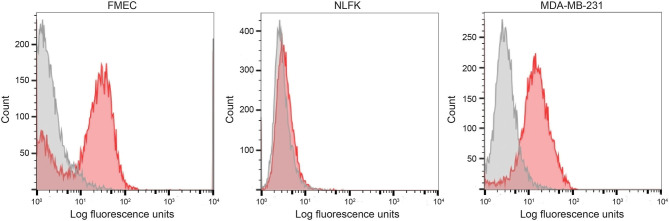
Epithelial cell adhesion molecule (EpCAM) is a transmembrane protein expressed at intercellular junctions in epithelial cells. As an epithelial biomarker, it used for immunologic-based capture of epithelial-derived circulating tumor cells (CTCs) in human patients with different carcinomas. EpCAM expression has not been described in normal or neoplastic epithelial tissues in cats. Our goal was to find a commercial antibody that recognizes surface EpCAM expression for CTC detection. We tested two anti-human EpCAM antibodies, designated for use with flow cytometry, for detection of surface EpCAM expression on feline cell lines derived from normal mammary and renal epithelia and mammary and oropharyngeal squamous cell carcinomas in cats. Only one of the antibodies, a goat polyclonal antibody, labeled normal and neoplastic feline mammary epithelial cells and oropharyngeal squamous cell carcinoma cells; no labeling was observed for normal feline kidney epithelial cells. At low dilution, this antibody immunohistochemically stained the intercellular junctions of normal pancreatic, intestinal and mammary epithelium, as well as neoplastic mammary epithelium in feline tissues; however, oral mucosa, skin, and an oropharyngeal squamous cell carcinoma showed no positive immunostaining. The antibody only weakly bound feline squamous cell carcinoma cell lines under static adhesion. Our results indicate that EpCAM is expressed in specific epithelia in cats but is variably expressed in feline mammary tumors and oropharyngeal squamous cell carcinoma. A higher avidity cross-reactive or feline-specific antibody will be required to further investigate EpCAM expression in normal and neoplastic feline tissue or for detecting CTCs in the blood of tumor-bearing cats.
上皮细胞粘附分子(EpCAM)是一种跨膜蛋白,表达于上皮细胞的细胞间连接处。作为一种上皮生物标志物,它用于基于免疫捕获人类不同癌症患者上皮来源的循环肿瘤细胞(CTC)。猫的正常或肿瘤性上皮组织中尚未描述EpCAM的表达情况。我们的目标是找到一种能够识别表面EpCAM表达以用于CTC检测的商业抗体。我们测试了两种指定用于流式细胞术的抗人EpCAM抗体,以检测猫正常乳腺和肾上皮以及乳腺和口咽鳞状细胞癌来源的猫细胞系表面EpCAM的表达。只有一种抗体,即山羊多克隆抗体,标记了正常和肿瘤性猫乳腺上皮细胞以及口咽鳞状细胞癌细胞;未观察到正常猫肾上皮细胞有标记。在低稀释度下,该抗体通过免疫组织化学染色了猫组织中正常胰腺、肠道和乳腺上皮以及肿瘤性乳腺上皮的细胞间连接处;然而,口腔黏膜、皮肤和口咽鳞状细胞癌未显示阳性免疫染色。在静态黏附条件下,该抗体仅与猫鳞状细胞癌细胞系微弱结合。我们的结果表明,EpCAM在猫的特定上皮中表达,但在猫乳腺肿瘤和口咽鳞状细胞癌中表达存在差异。需要更高亲和力的交叉反应性或猫特异性抗体来进一步研究EpCAM在正常和肿瘤性猫组织中的表达情况,或用于检测荷瘤猫血液中的CTC。