Sousa Arturo, Aguilar-Alba Mónica, Vetter Mark, García-Barrón Leoncio, Morales Julia
Department of Plant Biology and Ecology, Universidad de Sevilla, 41012 Seville, Spain.
Department of Physical Geography and AGR, Universidad de Sevilla, 41004 Seville, Spain.
EuroMediterr J Environ Integr. 2021;6(1):33. doi: 10.1007/s41207-021-00245-8. Epub 2021 Feb 16.
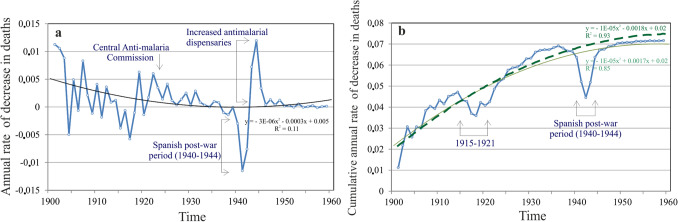
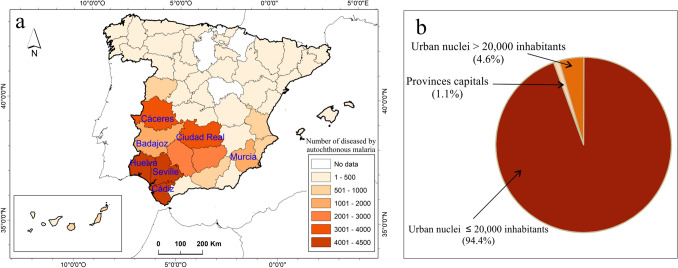
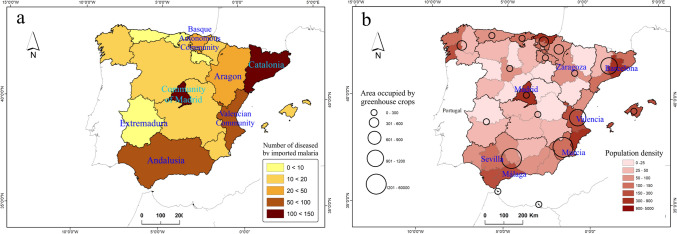
Since the early twentieth century, the intensity of malaria transmission has decreased sharply worldwide, although it is still an infectious disease with a yearly estimate of 228 million cases. The aim of this study was to expand our knowledge on the main drivers of malaria in Spain. In the case of autochthonous malaria, these drivers were linked to socioeconomic and hygienic and sanitary conditions, especially in rural areas due to their close proximity to the wetlands that provide an important habitat for anopheline reproduction. In the case of imported malaria, the main drivers were associated with urban areas, a high population density and international communication nodes (e.g. airports). Another relevant aspect is that the major epidemic episodes of the twentieth century were strongly influenced by war and military conflicts and overcrowding of the healthcare system due to the temporal overlap with the pandemic flu of 1918. Therefore, military conflicts and overlap with other epidemics or pandemics are considered to be drivers of malaria that can-in a temporary manner-exponentially intensify transmission of the disease. Climatic factors did not play a relevant role as drivers of malaria in Spain (at least directly). However, they did influence the seasonality of the disease and, during the epidemic outbreak of 1940-1944, the climate conditions favored or coadjuvated its spread. The results of this study provide additional knowledge on the seasonal and interannual variability of malaria that can help to develop and implement health risk control measures.
The online version contains supplementary material available at 10.1007/s41207-021-00245-8.
自20世纪初以来,全球疟疾传播强度急剧下降,尽管它仍是一种传染病,每年估计有2.28亿病例。本研究的目的是扩展我们对西班牙疟疾主要驱动因素的认识。就本土疟疾而言,这些驱动因素与社会经济以及卫生和环境卫生条件有关,特别是在农村地区,因为农村地区靠近为按蚊繁殖提供重要栖息地的湿地。就输入性疟疾而言,主要驱动因素与城市地区、高人口密度和国际交通枢纽(如机场)有关。另一个相关方面是,20世纪的主要疫情受到战争和军事冲突以及由于与1918年大流感时间重叠导致医疗系统过度拥挤的强烈影响。因此,军事冲突以及与其他流行病或大流行病的重叠被认为是疟疾的驱动因素,它们可以暂时以指数方式加剧疾病的传播。气候因素在西班牙并非疟疾的相关驱动因素(至少直接不是)。然而,它们确实影响了疾病的季节性,并且在1940 - 1944年的疫情爆发期间,气候条件有利于或促进了其传播。本研究结果提供了关于疟疾季节性和年际变化的更多知识,有助于制定和实施健康风险控制措施。
在线版本包含可在10.1007/s41207 - 021 - 00245 - 8获取的补充材料。