Department of Biochemistry and Molecular Biology, Biomedicine Discovery Institute, Monash University, Clayton, Victoria, Australia.
Research School of Chemistry, Australian National University, Canberra, Australian Capital Territory, Australia.
J Biol Chem. 2021 Jan-Jun;296:100447. doi: 10.1016/j.jbc.2021.100447. Epub 2021 Feb 20.
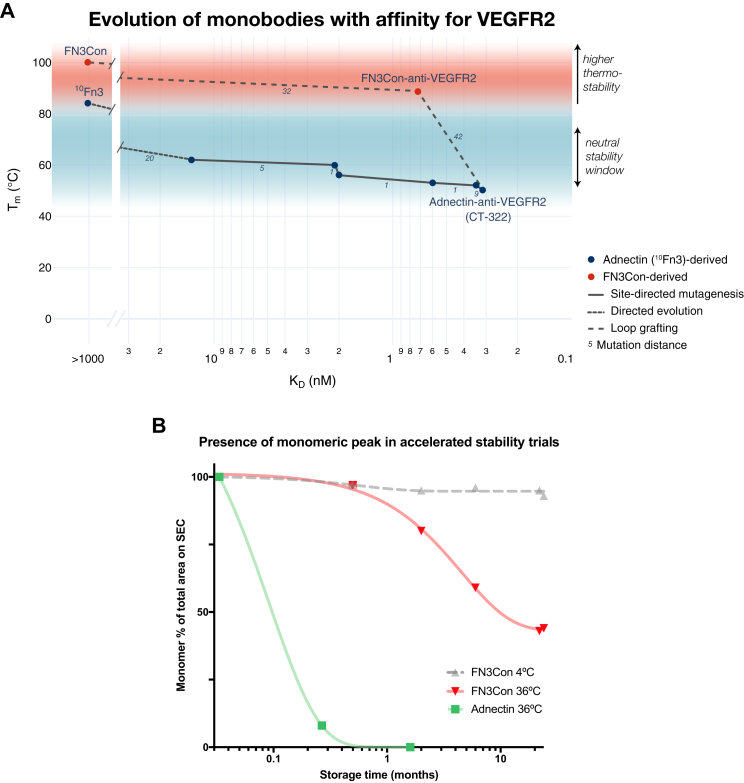
The fibronectin type III (FN3) monobody domain is a promising non-antibody scaffold, which features a less complex architecture than an antibody while maintaining analogous binding loops. We previously developed FN3Con, a hyperstable monobody derivative with diagnostic and therapeutic potential. Prestabilization of the scaffold mitigates the stability-function trade-off commonly associated with evolving a protein domain toward biological activity. Here, we aimed to examine if the FN3Con monobody could take on antibody-like binding to therapeutic targets, while retaining its extreme stability. We targeted the first of the Adnectin derivative of monobodies to reach clinical trials, which was engineered by directed evolution for binding to the therapeutic target VEGFR2; however, this function was gained at the expense of large losses in thermostability and increased oligomerization. In order to mitigate these losses, we grafted the binding loops from Adnectin-anti-VEGFR2 (CT-322) onto the prestabilized FN3Con scaffold to produce a domain that successfully bound with high affinity to the therapeutic target VEGFR2. This FN3Con-anti-VEGFR2 construct also maintains high thermostability, including remarkable long-term stability, retaining binding activity after 2 years of storage at 36 °C. Further investigations into buffer excipients doubled the presence of monomeric monobody in accelerated stability trials. These data suggest that loop grafting onto a prestabilized scaffold is a viable strategy for the development of monobody domains with desirable biophysical characteristics and that FN3Con is therefore well-suited to applications such as the evolution of multiple paratopes or shelf-stable diagnostics and therapeutics.
纤连蛋白结构域 III(FN3)单域抗体是一种很有前途的非抗体支架,其结构比抗体简单,同时保持类似的结合环。我们之前开发了 FN3Con,这是一种超稳定的单域抗体衍生物,具有诊断和治疗潜力。支架的预稳定减轻了与将蛋白质结构域进化为生物活性相关的稳定性-功能权衡。在这里,我们旨在研究 FN3Con 单域抗体是否可以像抗体一样与治疗靶标结合,同时保持其极端稳定性。我们针对第一个进入临床试验的 Adnectin 单域抗体衍生物进行了研究,该单域抗体是通过定向进化工程设计用于结合治疗靶点 VEGFR2 的;然而,这种功能是通过大量丧失热稳定性和增加寡聚化获得的。为了减轻这些损失,我们将 Adnectin-anti-VEGFR2(CT-322)的结合环嫁接到预稳定的 FN3Con 支架上,产生了一种能够与治疗靶点 VEGFR2 高亲和力结合的结构域。这种 FN3Con-anti-VEGFR2 构建体也保持了高热稳定性,包括显著的长期稳定性,在 36°C 下储存 2 年后仍保持结合活性。进一步研究缓冲剂赋形剂将加速稳定性试验中单域抗体单体的存在增加了一倍。这些数据表明,将环嫁接在预稳定的支架上是开发具有理想物理特性的单域抗体的可行策略,因此 FN3Con 非常适合用于进化多个抗原结合位点或货架稳定的诊断和治疗等应用。