Department of Biochemistry and Molecular Biology, Biomedicine Discovery Institute, Monash University, Clayton, Victoria 3800, Australia.
Cells. 2020 Mar 4;9(3):610. doi: 10.3390/cells9030610.
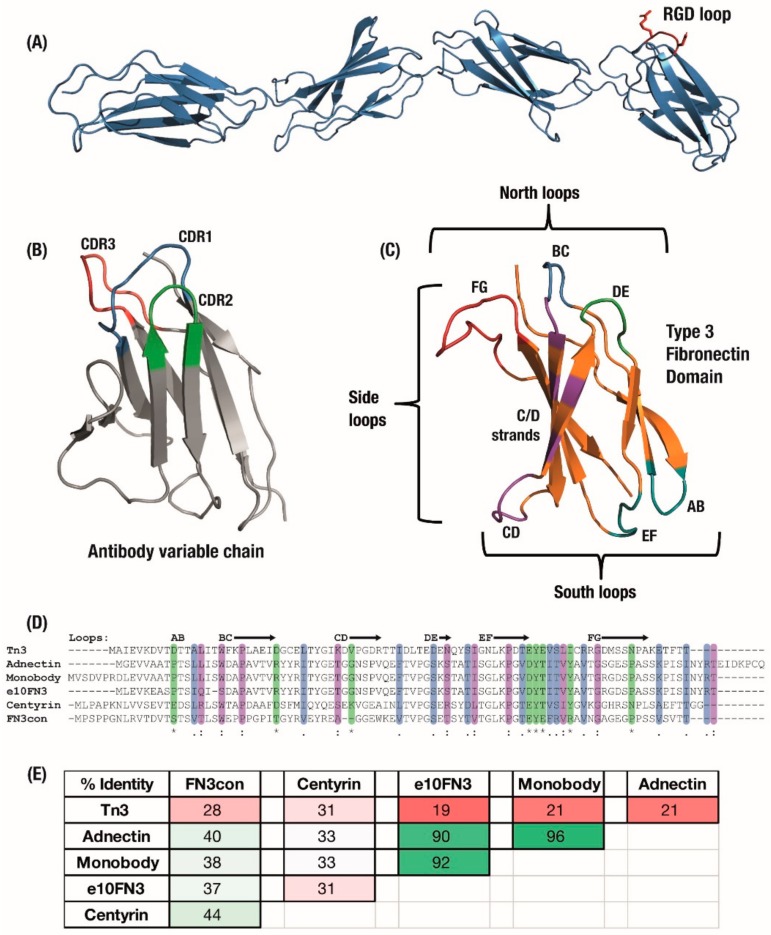
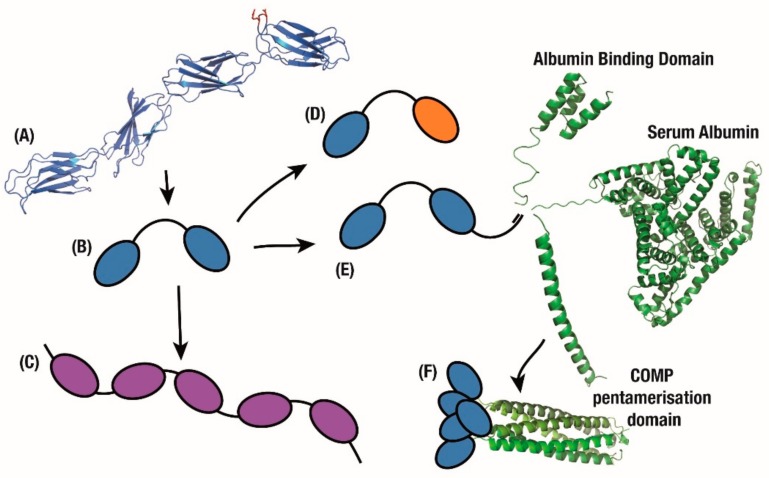
As a non-antibody scaffold, monobodies based on the fibronectin type III (FN3) domain overcome antibody size and complexity while maintaining analogous binding loops. However, antibodies and their derivatives remain the gold standard for the design of new therapeutics. In response, clinical-stage therapeutic proteins based on the FN3 domain are beginning to use native fibronectin function as a point of differentiation. The small and simple structure of monomeric monobodies confers increased tissue distribution and reduced half-life, whilst the absence of disulphide bonds improves stability in cytosolic environments. Where multi-specificity is challenging with an antibody format that is prone to mis-pairing between chains, multiple FN3 domains in the fibronectin assembly already interact with a large number of molecules. As such, multiple monobodies engineered for interaction with therapeutic targets are being combined in a similar beads-on-a-string assembly which improves both efficacy and pharmacokinetics. Furthermore, full length fibronectin is able to fold into multiple conformations as part of its natural function and a greater understanding of how mechanical forces allow for the transition between states will lead to advanced applications that truly differentiate the FN3 domain as a therapeutic scaffold.
作为一种非抗体支架,基于纤连蛋白 III 型 (FN3) 结构域的单域抗体克服了抗体的大小和复杂性,同时保持了类似的结合环。然而,抗体及其衍生物仍然是设计新型治疗药物的金标准。作为回应,基于 FN3 结构域的临床阶段治疗性蛋白开始将天然纤连蛋白的功能用作区分点。单体单域抗体的小而简单的结构赋予其更高的组织分布和更短的半衰期,而不存在二硫键则提高了细胞内环境的稳定性。在抗体形式容易发生链间错配的情况下,多特异性具有挑战性,而纤连蛋白组装中的多个 FN3 结构域已经与大量分子相互作用。因此,正在将多个针对治疗靶点设计的单域抗体组合在类似的珠串组装中,这提高了疗效和药代动力学。此外,全长纤连蛋白能够折叠成多种构象,作为其天然功能的一部分,对机械力如何允许状态之间的转换有更深入的了解,将导致先进的应用,真正将 FN3 结构域作为一种治疗支架进行区分。