Chen Ke, Wang Xiao, Yang Liu, Chen Zheling
Department of Gastrointestinal and Pancreatic Surgery, 74678Zhejiang Provincial People's Hospital, People's Hospital of Hangzhou Medical College, Hangzhou, Zhejiang, People's Republic of China.
Department of Medical Oncology, 74678Zhejiang Provincial People's Hospital, People's Hospital of Hangzhou Medical College, Hangzhou, Zhejiang, People's Republic of China.
Cancer Control. 2021 Jan-Dec;28:1073274821997430. doi: 10.1177/1073274821997430.
Treatment options for advanced gastric esophageal cancer are quite limited. Chemotherapy is unavoidable at certain stages, and research on targeted therapies has mostly failed. The advent of immunotherapy has brought hope for the treatment of advanced gastric esophageal cancer. The aim of the study was to analyze the safety of anti-PD-1/PD-L1 immunotherapy and the long-term survival of patients who were diagnosed as gastric esophageal cancer and received anti-PD-1/PD-L1 immunotherapy.
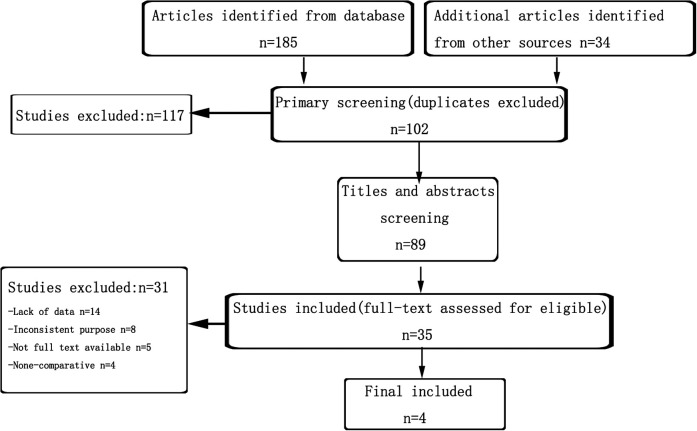
Studies on anti-PD-1/PD-L1 immunotherapy of advanced gastric esophageal cancer published before February 1, 2020 were searched online. The survival (e.g. 6-month overall survival, 12-month overall survival (OS), progression-free survival (PFS), objective response rates (ORR)) and adverse effects of immunotherapy were compared to that of control therapy (physician's choice of therapy).
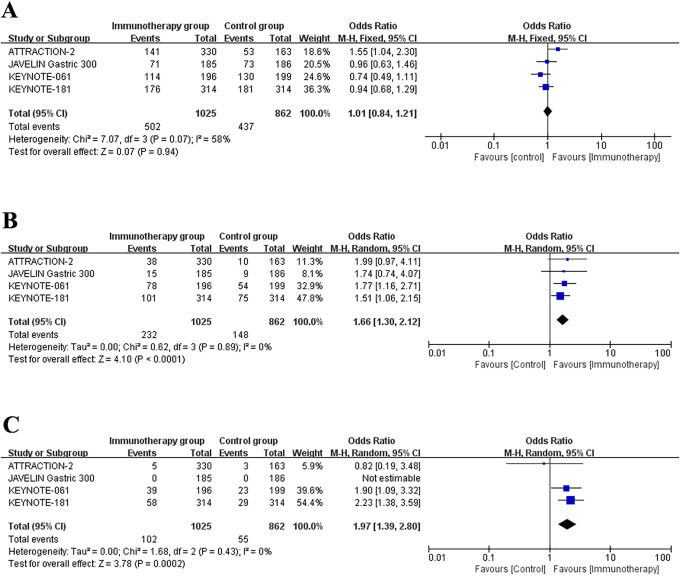
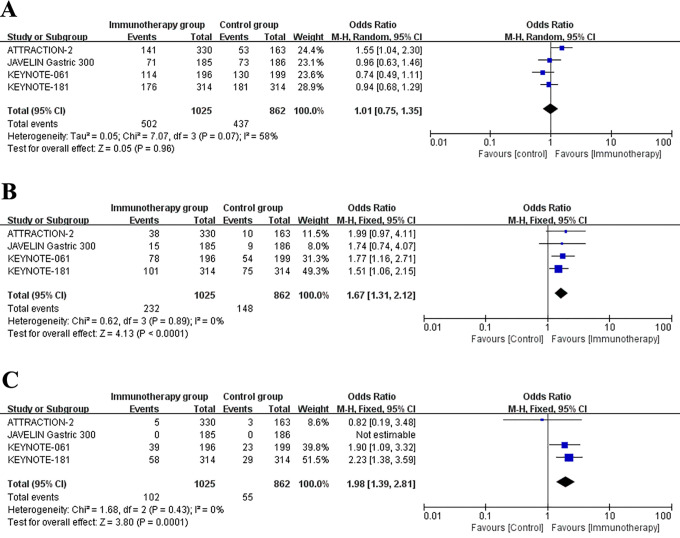
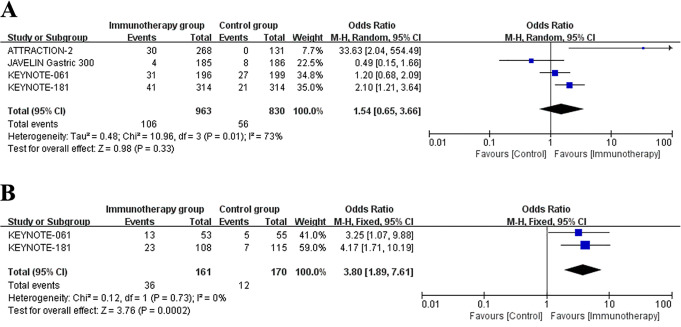
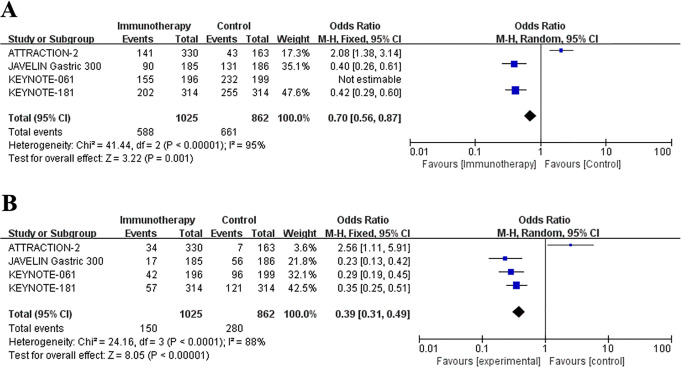
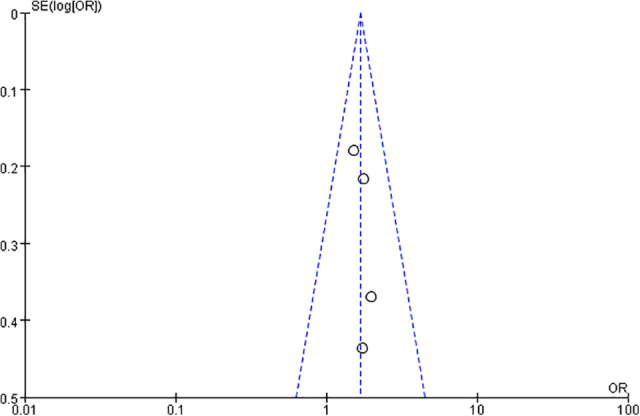
After screening 185 studies, 4 comparative cohort studies which reported the long-term survival of patients receiving immunotherapy were included. Compared to control group, the 12-month survival (OR = 1.67, 95% CI: 1.31 to 2.12, P < 0.0001) and 18-month survival (OR = 1.98, 95% CI: 1.39 to 2.81, P = 0.0001) were significantly longer in immunotherapy group. The 3-month survival rate (OR = 1.05, 95% CI: 0.36 to 3.06, P = 0.92) and 18-month survival rate (OR = 1.44, 95% CI: 0.98 to 2.12, P = 0.07) were not significantly different between immunotherapy group and control group. The ORR were not significantly different between immunotherapy group and control group (OR = 1.54, 95% CI: 0.65 to 3.66, P = 0.01). Meta-analysis pointed out that in the PD-L1 CPS ≥10 sub group population, the immunotherapy could obviously benefit the patients in tumor response rates (OR = 3.80, 95% CI: 1.89 to 7.61, P = 0.0002).
For the treatment of advanced gastric esophageal cancer, the therapeutic efficacy of anti-PD-1/PD-L1 immunotherapy was superior to that of chemotherapy or palliative care.
晚期胃食管癌的治疗选择非常有限。在某些阶段化疗不可避免,且靶向治疗的研究大多失败。免疫疗法的出现为晚期胃食管癌的治疗带来了希望。本研究的目的是分析抗PD-1/PD-L1免疫疗法的安全性以及被诊断为胃食管癌并接受抗PD-1/PD-L1免疫疗法患者的长期生存率。
在网上检索2020年2月1日前发表的关于晚期胃食管癌抗PD-1/PD-L1免疫疗法的研究。将免疫疗法的生存率(如6个月总生存率、12个月总生存率(OS)、无进展生存期(PFS)、客观缓解率(ORR))和不良反应与对照疗法(医生选择的疗法)进行比较。
筛选185项研究后,纳入4项报告接受免疫疗法患者长期生存情况的比较队列研究。与对照组相比,免疫疗法组的12个月生存率(OR = 1.67,95%CI:1.31至2.12,P < 0.0001)和18个月生存率(OR = 1.98,95%CI:1.39至2.81,P = 0.0001)显著更长。免疫疗法组与对照组的3个月生存率(OR = 1.05,95%CI:0.36至3.06,P = 0.92)和18个月生存率(OR = 1.44,95%CI:0.98至2.12,P = 0.07)无显著差异。免疫疗法组与对照组的ORR无显著差异(OR = 1.54,95%CI:0.65至3.66,P = 0.01)。荟萃分析指出,在PD-L1 CPS≥10亚组人群中,免疫疗法在肿瘤缓解率方面可明显使患者获益(OR = 3.80,95%CI:1.89至7.61,P = 0.0002)。
对于晚期胃食管癌的治疗,抗PD-1/PD-L1免疫疗法的治疗效果优于化疗或姑息治疗。