Bower Hannah, Frisell Thomas, Di Giuseppe Daniela, Delcoigne Bénédicte, Ahlenius Gerd-Marie, Baecklund Eva, Chatzidionysiou Katerina, Feltelius Nils, Forsblad-d'Elia Helena, Kastbom Alf, Klareskog Lars, Lindqvist Elisabet, Lindström Ulf, Turesson Carl, Sjöwall Christopher, Askling Johan
Department of Medicine Solna, Karolinska Institutet, Stockholm, Sweden
Department of Medicine Solna, Karolinska Institutet, Stockholm, Sweden.
Ann Rheum Dis. 2021 Aug;80(8):1086-1093. doi: 10.1136/annrheumdis-2021-219845. Epub 2021 Feb 23.
To estimate absolute and relative risks for all-cause mortality and for severe COVID-19 in inflammatory joint diseases (IJDs) and with antirheumatic therapies.
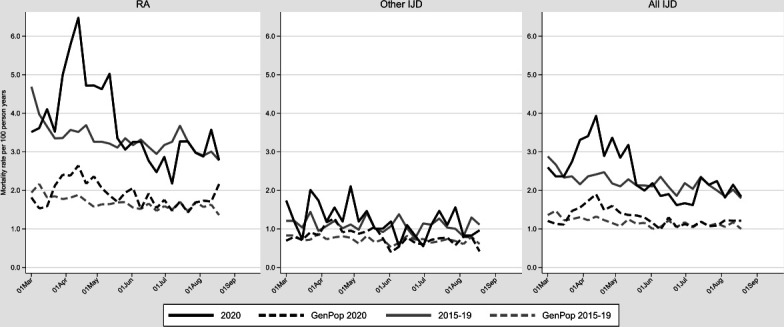
Through Swedish nationwide multiregister linkages, we selected all adult patients with rheumatoid arthritis (RA, n=53 455 in March 2020), other IJDs (here: spondyloarthropathies, psoriatic arthritis and juvenile idiopathic arthritis, n=57 112), their antirheumatic drug use, and individually matched population referents. We compared annual all-cause mortality March-September 2015 through 2020 within and across cohorts, and assessed absolute and relative risks for hospitalisation, admission to intensive care and death due to COVID-19 March-September 2020, using Cox regression.
During March-September 2020, the absolute all-cause mortality in RA and in other IJDs was higher than 2015-2019, but relative risks versus the general population (around 2 and 1.5) remained similar during 2020 compared with 2015-2019. Among patients with IJD, the risks of hospitalisation (0.5% vs 0.3% in their population referents), admission to intensive care (0.04% vs 0.03%) and death (0.10% vs 0.07%) due to COVID-19 were low. Antirheumatic drugs were not associated with increased risk of serious COVID-19 outcomes, although for certain drugs, precision was limited.
Risks of severe COVID-19-related outcomes were increased among patients with IJDs, but risk increases were also seen for non-COVID-19 morbidity. Overall absolute and excess risks are low and the level of risk increases are largely proportionate to those in the general population, and explained by comorbidities. With possible exceptions, antirheumatic drugs do not have a major impact on these risks.
评估炎性关节病(IJD)及抗风湿治疗中全因死亡率和重症新型冠状病毒肺炎(COVID-19)的绝对风险和相对风险。
通过瑞典全国多登记处联动,我们选取了所有成年类风湿关节炎(RA,2020年3月有53455例)、其他IJD(此处为脊柱关节炎、银屑病关节炎和幼年特发性关节炎,57112例)患者、他们的抗风湿药物使用情况,以及个体匹配的人群对照。我们比较了2015年3月至2020年9月各队列内及队列间的年度全因死亡率,并使用Cox回归评估了2020年3月至9月因COVID-19住院、入住重症监护病房和死亡的绝对风险和相对风险。
在2020年3月至9月期间,RA和其他IJD的绝对全因死亡率高于2015 - 2019年,但与普通人群相比的相对风险(约为2和1.5)在2020年与2015 - 2019年期间保持相似。在IJD患者中,因COVID-19住院(0.5% vs 其人群对照中的0.3%)、入住重症监护病房(0.04% vs 0.03%)和死亡(0.10% vs 0.07%)的风险较低。抗风湿药物与严重COVID-19结局风险增加无关,尽管对于某些药物,精确性有限。
IJD患者中与严重COVID-19相关结局的风险增加,但非COVID-19发病率也有所上升。总体绝对风险和超额风险较低,风险增加水平在很大程度上与普通人群成比例,并由合并症解释。除可能的例外情况外,抗风湿药物对这些风险没有重大影响。