Ginley Brandon, Jen Kuang-Yu, Han Seung Seok, Rodrigues Luís, Jain Sanjay, Fogo Agnes B, Zuckerman Jonathan, Walavalkar Vighnesh, Miecznikowski Jeffrey C, Wen Yumeng, Yen Felicia, Yun Donghwan, Moon Kyung Chul, Rosenberg Avi, Parikh Chirag, Sarder Pinaki
Departments of Pathology and Anatomical Sciences, University at Buffalo - The State University of New York, Buffalo, New York.
Department of Pathology and Laboratory Medicine, University of California at Davis, Sacramento, California.
J Am Soc Nephrol. 2021 Apr;32(4):837-850. doi: 10.1681/ASN.2020050652. Epub 2021 Feb 23.
Interstitial fibrosis, tubular atrophy (IFTA), and glomerulosclerosis are indicators of irrecoverable kidney injury. Modern machine learning (ML) tools have enabled robust, automated identification of image structures that can be comparable with analysis by human experts. ML algorithms were developed and tested for the ability to replicate the detection and quantification of IFTA and glomerulosclerosis that renal pathologists perform.
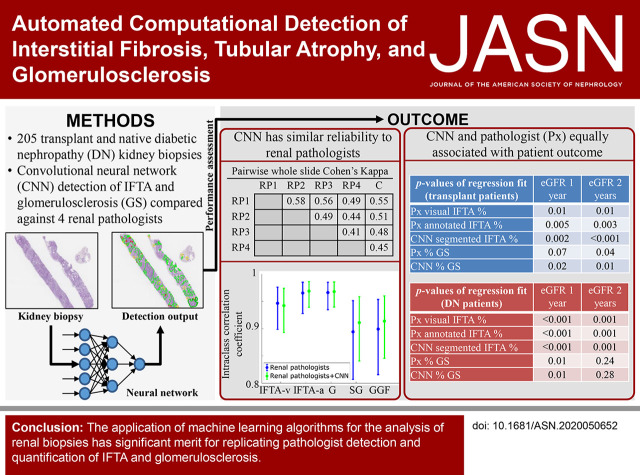
A renal pathologist annotated renal biopsy specimens from 116 whole-slide images (WSIs) for IFTA and glomerulosclerosis. A total of 79 WSIs were used for training different configurations of a convolutional neural network (CNN), and 17 and 20 WSIs were used as internal and external testing cases, respectively. The best model was compared against the input of four renal pathologists on 20 new testing slides. Further, for 87 testing biopsy specimens, IFTA and glomerulosclerosis measurements made by pathologists and the CNN were correlated to patient outcome using classic statistical tools.
The best average performance across all image classes came from a DeepLab version 2 network trained at 40× magnification. IFTA and glomerulosclerosis percentages derived from this CNN achieved high levels of agreement with four renal pathologists. The pathologist- and CNN-based analyses of IFTA and glomerulosclerosis showed statistically significant and equivalent correlation with all patient-outcome variables.
ML algorithms can be trained to replicate the IFTA and glomerulosclerosis assessment performed by renal pathologists. This suggests computational methods may be able to provide a standardized approach to evaluate the extent of chronic kidney injury in situations in which renal-pathologist time is restricted or unavailable.
间质纤维化、肾小管萎缩(IFTA)和肾小球硬化是不可恢复性肾损伤的指标。现代机器学习(ML)工具已能够对图像结构进行强大的自动识别,其结果可与人类专家的分析相媲美。开发并测试了ML算法,以评估其复制肾脏病理学家对IFTA和肾小球硬化进行检测和定量分析的能力。
一名肾脏病理学家对116张全切片图像(WSIs)的肾活检标本进行IFTA和肾小球硬化标注。总共79张WSIs用于训练卷积神经网络(CNN)的不同配置,17张和20张WSIs分别用作内部和外部测试病例。将最佳模型与四位肾脏病理学家对20张新测试玻片的输入结果进行比较。此外,对于87份测试活检标本,使用经典统计工具将病理学家和CNN对IFTA和肾小球硬化的测量结果与患者预后相关联。
所有图像类别的最佳平均性能来自于在40倍放大倍数下训练的DeepLab v2网络。该CNN得出的IFTA和肾小球硬化百分比与四位肾脏病理学家的结果高度一致。基于病理学家和CNN的IFTA和肾小球硬化分析显示,与所有患者预后变量均存在统计学上的显著且等效的相关性。
可以训练ML算法来复制肾脏病理学家对IFTA和肾小球硬化的评估。这表明在肾脏病理学家时间有限或无法提供服务的情况下,计算方法可能能够提供一种标准化方法来评估慢性肾损伤的程度。