Hölscher David L, Bülow Roman D
Department for Nephrology and Clinical Immunology, RWTH Aachen University Hospital, Pauwelsstraße 30, 52074, Aachen, Germany.
Institute for Pathology, RWTH Aachen University Hospital, Pauwelsstraße 30, 52074, Aachen, Germany.
Pflugers Arch. 2025 Apr;477(4):555-570. doi: 10.1007/s00424-024-03002-2. Epub 2024 Aug 3.
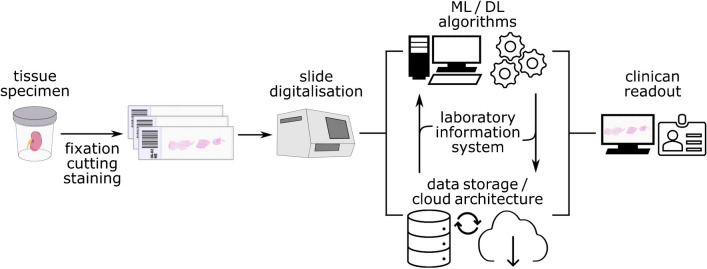
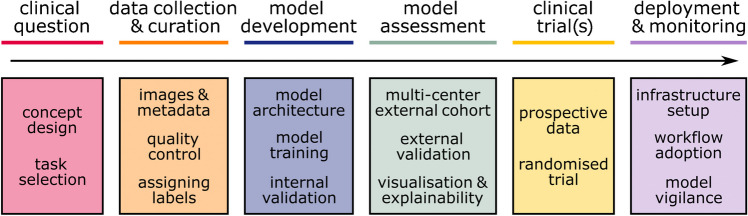
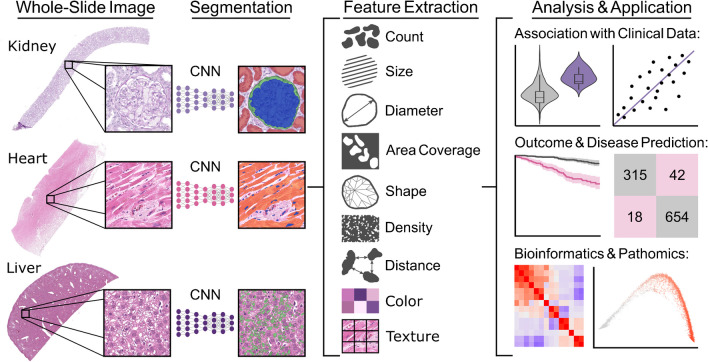
Traditional histopathology, characterized by manual quantifications and assessments, faces challenges such as low-throughput and inter-observer variability that hinder the introduction of precision medicine in pathology diagnostics and research. The advent of digital pathology allowed the introduction of computational pathology, a discipline that leverages computational methods, especially based on deep learning (DL) techniques, to analyze histopathology specimens. A growing body of research shows impressive performances of DL-based models in pathology for a multitude of tasks, such as mutation prediction, large-scale pathomics analyses, or prognosis prediction. New approaches integrate multimodal data sources and increasingly rely on multi-purpose foundation models. This review provides an introductory overview of advancements in computational pathology and discusses their implications for the future of histopathology in research and diagnostics.
传统组织病理学以手动定量和评估为特征,面临着诸如低通量和观察者间变异性等挑战,这些挑战阻碍了精准医学在病理学诊断和研究中的应用。数字病理学的出现使得计算病理学得以引入,这是一门利用计算方法,特别是基于深度学习(DL)技术来分析组织病理学标本的学科。越来越多的研究表明,基于DL的模型在病理学的众多任务中表现出色,如突变预测、大规模病理组学分析或预后预测。新方法整合了多模态数据源,并越来越依赖多用途基础模型。本综述提供了计算病理学进展的入门概述,并讨论了它们对组织病理学在研究和诊断方面未来发展的影响。