Department of Psychology, University of Minnesota, Minneapolis, MN, 55455, United States.
Department of Psychology, University of Minnesota, Minneapolis, MN, 55455, United States; Hennepin Healthcare Research Institute, Minneapolis, MN, 55404, United States.
Drug Alcohol Depend. 2021 Apr 1;221:108598. doi: 10.1016/j.drugalcdep.2021.108598. Epub 2021 Feb 13.
Opioid abuse is a chronic disorder likely involving stable neuroplastic modifications. While a number of molecules contributing to these changes have been identified, the broader spectrum of genes and gene networks that are affected by repeated opioid administration remain understudied.
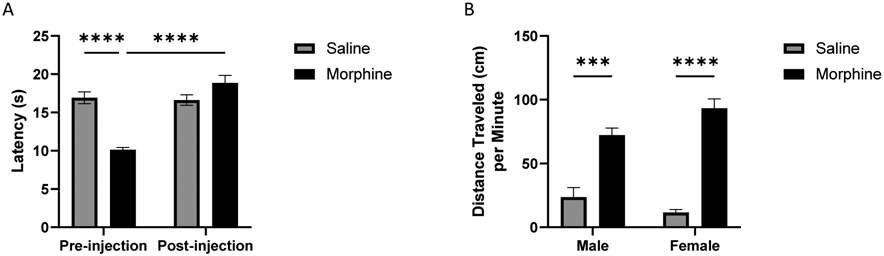
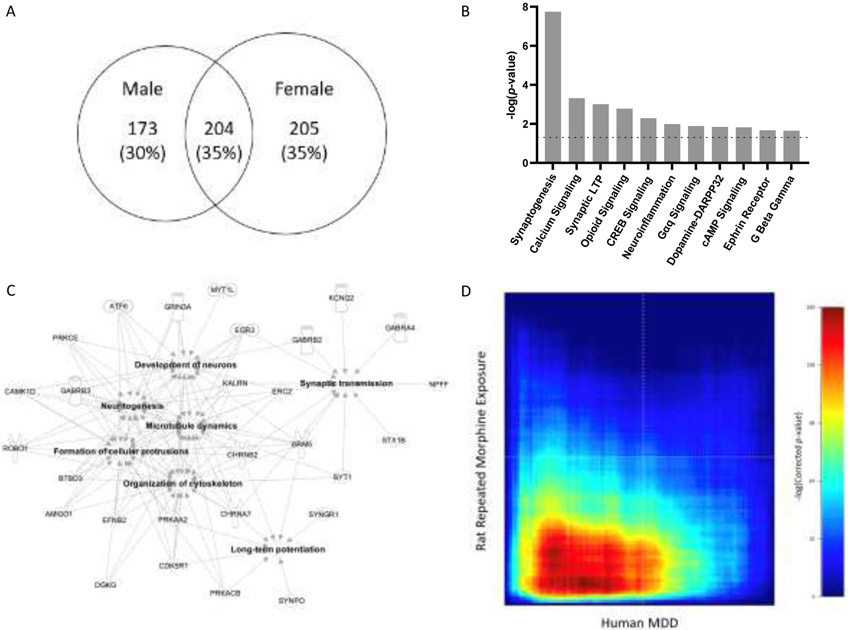
We employed Next-Generation RNA-sequencing (RNA-seq) followed by quantitative chromatin immunoprecipitation to investigate changes in gene expression and their regulation in adult male and female rats' dorsomedial prefrontal cortex (dmPFC) after a regimen of daily injection of morphine (5.0 mg/kg; 10 days). Ingenuity Pathway Analysis (IPA) was used to analyze affected molecular pathways, gene networks, and associated regulatory factors. A complementary behavioral study evaluated the effects of the same morphine injection regimen on locomotor activity, pain sensitivity, and somatic withdrawal signs.
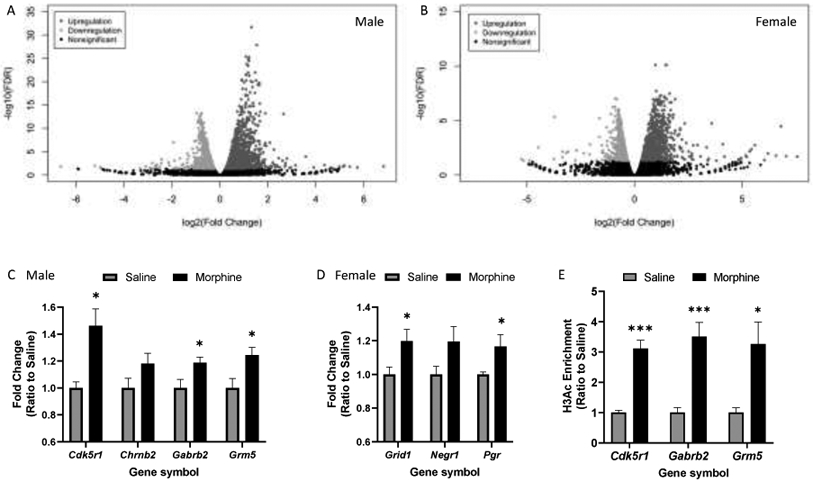
Behaviorally, repeated morphine injection induced locomotor hyperactivity and hyperalgesia in both sexes. 90 % of differentially expressed genes (DEGs) in morphine-treated rats were upregulated in both males and females, with a 35 % overlap between sexes. A substantial number of DEGs play roles in synaptic signaling and neuroplasticity. Chromatin immunoprecipitation revealed enrichment of H3 acetylation, a transcriptionally activating chromatin mark. Although broadly similar, some differences were revealed in the gene ontology networks enriched in females and males.
Our results cohere with findings from previous studies based on a priori gene selection. Our results also reveal novel genes and molecular pathways that are upregulated by repeated morphine exposure, with some common to males and females and others that are sex-specific.
阿片类药物滥用是一种慢性疾病,可能涉及稳定的神经可塑性改变。虽然已经确定了许多导致这些变化的分子,但反复给予阿片类药物后受影响的基因和基因网络的更广泛谱仍有待研究。
我们采用下一代 RNA 测序(RNA-seq)和定量染色质免疫沉淀技术,研究了在每日注射吗啡(5.0mg/kg;10 天)后,成年雄性和雌性大鼠背内侧前额叶皮层(dmPFC)中基因表达的变化及其调控。使用 IPA 分析受影响的分子途径、基因网络和相关调节因子。一项补充的行为研究评估了相同的吗啡注射方案对运动活动、疼痛敏感性和躯体戒断症状的影响。
行为上,重复给予吗啡注射会导致雄性和雌性动物的运动活动过度和痛觉过敏。吗啡处理大鼠中 90%的差异表达基因(DEGs)在雄性和雌性中均上调,且性别间有 35%的重叠。大量的 DEGs 在突触信号和神经可塑性中发挥作用。染色质免疫沉淀显示 H3 乙酰化的富集,这是一种转录激活的染色质标记。虽然大致相似,但在雌性和雄性中富集的基因本体网络中也揭示了一些差异。
我们的结果与基于先验基因选择的先前研究的结果一致。我们的结果还揭示了反复暴露于吗啡后上调的新基因和分子途径,其中一些在雄性和雌性中共同上调,而另一些则是性别特异性的。