Bundeswehr Institute of Radiobiology Affiliated To University Ulm, Neuherbergstr. 11, 80937, Munich, Germany.
Bundeswehr Research Institute for Protective Technologies and CBRN Protection, Humboldtstraße 100, 29633 Munster, Germany.
Sci Rep. 2021 Feb 24;11(1):4444. doi: 10.1038/s41598-021-82278-1.
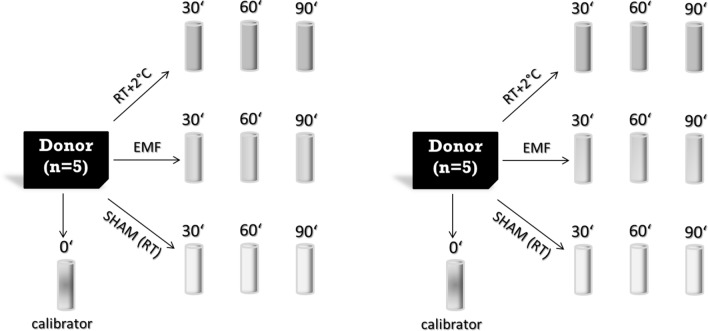
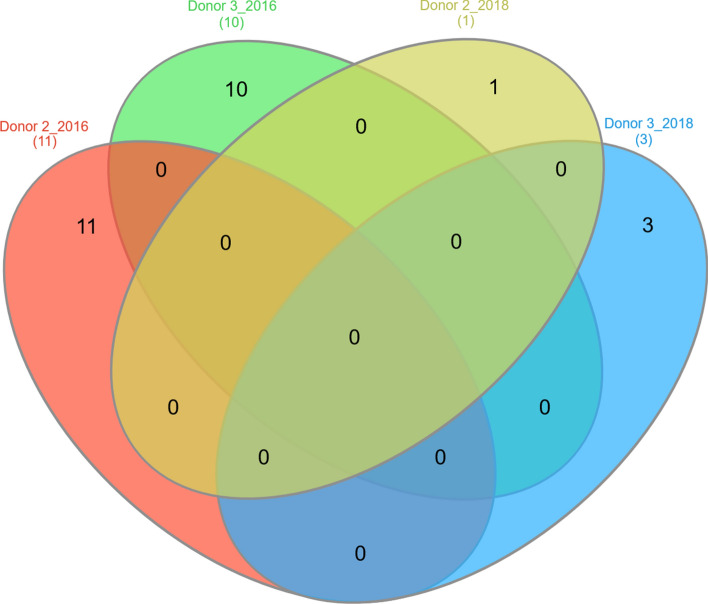
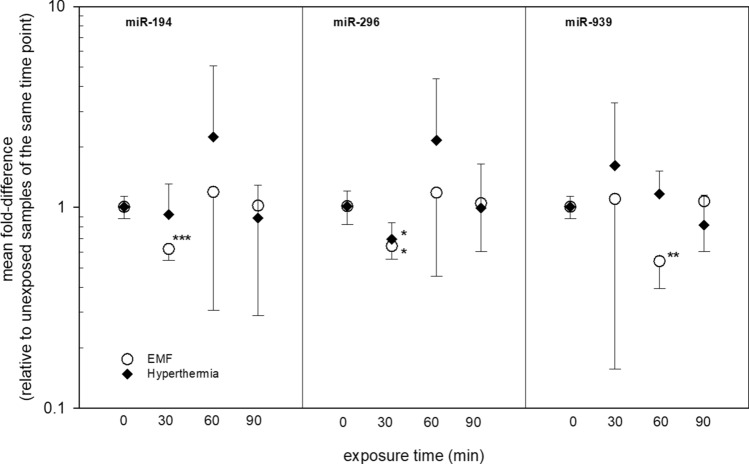
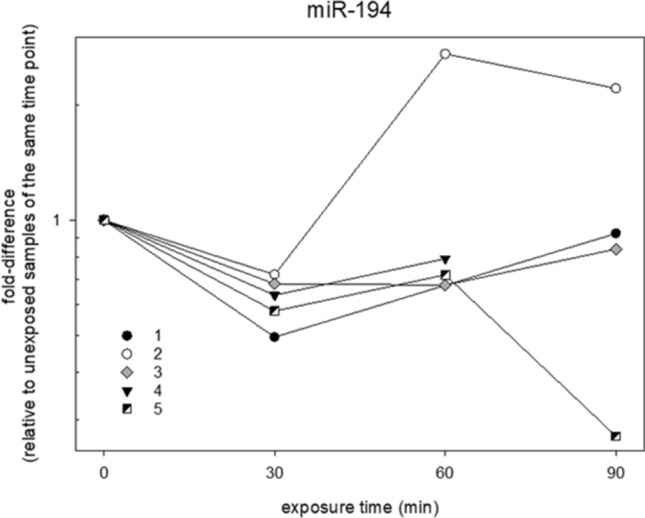
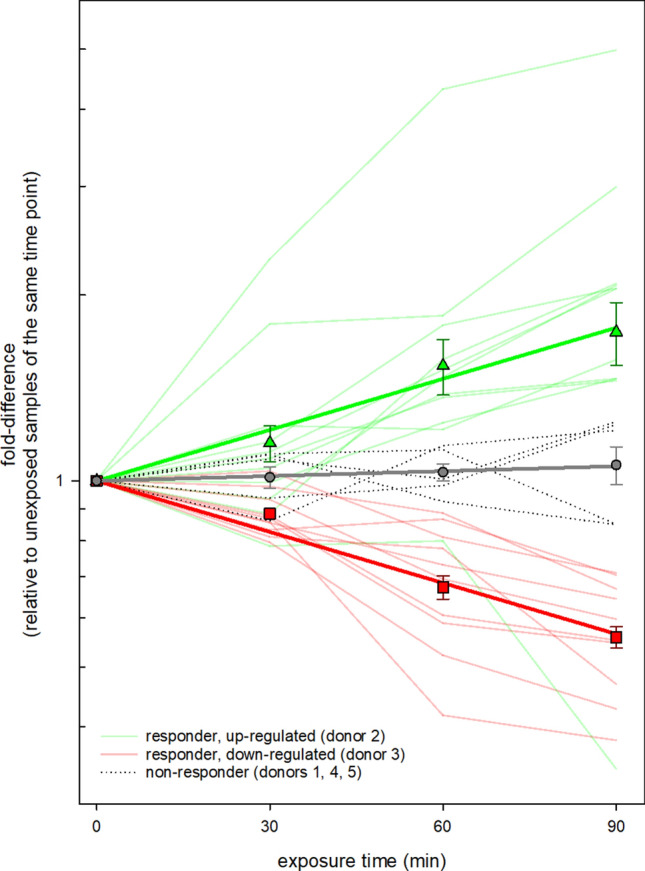
More than ever before, people around the world are frequently exposed to different sections of the electromagnetic spectrum, mainly emitted from wireless modern communication technologies. Especially, the level of knowledge on non-thermal biological EMF effects remains controversial. New technologies allow for a more detailed detection of non-coding RNAs which affect the post-transcriptional control. Such method shall be applied in this work to investigate the response of human blood cells to electromagnetic irradiation. In this ex vivo in vitro study, we exposed peripheral blood cells from 5 male donors to a continuous wave of 900 MHz EMF for 0, 30, 60 and 90 min. Significant micro RNA (miRNA) expression changes (p ≤ 0.05) above or below the SHAM exposed samples were evaluated using a quantitative real time PCR platform for simultaneous detection of 667 miRNAs called low density array. Only significant miRNA expression changes which were detectable in at least 60% of the samples per exposure group were analyzed. The results were compared with data from room temperature + 2 °C (RT + 2 °C) samples (here referred to as hyperthermia) to exclude miRNA expression altered by hyperthermia. The validation study by using the same donors and study design was performed after an interval of 2 years. When analyzing a total of 667 miRNAs during the screening study, 2 promising candidate miRNAs were identified, which were down regulated almost twice and showed a complete separation from the unexposed control group (miR-194 at 30 min and miR-939 at 60 min). The p-values even survived the Bonferroni correction for multiple comparisons (p = 0.0007 and p = 0.004, respectively). None of these miRNAs were expressed at a second time point after EMF exposure. Following an alternative analysis approach, we examined for miRNAs revealing an expected significant association of differential miRNA expression with the dose-time EMF exposure product, separately for each donor. Donors 2 and 3 revealed 11 and 10 miRNA species being significantly associated with EMF exposure which differed significantly from the other donors showing a minor number of differentially expressed miRNAs and could identify donors 2 and 3 as particularly EMF-responsive. The measurements were repeated after 2 years. The number of expressed/non-expressed miRNAs was almost similar (97.4%), but neither the number nor the previously differentially expressed miRNAs could be reproduced. Our data neither support evidence of early changes at miRNA expression level in human whole blood cells after 900 MHz EMF exposure nor the identification of EMF-responsive individuals.
如今,世界各地的人们比以往任何时候都更频繁地接触到不同部分的电磁波谱,主要来自于无线现代通信技术。特别是,关于非热生物电磁场效应的知识水平仍然存在争议。新技术可以更详细地检测影响转录后控制的非编码 RNA。本研究将采用这种方法来研究人类血细胞对电磁辐射的反应。在这项离体体外研究中,我们将来自 5 名男性供体的外周血单个核细胞暴露于 900MHz 的连续波辐射下 0、30、60 和 90 分钟。使用实时定量 PCR 平台同时检测 667 种称为低密度阵列的 miRNA,评估显著的 miRNA 表达变化(p≤0.05)。仅分析每个暴露组中至少 60%的样本可检测到的显著 miRNA 表达变化。将结果与室温+2°C(RT+2°C)样本(此处称为热疗)的数据进行比较,以排除热疗引起的 miRNA 表达改变。在间隔 2 年后,使用相同的供体和研究设计进行了验证研究。在筛选研究中分析了总共 667 种 miRNA 后,鉴定出了 2 种有前途的候选 miRNA,它们的表达下调了近两倍,与未暴露的对照组完全分离(miR-194 在 30 分钟,miR-939 在 60 分钟)。即使在对多个比较进行 Bonferroni 校正后,p 值仍然存活(分别为 p=0.0007 和 p=0.004)。这些 miRNA 都没有在电磁场暴露后的第二个时间点表达。在采用替代分析方法后,我们分别针对每位供体,检查了与剂量-时间电磁场暴露产物有显著关联的 miRNA,发现有 11 种和 10 种 miRNA 与电磁场暴露有显著关联,与其他供体表现出较少的差异表达 miRNA 明显不同,可以将供体 2 和 3 识别为特别对电磁场有反应。2 年后重复测量。表达/非表达 miRNA 的数量几乎相似(97.4%),但之前差异表达的 miRNA 的数量和种类都无法重现。我们的数据既不支持在人类全血细胞中电磁场暴露后 miRNA 表达水平早期变化的证据,也不支持识别对电磁场有反应的个体。