Department of Rheumatology, Qilu Hospital of Shandong University, Ji'nan 250012, Shandong, China.
Int J Med Sci. 2021 Jan 29;18(6):1449-1455. doi: 10.7150/ijms.51117. eCollection 2021.
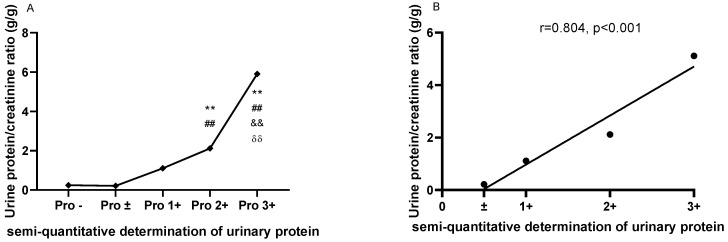
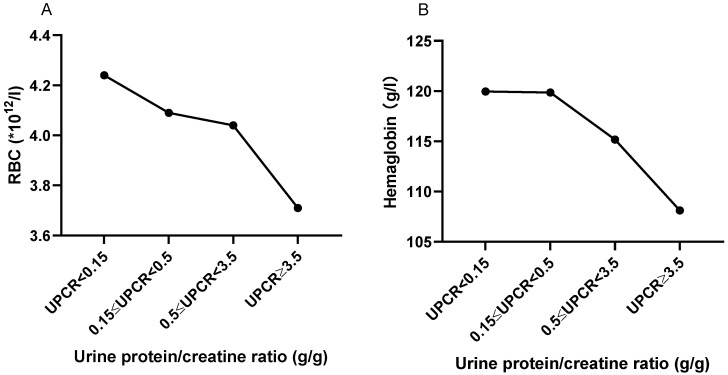
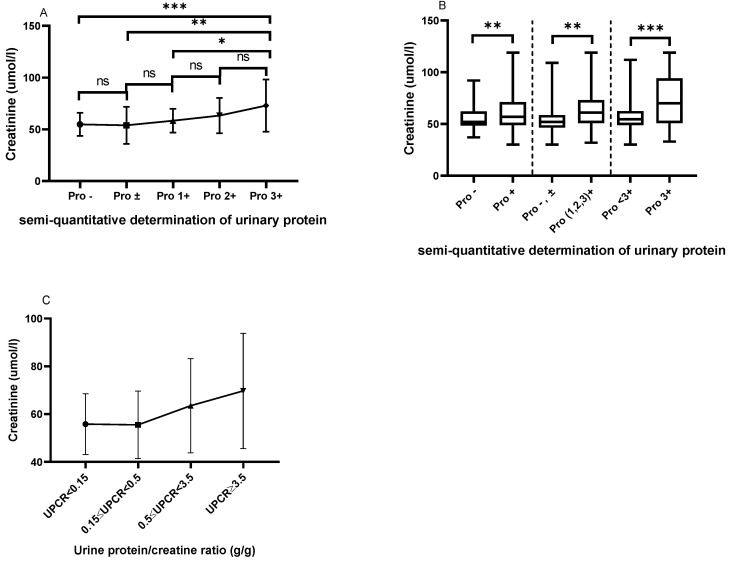
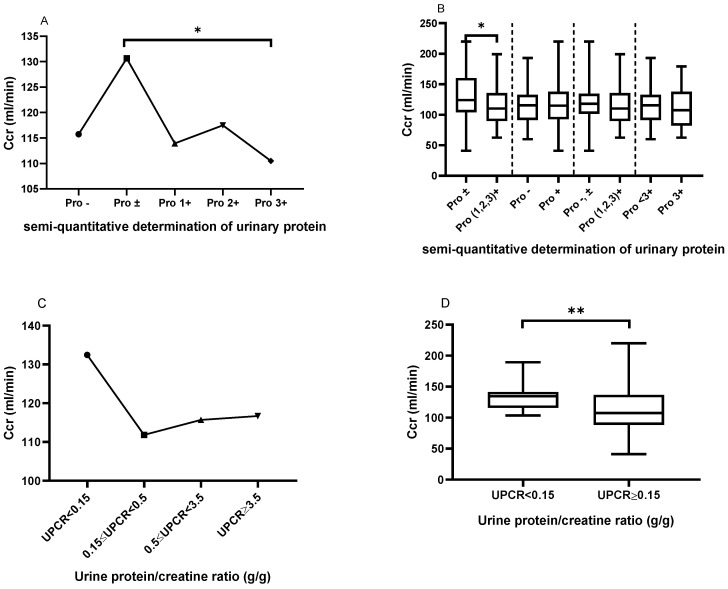
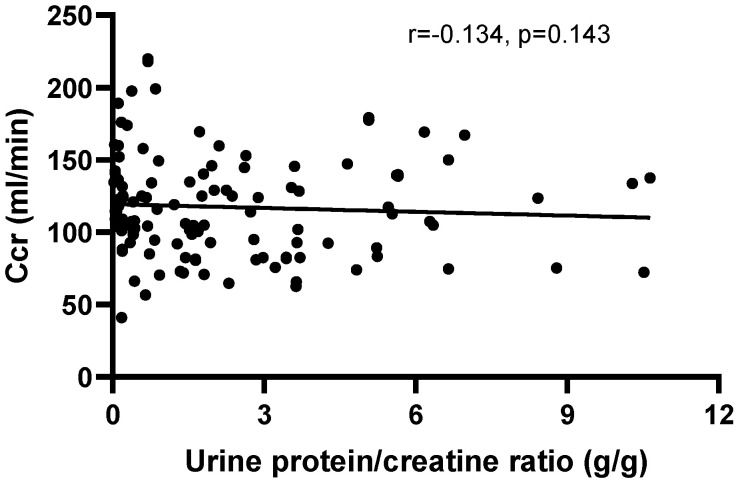
The present study aimed to observe the differences in creatinine clearance (Ccr) in systemic lupus erythematosus (SLE) patients with normal serum creatinine at different levels of urinary protein. The present cross-sectional study included 177 SLE patients with normal serum creatinine from Qilu Hospital of Shandong University between January 2010 and April 2020. The following data were collected: blood urea nitrogen (BUN), serum creatinine (Cr), serum total protein, serum albumin, immunoglobulin (Ig) G, IgA, IgM, complement 3, complement 4, anti-ds-DNA antibody, routine urine test, urine protein/creatinine ratio (UPCR) (g/g), and the SLE disease activity index. The estimated Ccr was calculated according to the Cockcroft formula. 123 patients were with positive urinary protein (Lupus Nephritis, LN group) and 54 patients were with negative urinary protein (Non-LN group). Compared with the Non-LN group, the LN group had higher BUN (5.76±3.22 . 4.78±1.58, P=0.007) and Cr (62.36±19.53 . 54.83±11.09, P=0.001). There was a strong correlation between the UPCR and the semi-quantitative determination of urine protein in LN patients (r=0.9583, P=0.0417). The serum creatinine levels were significantly higher in patients with urine protein 3+ (72.97±25.16) or massive proteinuria (62.32±19.66) than the other groups. Patients with urinary protein ± exhibited a significantly elevated Ccr when compared to patients with urinary protein 3+ (130.6±44.15 110.5±33.50, P=0.02), and patients with UPCR<0.15 g/g had higher Ccr than other groups and showed significantly increased Ccr compared with patients with UPCR≥0.15 g/g (132.44±21.02 115.14±35.89, P=0.007). Early renal function impairment may be present in LN patients. The kidneys of LN patients with urinary protein ± or UPCR<0.15 g/g are in a state of hyperfunction.
本研究旨在观察不同尿蛋白水平下血清肌酐正常的系统性红斑狼疮(SLE)患者的肌酐清除率(Ccr)差异。本横断面研究纳入了 2010 年 1 月至 2020 年 4 月期间来自山东大学齐鲁医院的 177 例血清肌酐正常的 SLE 患者。收集以下数据:血尿素氮(BUN)、血清肌酐(Cr)、血清总蛋白、血清白蛋白、免疫球蛋白(Ig)G、IgA、IgM、补体 3、补体 4、抗双链 DNA 抗体、常规尿液检查、尿蛋白/肌酐比值(UPCR)(g/g)和 SLE 疾病活动指数。根据 Cockcroft 公式计算估计的 Ccr。123 例患者尿蛋白阳性(狼疮肾炎,LN 组),54 例患者尿蛋白阴性(非 LN 组)。与非 LN 组相比,LN 组的 BUN(5.76±3.22 vs. 4.78±1.58,P=0.007)和 Cr(62.36±19.53 vs. 54.83±11.09,P=0.001)更高。LN 患者的 UPCR 与尿蛋白半定量测定呈强相关性(r=0.9583,P=0.0417)。尿蛋白 3+(72.97±25.16)或大量蛋白尿(62.32±19.66)患者的血清肌酐水平明显高于其他组。与尿蛋白 3+患者相比,尿蛋白±患者的 Ccr 显著升高(130.6±44.15 vs. 110.5±33.50,P=0.02),且 UPCR<0.15 g/g 的患者的 Ccr 高于其他组,与 UPCR≥0.15 g/g 的患者相比,Ccr 显著升高(132.44±21.02 vs. 115.14±35.89,P=0.007)。LN 患者可能存在早期肾功能损害。LN 患者尿蛋白±或 UPCR<0.15 g/g 时,肾脏处于高功能状态。