Lee Cheryl Yi-Pin, Amrun Siti Naqiah, Chee Rhonda Sin-Ling, Goh Yun Shan, Mak Tze-Minn, Octavia Sophie, Yeo Nicholas Kim-Wah, Chang Zi Wei, Tay Matthew Zirui, Torres-Ruesta Anthony, Carissimo Guillaume, Poh Chek Meng, Fong Siew-Wai, Bei Wang, Lee Sandy, Young Barnaby Edward, Tan Seow-Yen, Leo Yee-Sin, Lye David C, Lin Raymond Tp, Maurer-Stroh Sebastien, Lee Bernett, Wang Cheng-I, Renia Laurent, Ng Lisa Fp
ASTAR Infectious Diseases Labs Agency for Science, Technology and Research (A*STAR) Singapore.
Singapore Immunology Network Agency for Science, Technology and Research (ASTAR) Singapore.
Clin Transl Immunology. 2021 Feb 22;10(2):e1241. doi: 10.1002/cti2.1241. eCollection 2021.
The emergence of a SARS-CoV-2 variant with a point mutation in the spike (S) protein, D614G, has taken precedence over the original Wuhan isolate by May 2020. With an increased infection and transmission rate, it is imperative to determine whether antibodies induced against the D614 isolate may cross-neutralise against the G614 variant.
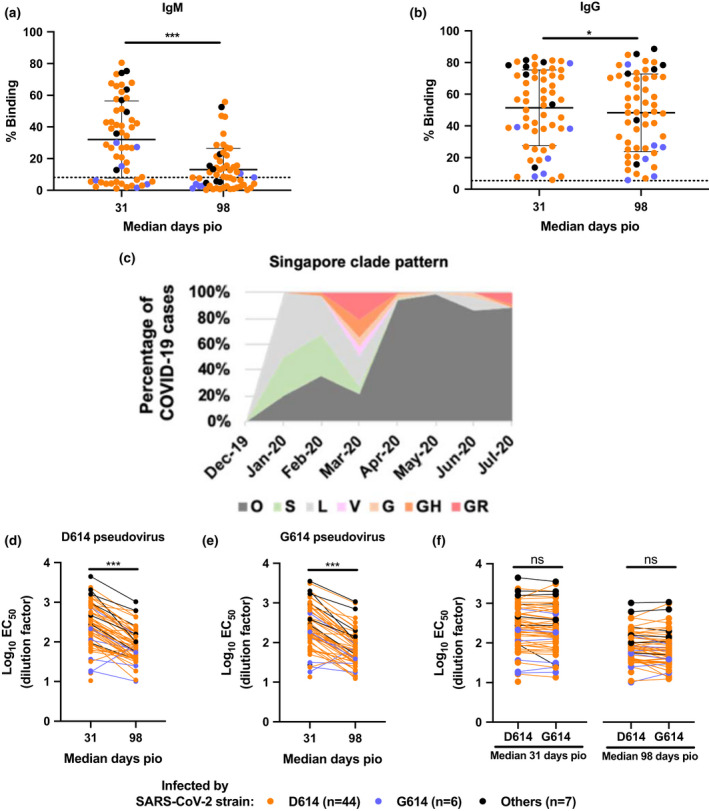
Antibody profiling against the SARS-CoV-2 S protein of the D614 variant by flow cytometry and assessment of neutralising antibody titres using pseudotyped lentiviruses expressing the SARS-CoV-2 S protein of either the D614 or G614 variant tagged with a luciferase reporter were performed on plasma samples from COVID-19 patients with known D614G status ( = 44 infected with D614, = 6 infected with G614, = 7 containing all other clades: O, S, L, V, G, GH or GR).
Profiling of the anti-SARS-CoV-2 humoral immunity reveals similar neutralisation profiles against both S protein variants, albeit waning neutralising antibody capacity at the later phase of infection. Of clinical importance, patients infected with either the D614 or G614 clade elicited a similar degree of neutralisation against both pseudoviruses, suggesting that the D614G mutation does not impact the neutralisation capacity of the elicited antibodies.
Cross-reactivity occurs at the functional level of the humoral response on both the S protein variants, which suggests that existing serological assays will be able to detect both D614 and G614 clades of SARS-CoV-2. More importantly, there should be negligible impact towards the efficacy of antibody-based therapies and vaccines that are currently being developed.
严重急性呼吸综合征冠状病毒2(SARS-CoV-2)刺突(S)蛋白发生D614G点突变的变异株在2020年5月已超过原始的武汉分离株。鉴于其感染率和传播率增加,确定针对D614分离株诱导产生的抗体是否能交叉中和G614变异株至关重要。
对已知D614G状态的新冠肺炎患者的血浆样本进行流式细胞术检测针对D614变异株的SARS-CoV-2 S蛋白的抗体谱,并使用表达带有荧光素酶报告基因的D614或G614变异株的SARS-CoV-2 S蛋白的假型慢病毒评估中和抗体滴度(n = 44例感染D614,n = 6例感染G614,n = 7例包含所有其他进化枝:O、S、L、V、G、GH或GR)。
抗SARS-CoV-2体液免疫分析显示,针对两种S蛋白变异株的中和谱相似,尽管在感染后期中和抗体能力有所下降。具有临床意义的是,感染D614或G614进化枝的患者对两种假病毒产生的中和程度相似,这表明D614G突变不会影响诱导产生的抗体的中和能力。
在两种S蛋白变异株的体液反应功能水平上均发生了交叉反应,这表明现有的血清学检测方法将能够检测SARS-CoV-2的D614和G614进化枝。更重要的是,对目前正在研发的基于抗体的治疗方法和疫苗的疗效影响应该可以忽略不计。